
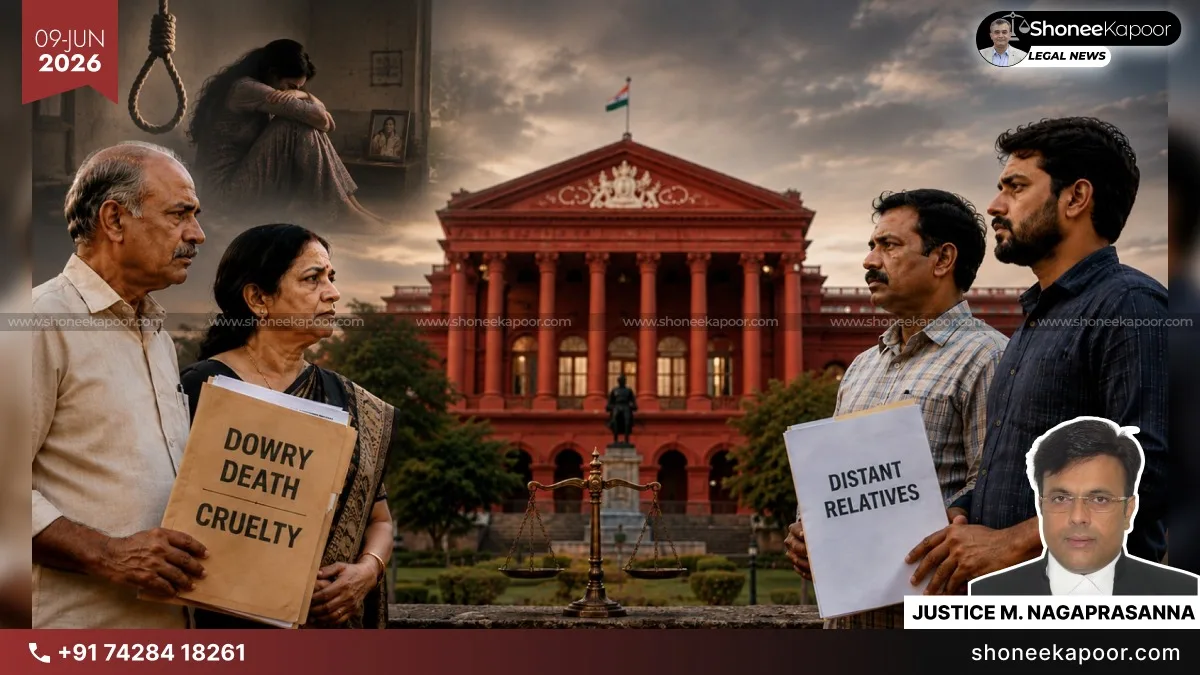
Can every relative of a husband be prosecuted in a dowry death case? The Karnataka High Court held that distant relatives who are not related to the husband by blood, marriage, or adoption cannot automatically be prosecuted in dowry death cases.
BENGALURU: In a judgment delivered on June 4, 2026, Justice M. Nagaprasanna of the Karnataka High Court partly allowed a petition filed by family members accused in a dowry death case and quashed the criminal proceedings against two distant relatives, holding that they could not be prosecuted under the dowry death provisions merely because they were known to the family.
The case arose from the death of a young woman who died by suicide within a few months of her marriage. Her father lodged a complaint alleging that she had been subjected to mental and physical cruelty by her husband and his family. Based on the complaint, the police registered a case under Sections 80, 85 and other provisions of the Bharatiya Nyaya Sanhita (BNS), which correspond to dowry death and cruelty offences.
According to the records, the marriage took place on November 10, 2024. Soon after the wedding, the husband returned to the United States, where he was working. The wife later joined him in February 2025. However, the relationship allegedly became strained and she returned to her parental home in Bengaluru in April 2025.
The prosecution alleged that the husband subjected her to mental cruelty, questioned her character, and accused her of having relationships with other men. It was further alleged that on April 23, 2025, several members of the husband’s family visited her parental home and humiliated her. The woman died by suicide the next day after leaving a detailed note.
The father claimed that the humiliation and mental cruelty suffered by his daughter pushed her to take the extreme step. The police investigated the matter and filed a charge sheet against six accused persons.
During the hearing, the accused argued that there was no material to attract the offences of dowry death and cruelty. They also contended that Accused Nos.5 and 6 were merely distant relatives who had no role in the marital life of the couple and were wrongly implicated.
While examining the issue, the High Court referred to Supreme Court precedent on the meaning of the term “relative of the husband” in dowry death cases. The Court reproduced the following passage:
“The word “relative of the husband” in Section 304-B IPC would mean such persons, who are related by blood, marriage or adoption. When we apply this principle the respondent herein is not related to the husband of the deceased either by blood or marriage or adoption.”
After considering the facts, Justice Nagaprasanna held that Accused Nos.5 and 6 were distant relatives and did not fall within the legal definition of “relatives of the husband” for the purpose of dowry death prosecution. The Court found that allowing criminal proceedings against them would amount to an abuse of the legal process.
The Court observed:
“Therefore, permitting proceedings against accused nos.5 and 6 who had no role to play in the lives of accused no.1 to 4 or the deceased or the complainant, permitting proceedings against accused nos.5 and 6 would become an abuse of the process of the law.”
However, the Court refused to interfere with the proceedings against the husband and the close family members. It found that the allegations against Accused Nos.1 to 4 required a full trial and could not be examined in detail at the stage of quashing.
The Court stated:
“Insofar as the other accused are concerned, this Court is of the opinion that the proceedings cannot be quashed against them.”
As a result, the High Court dismissed the husband’s petition and partly allowed the petition filed by the other accused. The criminal proceedings were quashed only against Accused Nos.5 and 6, while the case will continue against Accused Nos.1 to 4.
EXPLANATORY TABLE: LAWS & SECTIONS INVOLVED
| Law / Section | Purpose | Application in This Case |
| Section 80 BNS (Dowry Death) | Punishes dowry-related death. | Applied as the wife died within months of marriage. |
| Section 85 BNS (Cruelty by Husband or Relatives) | Punishes mental or physical cruelty. | Allegations of harassment and humiliation were made. |
| Section 352 BNS (Intentional Insult) | Punishes insulting conduct. | Based on allegations of verbal abuse. |
| Section 3(5) BNS (Common Intention) | Fixes joint liability. | Used against all accused collectively. |
| Section 528 BNSS (Quashing Power) | Allows High Court to prevent abuse of process. | Invoked to seek quashing of the case. |
| Article 226, Constitution of India | Gives writ powers to High Courts. | Basis for filing the writ petitions. |
CASE DETAILS
- Case Title: Vinay Kumar S. v. State of Karnataka & Ors. Connected With Siddaiah B. & Ors. v. State of Karnataka & Anr.
- Case Numbers:
- Writ Petition No.18828 of 2025 (GM-RES)
- Writ Petition No.31907 of 2025 (GM-RES)
- Court: High Court of Karnataka
- Bench: Hon’ble Mr. Justice M. Nagaprasanna
- Date Of Judgment: 04.06.2026
- Neutral Citation: 2026:KHC:22474
- Counsels:
- For Petitioners: Sri Hashmath Pasha, Senior Advocate, and Sri Kariappa N.A., Advocate
- For State: Sri B.N. Jagadeesha, Additional State Public Prosecutor
- For Respondent No.3 / Complainant: Sri Manu B.P., Advocate
KEY TAKEAWAYS
- Criminal law should punish actual wrongdoing, not mere family connections.
- Allegations alone are not enough; every accused person must be linked to the alleged offence through specific facts.
- No individual should be forced to face a criminal trial without a clear legal basis and evidence against them.
- Courts must separate genuine accused persons from those who are unnecessarily dragged into family disputes.
- Justice is served when accountability is fixed on the right people and innocent individuals are protected from misuse of the legal process.
This Could Change Your Case-Get FREE Legal Advice-Click Here!
Disclaimer: The views and opinions expressed in this article are those of the Indian courts and do not necessarily reflect the official policy or position of “ShoneeKapoor.com” or its affiliates. This article is intended for informational and educational purposes only. The content provided is not legal advice, and viewers should not act upon this information without seeking professional counsel. Viewer discretion is advised.
