
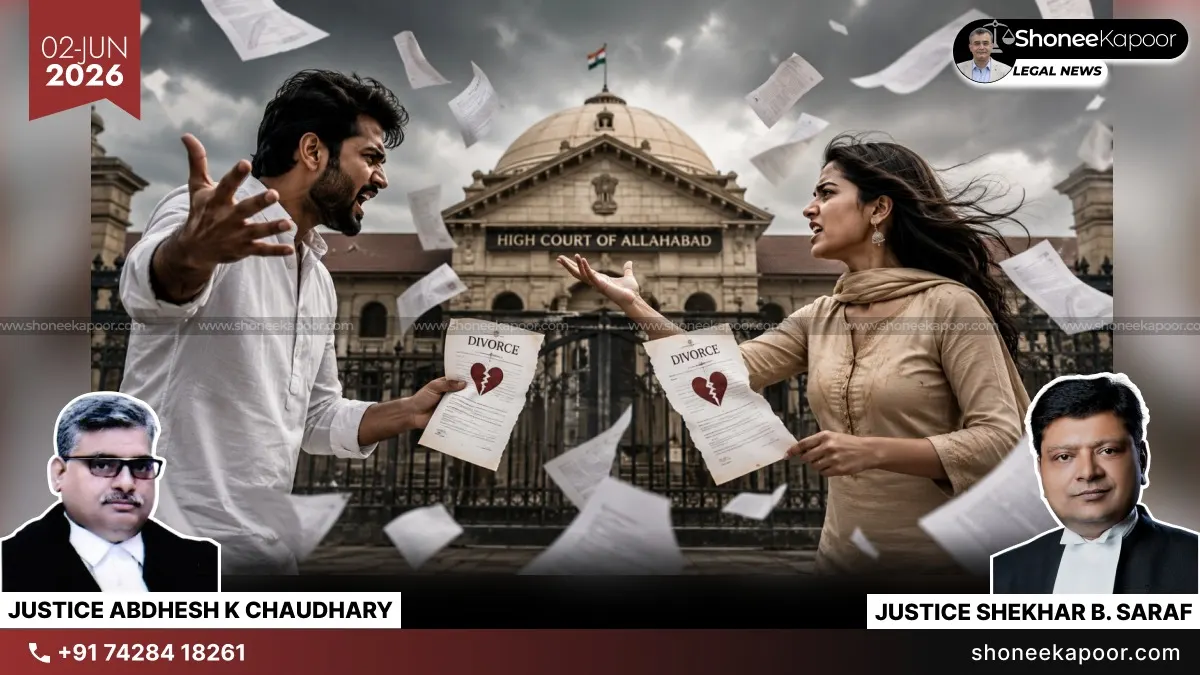
Can a mediation settlement in Lok Adalat end a marriage and allow remarriage? Allahabad High Court clarifies why only a Family Court can legally grant a divorce decree.
PRAYAGRAJ: The Allahabad High Court has held that a Lok Adalat or District Legal Services Authority (DLSA) has no legal power to grant a divorce decree. The Court clarified that the authority to dissolve a marriage lies exclusively with competent Family Courts and Civil Courts.
The judgment was delivered by a Division Bench of Justice Shekhar B. Saraf and Justice Abdhesh Kumar Chaudhary while hearing a petition filed by Sushma Devi. She challenged a July 2018 order of the DLSA, Unnao, which had accepted a mediation settlement between her and her husband. The husband later started treating that settlement as a valid divorce.
The Court strongly criticised the DLSA for exceeding its jurisdiction and mechanically approving a settlement that created confusion regarding the marital status of the parties.
The Court observed:
“It is expected that these Lok Adalats/ DLSA, who are harbingers of early disposal should exercise their powers strictly within the four corners of law as provided under the provisions of the Act and the Regulations framed therein and should not wander into the realms, which is exclusively reserved for regular courts/tribunals”.
According to the facts of the case, the husband had filed a pre-litigation matter before the DLSA, Unnao, in June 2018. The dispute was referred to mediation. The wife alleged that her signatures were obtained fraudulently on settlement terms relating to divorce and that the DLSA disposed of the matter without properly examining the legality of the settlement.
A major dispute arose because the settlement recorded that the “parties are free to remarry.” Relying on this clause, the husband later justified his second marriage.
The wife opposed this stand and argued that the settlement could never be treated as a divorce. She pointed out that even after the alleged settlement, both parties continued to live together as husband and wife. She further stated that a daughter was born to them in November 2019, nearly one year after the so-called divorce settlement.
When her review application was dismissed by the DLSA, she approached the High Court challenging both the original order and the review order.
The High Court found serious flaws in the manner in which the DLSA handled the matter. The Bench noted that the Secretary of the DLSA is a senior judicial officer and is expected to be fully aware of the limits of the Authority’s powers.
Referring to the Legal Services Authorities Act, 1987 and the National Legal Services Authority (Lok Adalats) Regulations, 2009, the Court explained that Lok Adalats can facilitate settlements and negotiations but cannot adjudicate disputes or pass orders that only a court is empowered to pass.
The Court specifically noted that the law itself prohibits divorce matters from being referred to Lok Adalats.
“This Court fails to comprehend that when a divorce matter itself cannot be referred to Lok Adalat, how a decree of divorce could have been expected to be granted by any Lok Adalat in a prelitigation matter,” the bench observed.
The Court further remarked:
“The Lok Adalat/ Authority should be conscious and remember that when Regulation 17(7) specifically proscribes grant of divorce by mutual consent, which means it was not within the legal competency of the Lok Adalat to grant any such prayer of divorce, it is starting to see this kind of cryptic orders passed under the Regulations”.
The Bench also declared the settlement clause allowing remarriage to be completely illegal.
Expressing concern, the Court observed:
“This court is unable to understand as to how and in what manner the said settlement could had been signed and would had passed the eye-test of the members of the Lok Adalat in the first place, especially when it is quite understandable from the facts that parties had approached the Lok Adalat and/or Authority under a prelitigation suit and had not been divorced as per law as on that date”.
The Court said that even if parties settle their disputes, remarriage can only take place after a valid divorce decree is granted by a competent court. Any settlement suggesting otherwise has no legal force.
The Bench therefore rejected the husband’s argument that the DLSA settlement amounted to a divorce. It held that such an assumption has no basis in law.
While appreciating the role of Lok Adalats in providing quick and affordable justice, the Court cautioned against excessive haste in sensitive family disputes. The Bench observed that speedy disposal cannot come at the cost of legality, especially in matrimonial matters where the rights of both spouses are involved.
Repeating its concern, the Court stated:
“It is expected that these Lok Adalats/ DLSA, who are harbingers of early disposal, should exercise their powers strictly within the four corners of law as provided under the provisions of the Act and the Regulations framed therein and should not wander into the realms, which is exclusively reserved for regular courts/tribunals”.
The High Court finally clarified that no valid divorce decree exists between the parties even today. It granted liberty to the wife to take appropriate legal action against the husband in accordance with law.
The Court also directed that a copy of the judgment be circulated to all Lok Adalats and DLSAs across Uttar Pradesh for future compliance.
Explanatory Table Of Laws, Sections & Regulations
| Law / Provision | Purpose | Relevance in This Case |
| Article 226, Constitution of India | Gives High Courts power to issue writs | Wife filed writ petition challenging DLSA orders |
| Section 13B, Hindu Marriage Act, 1955 | Divorce by mutual consent | Court held only a Family Court/Civil Court can grant such divorce, not Lok Adalat |
| Legal Services Authorities Act, 1987 | Governs Legal Services Authorities and Lok Adalats | Core statute examined by Court |
| Section 9, Legal Services Authorities Act | Constitution of District Legal Services Authority | Court explained DLSA’s statutory role |
| Section 10, Legal Services Authorities Act | Functions of DLSA | Defines powers and responsibilities of DLSA |
| Sections 22A–22E, Legal Services Authorities Act | Pre-litigation settlement mechanism | Court discussed pre-litigation jurisdiction of DLSA |
| Section 29, Legal Services Authorities Act | Power to frame regulations | Basis for Lok Adalat Regulations, 2009 |
| Regulation 2(ba), NALSA Lok Adalat Regulations, 2009 | Defines pre-litigation matter | Applied to determine nature of proceedings |
| Regulation 6(c) | Composition of Lok Adalat benches | Court noted proper structure and responsibility of Lok Adalats |
| Regulation 9 | Lok Adalat can only facilitate settlement | Lok Adalat cannot adjudicate or pass binding judicial orders |
| Regulation 10(1) | Jurisdiction through court reference | Explains when Lok Adalat gets jurisdiction |
| Regulation 10(2) Proviso | Divorce matters cannot be referred to Lok Adalat | Central provision relied upon by Court |
| Section 20, Legal Services Authorities Act | Reference of cases to Lok Adalat | Mentioned while discussing jurisdiction |
| Section 89, CPC, 1908 | Alternative dispute resolution referrals | Mentioned regarding court references to Lok Adalat |
| Regulation 17 | Procedure regarding settlement awards | Court held settlement must be lawful and properly understood |
| Regulation 17(5) | Parties must understand settlement voluntarily | Court found serious shortcomings in compliance |
| Regulation 17(7) | Prohibits grant of divorce by mutual consent through Lok Adalat | Court relied heavily on this provision to reject husband’s stand |
| Section 12A, Commercial Courts Act, 2015 | Pre-institution mediation | Mentioned while discussing pre-litigation mechanisms |
Case Details
- Case Title: Smt. Sushma Devi v. State of U.P. Through Principal Secretary, Department of Law, Lucknow & 2 Others
- Case Number: WRIT – C No. 12174 of 2025
- Court: High Court of Judicature at Allahabad, Lucknow Bench
- Bench: Justice Shekhar B. Saraf & Justice Abdhesh Kumar Chaudhary
- Date of Judgment: 30 April 2026
- Petitioner: Smt. Sushma Devi
- Respondents: State of U.P. through Principal Secretary, Department of Law, Lucknow & 2 Others
- Counsel for Petitioner: Ashutosh Misra, Ziya Ahmad
- Counsel for Respondents: C.S.C., O.P. Tiwari, Shishir Jain, Vijay Dixit
- Neutral Citation: 2026:AHC-LKO:303
Key Takeaways
- A man cannot legally assume he is divorced merely because a Lok Adalat settlement says so. Only a competent Family Court can dissolve a marriage.
- Ambiguous settlements create years of litigation, uncertainty, and legal risks, often trapping both parties in fresh disputes.
- The Court recognised that illegal and mechanically drafted settlements can affect the status, rights, and future of multiple people.
- Matrimonial disputes require strict legal compliance. Shortcuts in family matters often create bigger legal battles later.
- The judgment is a warning that alternative dispute forums cannot bypass due process, especially in cases involving marriage, divorce, and remarriage.
This Could Change Your Case-Get FREE Legal Advice-Click Here!
Disclaimer: The views and opinions expressed in this article are those of the Indian courts and do not necessarily reflect the official policy or position of “ShoneeKapoor.com” or its affiliates. This article is intended for informational and educational purposes only. The content provided is not legal advice, and viewers should not act upon this information without seeking professional counsel. Viewer discretion is advised.
