
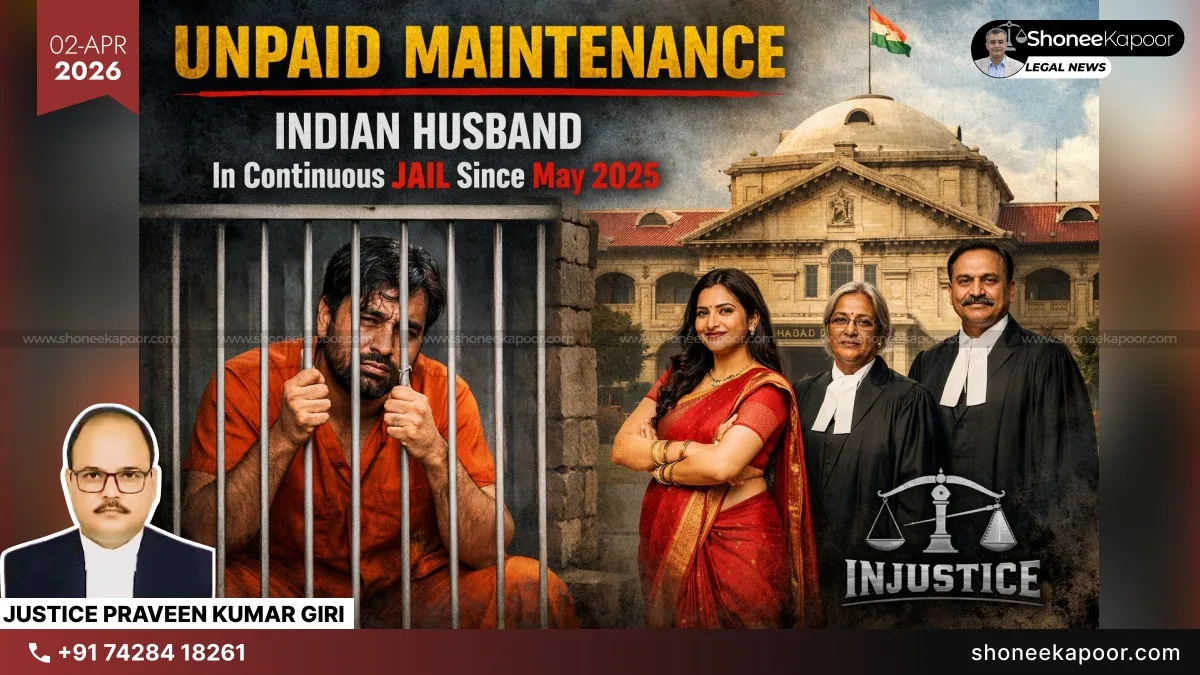
Can a man be kept in jail continuously just for unpaid maintenance, even when law limits custody? Allahabad High Court steps in—but what led to such prolonged detention?
PRAYAGRAJ: The Allahabad High Court has raised serious concerns over the continued custody of a man in a maintenance case and has sought an explanation from the Family Court in Mathura.
The matter relates to a man who has allegedly been in jail since May 23, 2025, due to non-payment of maintenance. The issue came before a bench of Justice Praveen Kumar Giri while hearing a criminal revision petition filed by Prem Singh.
The petition challenges an order dated January 9, 2026, passed by the Principal Judge, Family Court, Mathura, in proceedings under Section 125(3) CrPC.
During the hearing, the revisionist’s counsel argued that:
“A person cannot be kept in custody continuously by issuing fresh orders without releasing him from custody.”
The High Court took note of the legal position that under Section 125(3) CrPC, the maximum imprisonment for non-payment of maintenance, after execution of a warrant, may extend only up to one month.
The counsel further relied on the Supreme Court judgment in Rajnesh vs. Neha, where it was clarified that maintenance should be recovered like a money decree, and for that purpose, property attachment is the appropriate legal route instead of prolonged incarceration.
Additionally, reliance was placed on the Allahabad High Court decision in Mohammad Shahzad vs. State Of U.P. And 2 Others, which held that regular warrants of arrest cannot be repeatedly issued to enforce maintenance orders.
Considering these submissions, the Court has directed the Principal Judge, Family Court, Mathura to submit an explanation on or before April 6, 2026.
This case again brings focus on the implementation of maintenance laws and the limits prescribed under criminal procedure, especially when enforcement moves from recovery to continuous custody without clear statutory backing.
Explanatory Table – Laws & Legal Position
| Law / Case | Provision / Principle | What It Means in Simple Terms | Relevance in This Case |
| Section 125 CrPC | Maintenance to wife, children, parents | Court can order monthly maintenance if dependent person cannot sustain themselves | Basis of the entire dispute |
| Section 125(3) CrPC | Enforcement of maintenance order | If maintenance is not paid, court can issue warrant and jail up to 1 month per default | Core issue—man kept beyond permissible limit |
| Rajnesh vs. Neha | Maintenance recovery mechanism | Maintenance should be recovered like a civil debt; property attachment preferred | Suggests jail is not the primary recovery method |
| Mohammad Shahzad vs. State Of U.P. And 2 Others | Limits on arrest warrants | Repeated arrest warrants cannot be issued mechanically for maintenance enforcement | Directly challenges continuous custody practice |
Case Details
- Case Title: Prem Singh vs State (Maintenance Enforcement Matter under CrPC)
- Court: Allahabad High Court
- Bench: Justice Praveen Kumar Giri
- Lower Court Order Challenged: Order dated January 9, 2026, by Principal Judge, Family Court, Mathura
- Provision Involved: Section 125(3) CrPC
- Custody Details: Alleged continuous custody since May 23, 2025
- Next Date of Hearing: April 6, 2026
Key Takeaways
- Law clearly limits jail for maintenance default to one month, yet prolonged custody is happening in practice.
- Repeated arrest warrants are being used as a tool of pressure, not lawful enforcement.
- Supreme Court has already clarified that recovery should be through property, not indefinite imprisonment.
- Ground-level courts are ignoring binding precedents and procedural safeguards.
- This reflects a systemic issue where enforcement becomes punishment, especially when the accused is a man.
This Could Change Your Case-Get FREE Legal Advice-Click Here!
Disclaimer: The views and opinions expressed in this article are those of the Indian courts and do not necessarily reflect the official policy or position of “ShoneeKapoor.com” or its affiliates. This article is intended for informational and educational purposes only. The content provided is not legal advice, and viewers should not act upon this information without seeking professional counsel. Viewer discretion is advised.
