
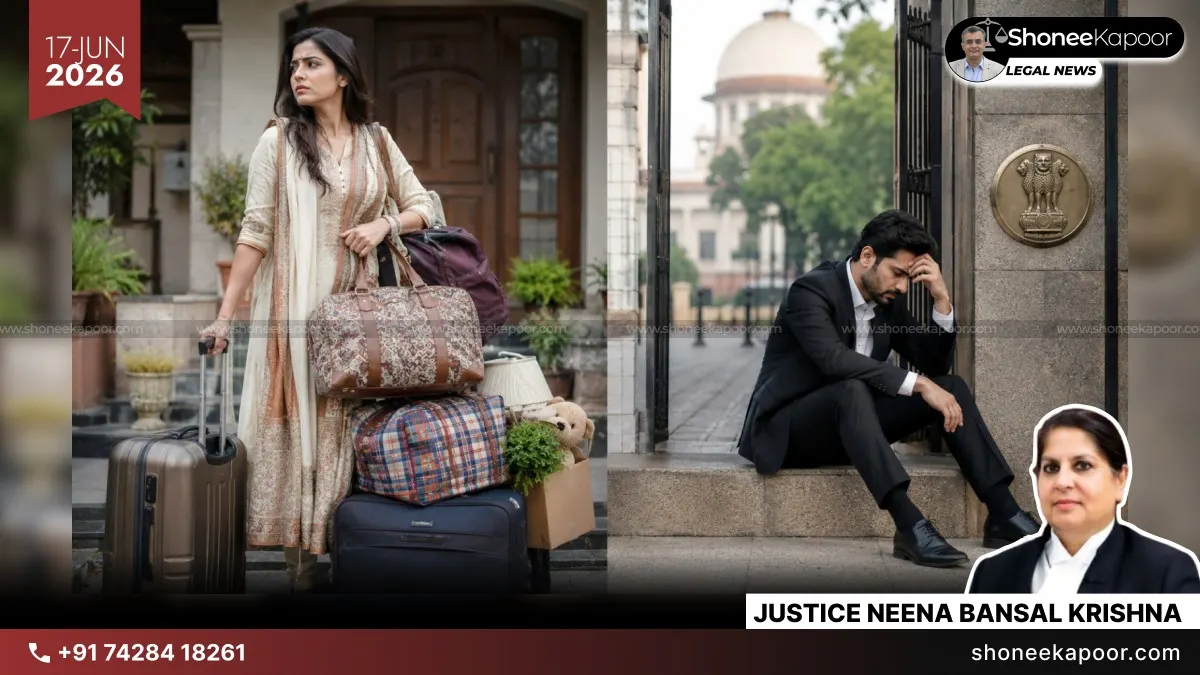
Can a wife continue living in her husband’s sister’s property after the husband himself moves out? The Delhi High Court has answered this question and clarified where residence rights end and ownership rights begin.
NEW DELHI: The Delhi High Court, in a judgment delivered by Justice Neena Bansal Krishna, has held that a wife cannot continue occupying a property owned by her sister-in-law once her husband, who was staying there only with permission, has vacated the premises. The Court dismissed the appeal filed by a woman who claimed a right to continue living in the property by treating it as her matrimonial home.
The case involved a property in Ramesh Nagar, New Delhi, owned by Meera Batra. The property originally belonged to her mother, Maya Devi, and later came to Meera through a Will executed on February 6, 2012. After Maya Devi’s death, Meera became the exclusive owner of the property.
Meera’s brother, Munish Kumar Lakhina, requested permission to stay on the ground floor of the house after their mother’s death. Considering their family relationship, Meera allowed him to live there as a licensee. After Munish married Shalu in October 2012, Shalu also started residing in the property along with him.
According to Meera, disputes began after the marriage. She alleged that both Munish and Shalu started harassing family members and pressuring her to transfer the property to them. She eventually issued a legal notice asking them to vacate the premises.
While Munish later moved out of the house, Shalu continued occupying the property and claimed that she had a right to stay there because it was her matrimonial home and shared household.
The trial court ruled in favour of Meera and directed Shalu to hand over possession of the property. The first appellate court upheld the same decision. Shalu then approached the Delhi High Court.
Before the High Court, Shalu argued that the property was her shared household and that the lower courts had wrongly denied her residence rights. She also alleged collusion between her husband and sister-in-law and questioned the genuineness of the Will through which Meera inherited the property.
However, the High Court found that the ownership of the property stood proved. The Court noted that Shalu entered the property only after her marriage and that her husband himself was residing there merely because his sister had allowed him to do so.
Justice Neena Bansal Krishna observed:
“…it is her husband MK who had been permitted to occupy the Suit premises and after marriage she had merely joined him to reside in the Suit property, as his family member. Once, the right of the MK itself was terminated and he also vacated the premises, the status of the Appellant becomes no better than that of a trespasser and she is liable to vacate the property.”
The Court further noted that Shalu had never shared a domestic relationship with her sister-in-law in a manner required under the Protection of Women from Domestic Violence Act to claim rights in the property. It held that merely residing in a relative’s house after marriage does not automatically create an independent legal right to remain there forever.
Rejecting her claim of continued occupation, the Court said:
“It has been rightly held by both the Courts that the Appellant had come to reside with her husband in the Suit property, as a permissive user and once, the permission was withdrawn, she had no right, title and interest to continue to reside in the property,”
The Court also clarified that if a woman seeks residence-related remedies arising out of matrimonial disputes, such remedies are to be pursued against the husband through the appropriate legal process and cannot be enforced against relatives who merely allowed temporary occupation of their property.
Emphasising that family disputes between spouses cannot deprive another family member of her ownership rights, the Court observed that the disagreement between husband and wife cannot be used to burden a sister-in-law who had acted in good faith by allowing them to stay.
“The discord inter-se the husband and the wife cannot become a penalty for a sister-in-law, who in good faith, had permitted them to occupy her Suit property.”
Finding no substantial question of law and no error in the concurrent findings of the lower courts, the Delhi High Court dismissed the appeal and directed that the sister-in-law’s ownership rights be protected.
EXPLANATORY TABLE: LAWS AND SECTIONS MENTIONED
| LAW / SECTION | PURPOSE | HOW IT APPLIED IN THIS CASE |
| Section 100, Code of Civil Procedure, 1908 | Governs Regular Second Appeals before the High Court. | The wife approached the Delhi High Court through a Second Appeal challenging concurrent findings of the lower courts. |
| Mandatory Injunction | Directs a person to perform a specific act. | Used to seek possession of the property and direct the wife to vacate the premises. |
| Permanent Injunction | Restrains a person from doing a particular act permanently. | Prevented the occupants from creating any third-party interest in the property. |
| Protection of Women from Domestic Violence Act, 2005 | Provides civil remedies including residence rights to aggrieved women. | The wife claimed residence rights by treating the property as a shared household. |
| Section 12, Domestic Violence Act | Enables filing of complaints seeking relief under the DV Act. | The wife had separately initiated proceedings under this provision against her husband. |
| Section 19(1)(f), Domestic Violence Act | Allows courts to direct the husband to secure alternate accommodation or pay rent. | The wife argued she should have been provided alternative accommodation. |
| Section 26, Domestic Violence Act | Permits DV Act reliefs to be sought in other legal proceedings. | The High Court held that civil courts could consider DV Act principles while examining the claim. |
| Law of Licence/Permissive Occupation | A licensee occupies property only with the owner’s permission and acquires no ownership rights. | The husband was a permissive occupant, and the wife’s rights could not exceed his. |
| Law Relating to Wills | Determines succession through testamentary documents. | The Court upheld the Will executed by Maya Devi, recognising Meera Batra as the owner. |
IMPORTANT PRECEDENTS REFERRED
| JUDGMENT | CITATION | RELEVANCE |
| Satish Chander Ahuja v. Sneha Ahuja | 2020 SCC OnLine SC 841 | Considered while examining the concept of “shared household” under the DV Act. |
| Navneet Arora v. Surinder Kaur & Ors. | Delhi High Court | Relied upon by the appellant to argue for alternate accommodation under Section 19(1)(f) DV Act. |
CASE DETAILS
| PARTICULARS | DETAILS |
| Case Title | Shalu v. Meera Batra & Anr. |
| Case Number | RSA 22/2022, CM APPL. 9470-9471/2022 & 40208/2024 |
| Court | High Court of Delhi at New Delhi |
| Judge/Bench | Hon’ble Ms. Justice Neena Bansal Krishna |
| Reserved On | 12 March 2026 |
| Pronounced On | 05 June 2026 |
| Neutral Citation | 2026:DHC:5085 |
| Appellant | Shalu |
| Respondent No.1 | Meera Batra |
| Respondent No.2 | Munish Kumar Lakhina |
| Nature of Proceedings | Regular Second Appeal under Section 100 CPC |
| Outcome | Appeal Dismissed |
| Relief Granted | Wife directed to vacate sister-in-law’s property; injunction upheld restraining creation of third-party rights. |
COUNSELS
- For the Appellant: Mr. Mohammad Sajid, Mr. Abdullah Bin Masood, Advocates with Appellant in person.
- For the Respondents: Mr. Tushar Sannu, Ms. Pulak Gupta Joshi, Ms. Payal Rajput, Advocates
KEY TAKEAWAYS
- A man’s marital dispute cannot become a weapon to deprive his relatives of their lawful property rights.
- Marriage does not automatically give a permanent right over every house the husband’s family owns.
- If a husband himself has no legal right to stay in a property, his wife cannot claim a greater right than him.
- Innocent family members should not be forced to pay the price for a broken marriage they did not create.
- Residence rights are meant for protection, not for converting permissive occupation into indefinite possession.
This Could Change Your Case-Get FREE Legal Advice-Click Here!
Disclaimer: The views and opinions expressed in this article are those of the Indian courts and do not necessarily reflect the official policy or position of “ShoneeKapoor.com” or its affiliates. This article is intended for informational and educational purposes only. The content provided is not legal advice, and viewers should not act upon this information without seeking professional counsel. Viewer discretion is advised.
