
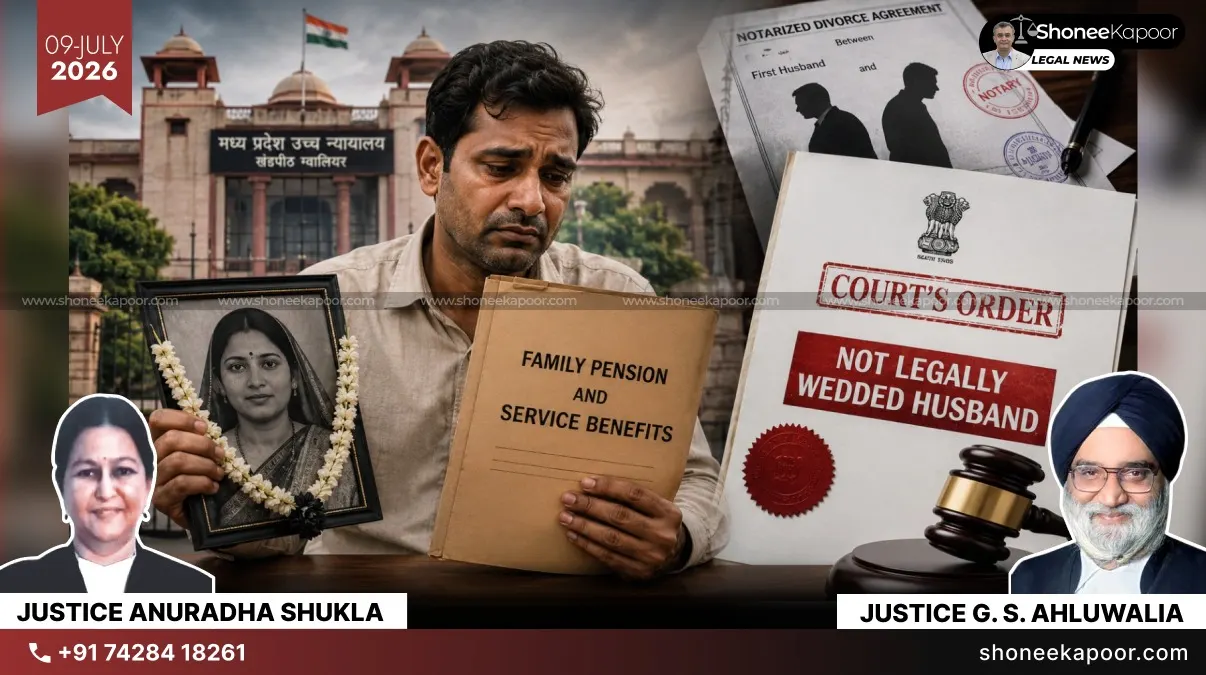
Can a notarized divorce paper end a Hindu marriage? Madhya Pradesh High Court said No. A Hindu marriage cannot be dissolved merely by signing a notarized divorce paper between the parties, it requires legal dissolution through court.
MADHYA PRADESH: The Madhya Pradesh High Court, through Justice G. S. Ahluwalia and Justice Anuradha Shukla, has held that a notarized divorce paper cannot legally end a Hindu marriage, and a notarized marriage agreement cannot create a valid Hindu marriage.
The Court dismissed the appeal of a man who claimed family pension and service benefits after the death of a government employee, saying he failed to prove that he was her legally wedded husband.
The case arose after a woman government employee died during service. After her death, one man approached the authorities claiming that he was her husband and therefore entitled to family pension and terminal benefits. He alleged that the benefits had been wrongly withheld despite repeated efforts.
The State opposed his claim and relied upon the official service records. According to the records, another man was mentioned as the husband of the deceased employee. Her children and other family members were also shown as legal heirs in the service documents and legal heir certificate. The State argued that the claimant was not legally entitled to receive any pension or death benefits.
The Single Judge had earlier dismissed the writ petition because the claimant could not prove that he was the husband of the deceased employee. However, liberty was given to him to establish his relationship before the competent forum and then raise his claim again.
In appeal, the claimant argued that the deceased woman had taken divorce from her first husband through a notarized paper and later married him through a marriage agreement. He also relied upon some documents where his name was mentioned as husband.
The High Court examined the original service book and found that the first husband’s name was clearly recorded without any overwriting or interpolation. The Court also noticed that when the deceased employee was asked by the department to clarify the position during her lifetime, she had clearly denied any marital relationship with the claimant and had stated that her husband was someone else.
The Court then examined the alleged notarized divorce and marriage agreement. It found that no divorce petition had ever been filed under the Hindu Marriage Act and no decree of divorce had ever been passed by any competent court. The Court held in clear words:
“Divorce cannot take place merely on execution of a notarized agreement of divorce.”
The Court said that since the first marriage was never legally dissolved, it continued to remain valid in the eyes of law. Therefore, the deceased woman could not have entered into another valid Hindu marriage during the lifetime of her first husband.
The Court also rejected the argument that a Hindu marriage could be created by a simple notarized agreement. It held:
“Marriage is not a contract under Hindu law, and therefore, it cannot be performed by executing a notarized agreement of marriage.”
The Court further held that the claimant failed to prove any legally recognised custom that allowed such a marriage by agreement. Merely producing a notarized paper was not enough to prove a valid Hindu marriage.
The Court also considered the argument of long cohabitation. It said that long cohabitation may sometimes raise a presumption of marriage, but such presumption cannot be accepted when the first marriage was still legally existing. Any such second marriage would be hit by the conditions of the Hindu Marriage Act and would be void.
Finally, the High Court held that the claimant may have been in a live-in relationship with the deceased woman, but that would not give him the legal status of husband. Since he was not the legally wedded husband, he was not entitled to family pension, terminal benefits or other service benefits after her death. The appeal was dismissed.
EXPLANATORY TABLE: LAWS AND SECTIONS INVOLVED
| Law / Provision | Purpose | Court’s Observation |
| Section 2(1), MP Uchcha Nyayalaya Adhiniyam, 2005 | Allows intra-court appeal before Division Bench. | Appeal was filed under this provision. |
| Order 41 Rule 27 CPC | Allows additional evidence in appeal in limited cases. | Appellant filed extra documents. |
| Section 5, Hindu Marriage Act | Lists conditions for valid Hindu marriage. | First marriage was still legally valid. |
| Section 11, Hindu Marriage Act | Makes certain marriages void. | Alleged second marriage was void. |
| Section 13, Hindu Marriage Act | Provides divorce by court decree. | No divorce petition was filed. |
| Section 13A, Hindu Marriage Act | Allows judicial separation in some cases. | No decree under this section existed. |
CASE DETAILS
- Case Title: Ram Kripal Singh v. The State of Madhya Pradesh and Others
- Case Number: Writ Appeal No. 1624 of 2026
- Court: High Court of Madhya Pradesh, Bench at Gwalior
- Neutral Citation: 2026:MPHC-GWL:19161
- Date of Judgment: 1 July 2026
- Bench: Justice G. S. Ahluwalia | Justice Anuradha Shukla
- Counsels:
- For Appellant: Mr. Mahabir Prasad Sharma, Advocate
- For Respondents/State: Mr. Ankur Mody, Additional Advocate General
KEY TAKEAWAYS
- Marriage cannot be ended by shortcuts; a legal relationship needs proper legal closure through law.
- A private paper may create confusion, but it cannot replace a valid marriage or divorce recognized by court.
- Living together may raise emotional or factual claims, but it cannot defeat an existing lawful marriage.
- In pension and benefit disputes, official records and lifetime declarations often carry more weight than later claims.
- Law protects certainty in family rights; it cannot allow private agreements to disturb settled legal relationships.
This Could Change Your Case-Get FREE Legal Advice-Click Here!
Disclaimer: The views and opinions expressed in this article are those of the Indian courts and do not necessarily reflect the official policy or position of “ShoneeKapoor.com” or its affiliates. This article is intended for informational and educational purposes only. The content provided is not legal advice, and viewers should not act upon this information without seeking professional counsel. Viewer discretion is advised.
