
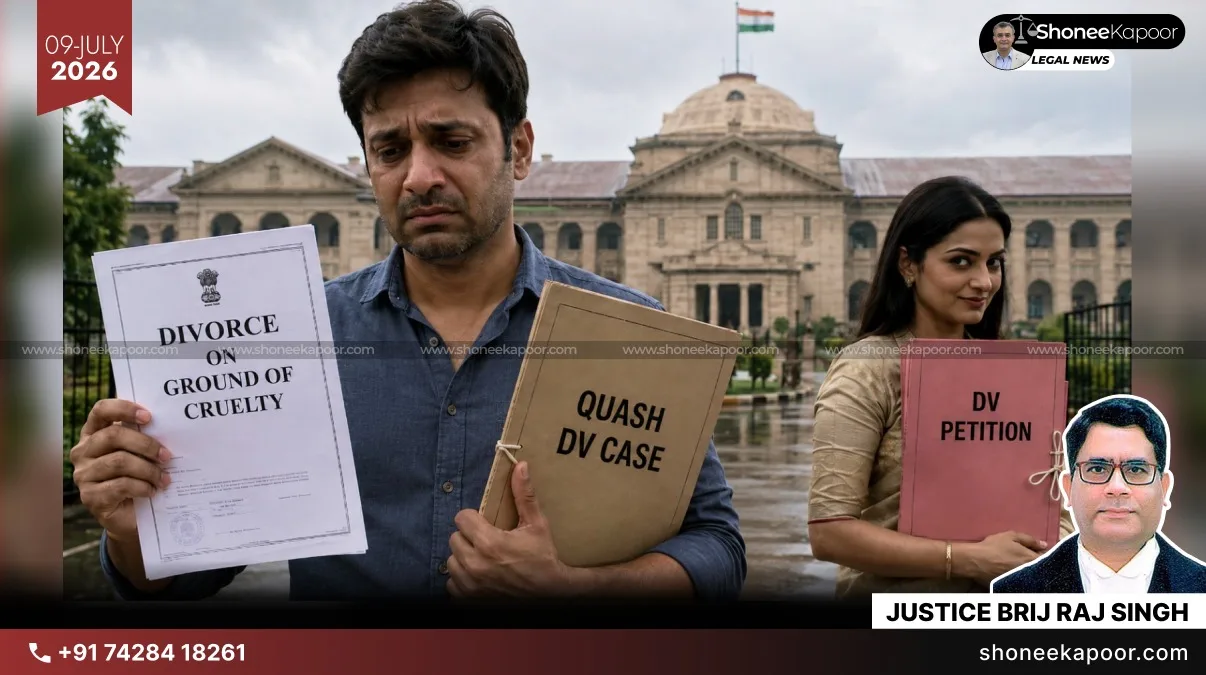
Can a husband’s divorce victory on cruelty grounds quash the wife’s DV case? Allahabad High Court said No. Even if the husband has obtained divorce on cruelty grounds, that alone is not enough to quash the wife’s domestic violence complaint at the initial stage.
LUCKNOW: The Allahabad High Court, Lucknow Bench, through Justice Brij Raj Singh, dismissed a husband’s petition seeking quashing of a domestic violence case filed by his wife under Section 12 of the Protection of Women from Domestic Violence Act, 2005.
The husband had approached the High Court under Section 482 CrPC, claiming that the DV case was an abuse of process. He said the marriage took place on 18 April 2017 at Lucknow without any dowry demand, but the relationship soon became strained.
According to the husband, his wife did not support him and his family during his father’s illness and death. He also claimed that she later made false allegations against him, including that he had beaten her and thrown her out on 14 April 2018, though he was allegedly in Germany from 8 April 2018 to 22 April 2018.
The husband submitted that he tried to save the marriage through mediation, but the wife did not cooperate. Later, he filed a divorce petition under Section 13 of the Hindu Marriage Act on the ground of cruelty.
The Family Court allowed the husband’s divorce petition on 1 March 2025. The wife’s petition for restitution of conjugal rights under Section 9 HMA and her claim for return of Stridhan under Section 27 HMA were also dismissed.
The husband argued that the wife had repeated the same allegations in the DV case, which had already been considered in the matrimonial proceedings. He also said his mother had been unnecessarily dragged into the case despite there being no proper domestic relationship.
The wife opposed the petition. She alleged that the husband was working in HCL Ltd., was earning around Rs. 40 lakh annually, and had an alleged extra-marital affair with a female co-worker. She also claimed that she was mentally and physically tortured and that her jewellery was retained by the husband and his family.
The High Court referred to the Supreme Court judgment in Inderjit Singh Grewal, where it was observed:
“Undoubtedly, for quashing a complaint, the court has to take its contents on its face value and in case the same discloses an offence, the court generally does not interfere with the same.”
The Court also referred to Shaurabh Kumar Tripathi, where the Supreme Court held that Section 482 CrPC can be used to quash DV Act proceedings, but only in limited cases. The Supreme Court cautioned:
“Normally, interference under Section 482 is warranted only in the case of gross illegality or injustice.”
The Court also referred to Juveria Abdul Majid Patni, where the Supreme Court held:
“An act of domestic violence once committed, subsequent decree of divorce will not absolve the liability of the respondent from the offence committed or to deny the benefit to which the aggrieved person is entitled under the Domestic Violence Act, 2005 including monetary relief under Section 20, child custody under Section 21, compensation under Section 22 and interim or ex parte order under Section 23 of the Domestic Violence Act, 2005.”
After considering the record, the High Court noted that the parties were admittedly married and had lived together in a shared household. Therefore, the wife’s DV case could not be quashed only because a divorce decree had been passed in favour of the husband.
The Court held that remedies under the DV Act, including monetary relief, custody, compensation and interim orders, require evidence. These issues cannot be decided at the initial stage by conducting a mini-trial under Section 482 CrPC.
The Court acknowledged that the husband had obtained divorce on cruelty grounds, showing his side of vulnerability in the matrimonial dispute. However, the High Court held that this was not enough to completely close the wife’s DV case without trial.
Accordingly, the Allahabad High Court found no merit in the husband’s application and dismissed the petition.
EXPLANATORY TABLE: LAWS AND SECTION INVOLVED
| Law / Section | Purpose | How It Applied In This Case |
| Section 482 CrPC | High Court’s power to stop misuse of court process. | Husband used it to seek quashing of wife’s DV case. |
| Section 528 BNSS | BNSS provision similar to Section 482 CrPC. | Mentioned while discussing quashing of DV proceedings. |
| Section 12, DV Act, 2005 | Filing provision for DV Act reliefs. | Wife filed her DV complaint under this section. |
| Section 2(f), DV Act, 2005 | Defines “domestic relationship.” | Wife claimed she had such relationship with husband. |
| Section 2(s), DV Act, 2005 | Defines “shared household.” | Parties had lived together after marriage. |
| Section 3, DV Act, 2005 | Defines domestic violence. | Wife alleged domestic violence by husband. |
| Section 17, DV Act, 2005 | Right to reside in shared household. | Discussed while explaining residence rights. |
| Section 20, DV Act, 2005 | Monetary relief. | Court said it can be considered after evidence. |
| Section 21, DV Act, 2005 | Custody orders. | Mentioned as a possible DV Act relief. |
| Section 22, DV Act, 2005 | Compensation and damages. | Mentioned as available remedy under DV Act. |
| Section 23, DV Act, 2005 | Interim and ex parte orders. | Court noted interim relief can be considered. |
| Section 13, HMA, 1955 | Divorce provision. | Husband got divorce on cruelty ground. |
| Section 9, HMA, 1955 | Restitution of conjugal rights. | Wife’s Section 9 petition was dismissed. |
| Section 27, HMA, 1955 | Property/Stridhan-related claims. | Wife’s Section 27 claim was also dismissed. |
CASE DETAILS
- Case Title: Husband v. State of U.P. Through Principal Secretary Home, Lucknow and Another
- Court: High Court of Judicature at Allahabad, Lucknow Bench
- Case Number: Application U/S 482 No. 6580 of 2025
- Bench: Hon’ble Justice Brij Raj Singh
- Neutral Citation: 2026:AHC-LKO:43629
- Date Of Judgment: 07.07.2026
- Counsels:
- For Applicant: Soma Pandey, Mukul Sudhir Pandey, Shashank Dwivedi and Shashi Dwivedi
- For Opposite Parties: G.A., Gaurav Kumar Hasani, Katyayan Mishra, Lovekush Pandey and Santosh Kumar Pandey
KEY TAKEAWAYS
- A husband may prove cruelty and win divorce, but even then, the litigation against him may continue through another case.
- A man can be declared the victim of cruelty in one court, yet still be forced to defend himself in parallel matrimonial proceedings.
- Years of mediation, divorce trial, legal expenses and mental pressure do not always bring final closure for a husband.
- When similar allegations are repeated in different proceedings, the husband has to fight the same battle again and again.
- This case shows why men need strong records, timelines and evidence, because in matrimonial litigation, innocence alone is rarely enough.
This Could Change Your Case-Get FREE Legal Advice-Click Here!
Disclaimer: The views and opinions expressed in this article are those of the Indian courts and do not necessarily reflect the official policy or position of “ShoneeKapoor.com” or its affiliates. This article is intended for informational and educational purposes only. The content provided is not legal advice, and viewers should not act upon this information without seeking professional counsel. Viewer discretion is advised.
