
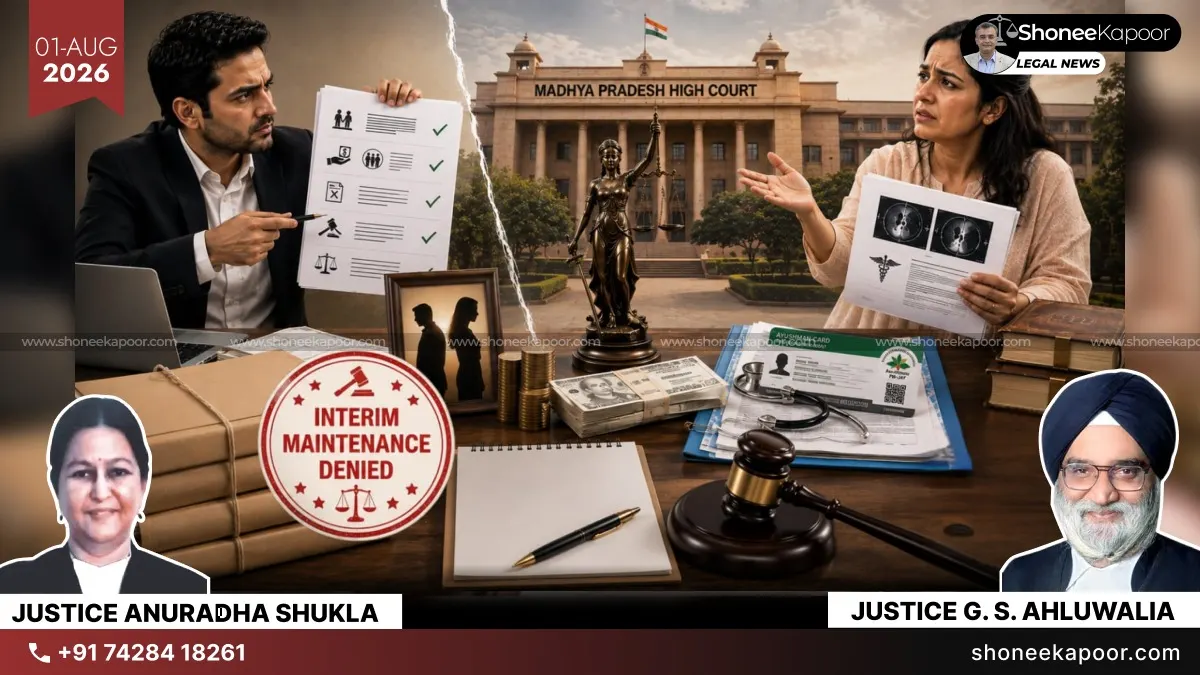
Can repeated maintenance proceedings continue despite permanent alimony, failed complaints and medical treatment covered through an Ayushman Card? The Madhya Pradesh High Court examined the wife’s own pleadings and litigation record before refusing further interim maintenance.
GWALIOR: The Madhya Pradesh High Court has refused to grant interim maintenance under Section 24 of the Hindu Marriage Act to a wife after considering her medical documents, previous maintenance proceedings, permanent alimony already received and her allegation that the husband was of unsound mind.
A Division Bench of Justice G. S. Ahluwalia and Justice Anuradha Shukla dismissed the wife’s appeal against an order passed by the Principal Judge, Family Court, Morena, on December 6, 2021.
The Family Court had rejected her application seeking interim maintenance in a divorce case filed by the husband.
The parties married in 2008. It was the second marriage for both of them. Their matrimonial dispute began in 2009 when the husband filed a divorce petition, which was later withdrawn.
In 2013, the parties filed a joint petition for divorce by mutual consent. That petition was dismissed because the agreed terms were not followed. The challenge against its dismissal also failed before the High Court.
The husband filed another divorce petition in 2014 but later withdrew it. He filed a third divorce petition in 2016. During that proceeding, the wife applied for maintenance under Section 24 of the Hindu Marriage Act.
The wife claimed that she had been harassed for dowry and removed from her matrimonial home. She alleged that the husband operated a medical store and earned approximately Rs 50,000 per month. On this basis, she sought Rs 20,000 per month, along with other expenses.
The husband denied operating a medical store. He stated that after his first wife died from cancer, he married the appellant. According to him, she began threatening to implicate him in a dowry harassment case soon after the marriage and later left the matrimonial home with valuables.
He also claimed that the wife earned at least Rs 30,000 per month by working as an advocate. The wife disputed this and stated that she was not practising as a lawyer. She said she had previously earned some money by working as a court-appointed commissioner for recording evidence, but that work had stopped.
During the appeal, the wife relied on fresh medical documents relating to her cancer treatment at a private hospital. She requested an additional maintenance amount of Rs 15,00,000.
The High Court examined the documents and found that one of them mentioned her Ayushman Card number. The Court stated:
“This shows her entitlement to the medical benefit available under Ayushman Card,”
The Bench further noted that she had not disclosed:
“what financial constraints she is still facing in her medical treatment, despite holding the Ayushman Card.”
The Court therefore held that her request for maintenance towards medical treatment could not be accepted.
The Bench also referred to the wife’s admission during her cross-examination on March 17, 2023, that the marriage had never been consummated.
The Court observed:
“Thus, the parties to an unconsummated marriage have spent a significant period of their lives in court litigation and are still warring factions,”
The judgment recorded that the wife had sought maintenance in several proceedings under the Hindu Marriage Act, the Protection of Women from Domestic Violence Act and Section 125 of the Code of Criminal Procedure, but had not received a favourable maintenance order.
The Court further recorded that the husband had already paid her Rs 7,50,000 as permanent alimony under the 2013 mutual-consent divorce arrangement.
According to the order, after receiving the amount, the wife refused to give her consent for the divorce. The divorce proceeding between the parties nevertheless remained pending.
The High Court also noted that the husband had been acquitted in the dowry harassment criminal case filed by the wife.
The order further recorded that those three successive proceedings had been filed by her under the Domestic Violence Act. The latest complaint was dismissed as not maintainable. She was also not granted maintenance in proceedings under Section 125 CrPC.
The Bench found that although the wife claimed that her earning capacity had materially changed after the Family Court’s order, the relevant facts and evidence relating to that alleged change had not been properly placed before the High Court.
The only additional documents produced before the Bench related to her illness. The Court held that these documents did not justify an award of maintenance because they referred to her entitlement to medical benefits under the Ayushman scheme.
The Court then considered an amendment made by the wife in her pleadings, through which she alleged that the husband was of unsound mind.
The Bench held:
“Generally, a wife cannot claim maintenance from a husband of unsound mind, unless it is established that his mental illness does not cause any functional incapacity to earn an income,”
The Court added that her:
“own pleadings have placed her claim in jeopardy.”
The husband’s counsel argued that the wife had never been willing to continue the matrimonial relationship. He submitted that despite receiving permanent alimony under the mutual-consent arrangement, she later refused to proceed with the divorce and continued the litigation.
After considering the parties’ prolonged litigation history, the medical documents, the previous maintenance proceedings, the permanent alimony payment and the wife’s own pleadings, the High Court dismissed the appeal.
The Bench held that she was:
“not entitled to any interim maintenance under section 24 of Hindu Marriage Act,”
EXPLANATORY TABLE OF LAWS AND SECTIONS
| Law and Provision | What It Means | Application in This Case |
| Section 24, Hindu Marriage Act, 1955 | Allows either spouse who does not have sufficient independent income to seek interim maintenance and litigation expenses during a matrimonial proceeding. | The wife sought monthly maintenance and other expenses during the husband’s pending divorce case. The Family Court rejected the application, and the High Court upheld that decision. |
| Section 13, Hindu Marriage Act, 1955 | Provides grounds on which a spouse may seek a contested divorce. | The husband’s divorce proceeding under Section 13 remained pending between the parties. Earlier divorce petitions had been withdrawn. |
| Section 13B, Hindu Marriage Act, 1955 | Permits spouses to jointly seek divorce by mutual consent when the statutory conditions are satisfied. | The parties filed a mutual-consent divorce petition in 2013. The husband reportedly paid Rs 7,50,000 as permanent alimony, but the wife later refused to continue with the consent divorce. |
| Section 125, Code of Criminal Procedure, 1973 | Permits a wife, child or parent unable to maintain themselves to seek maintenance from a person having sufficient means. | The judgment recorded that the wife had previously sought maintenance under Section 125 CrPC but was not granted relief. |
| Protection of Women from Domestic Violence Act, 2005 | Provides civil remedies to an aggrieved woman, including protection orders, residence orders and monetary relief in cases of domestic violence. | The Court recorded that the wife had filed three successive proceedings under the Act. The latest was dismissed as not maintainable. |
| Permanent Alimony | A lump-sum or continuing financial settlement granted or agreed upon for the long-term support of a spouse. | The order recorded that the husband had paid Rs 7,50,000 as permanent alimony under the mutual-consent divorce arrangement. |
| Ayushman Bharat Medical Benefits | An eligible beneficiary may receive cashless medical treatment for covered procedures at empanelled hospitals, subject to scheme rules. | The wife’s medical documents mentioned her Ayushman Card. The Court found no clear disclosure of the financial burden that remained despite the available medical benefit. |
CASE DETAILS
| Particular | Details |
| Case Title | Smt. Bharti Gupta v. Vishnu Gupta |
| Court | High Court of Madhya Pradesh at Gwalior |
| Case Number | First Appeal No. 1135 of 2024 |
| Neutral Citation | 2026:MPHC-GWL:21886 |
| Date of Order | July 21, 2026 |
| Bench | Justice G. S. Ahluwalia and Justice Anuradha Shukla |
| Judgment Author | Justice Anuradha Shukla |
| Appeal Filed By | Wife/Appellant |
| Respondent | Husband/Vishnu Gupta |
| Impugned Order | Family Court, Morena order dated December 6, 2021 |
| Family Court Case | RCS/HM No. 40/2016 |
| Final Result | Wife’s appeal dismissed; interim maintenance refused |
COUNSELS APPEARED
| Party | Counsel |
| For the Appellant/Wife | Manish Sharma, Advocate |
| For the Respondent/Husband | Surendra Singh Parihar, Advocate |
KEY TAKEAWAYS
- Maintenance is not automatic-A wife must prove genuine financial need with clear and consistent evidence.
- A husband’s previous payments cannot be ignored-The Court considered the Rs 7.5 lakh permanent alimony already paid.
- Repeated cases do not justify repeated financial relief- Her earlier maintenance claims under different laws had also failed.
- Contradictory allegations can destroy a maintenance claim-Her own plea about the husband’s unsound mind weakened her case.
- Men must preserve every legal and financial record-Payment receipts, settlement documents, acquittals and dismissal orders can protect a husband from repeated monetary claims.
This Could Change Your Case-Get FREE Legal Advice-Click Here!
Disclaimer: The views and opinions expressed in this article are those of the Indian courts and do not necessarily reflect the official policy or position of “ShoneeKapoor.com” or its affiliates. This article is intended for informational and educational purposes only. The content provided is not legal advice, and viewers should not act upon this information without seeking professional counsel. Viewer discretion is advised.
