
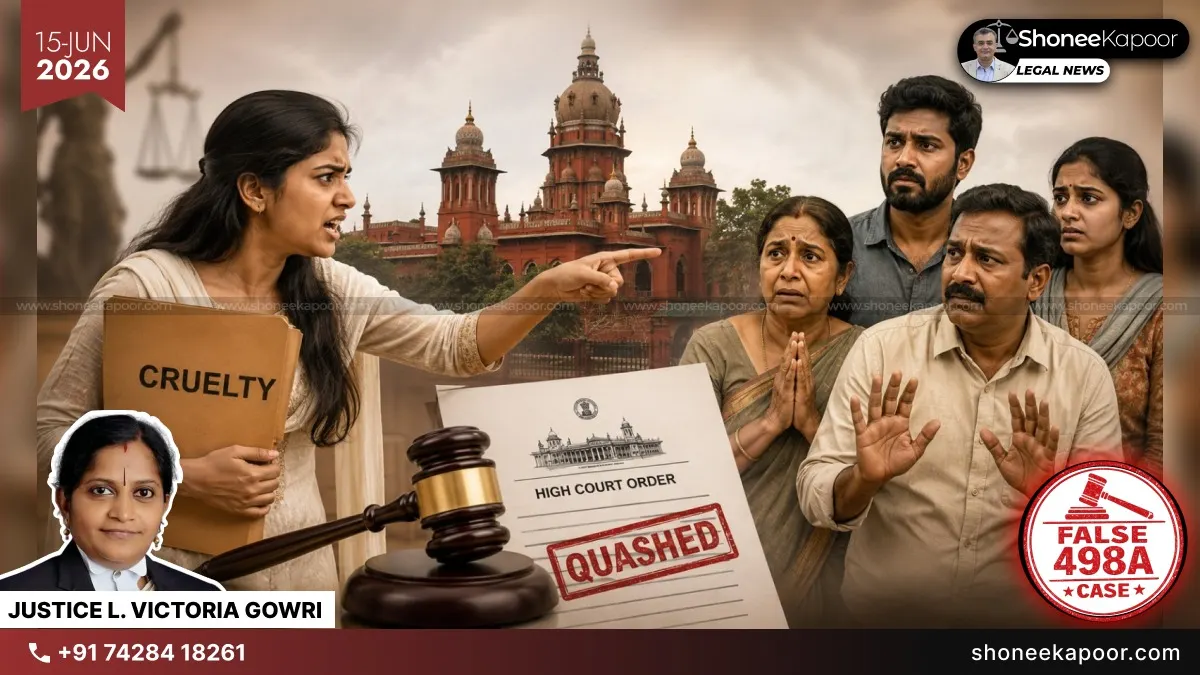
Can an entire family be put on trial over a broken marriage? Madras High Court says No, quashes 498A proceedings against in-laws, saying vague allegations of cruelty cannot sustain criminal trial
MADURAI: The Madurai Bench of the Madras High Court, through Justice L. Victoria Gowri, has drawn an important line in Section 498A cruelty prosecutions by holding that every relative of a husband cannot be forced to face a criminal trial merely because a marriage has broken down.
The case arose from a complaint filed by a wife against her husband and several of his family members. She alleged that the husband subjected her to cruelty, had developed an illicit relationship with another woman, assaulted her on 8 November 2022, seized her mobile phone, and later assaulted her again on 11 November 2022 while demanding its password.
Based on these allegations, the police filed a charge sheet under Sections 498A, 294(b), 323, 324 and 506(ii) IPC against the husband, while his relatives were implicated only under Section 498A IPC.
Justice Victoria Gowri observed that matrimonial cases often involve a delicate balance between genuine grievances and the tendency to rope in the husband’s entire family. The Court noted:
“Matrimonial prosecutions often present before the Court a difficult intersection between the legitimate cry of an aggrieved wife and the equally serious possibility of over-implication of every person standing within the relational circumference of the husband.”
After examining the records, the Court found that the allegations against the husband stood on a different footing. There were specific incidents, dates and acts attributed to him. Therefore, the Court refused to quash the proceedings against him, observing that:
“Whether these allegations are true or exaggerated is not a matter which can be adjudicated in this petition.”
The Court held that these allegations require evidence and must be tested during trial.
However, the position of the relatives was entirely different. The Court found that the complaint contained only broad statements that they had “supported” the husband, without explaining when, where or how they had subjected the complainant to cruelty. It observed that there were no specific overt acts, unlawful demands, or material satisfying the legal ingredients of Section 498A IPC against them.
In a significant observation, the Court held:
“The mere use of expressions such as ‘supported him’ or ‘in-laws caused mental cruelty’ cannot by itself constitute an offence under Section 498-A IPC.”
It further cautioned that:
“Criminal prosecution cannot be allowed to proceed on the basis of relationship alone.”
Although there was a delay of around 80 days in lodging the complaint, the Court noted that spouses often attempt reconciliation before approaching the police, and therefore delay by itself cannot defeat a genuine case against the husband. However, such delay assumes importance when allegations against separately living relatives are vague and unsupported by particulars.
The Court ultimately held that continuing the prosecution against the relatives would amount to abuse of the criminal process. It observed that:
“The criminal process must remain a shield for the genuinely aggrieved and not become a sword for collateral vengeance.”
Allowing the petition in part, the High Court quashed the criminal proceedings against Accused Nos. 2 to 7 and 10, while directing that the trial against the husband should proceed in accordance with law. Summing up the essence of the case, Justice Victoria Gowri remarked that:
“Justice, therefore, lies in separating the grain from the chaff.”
EXPLANATORY TABLE: LAWS AND SECTIONS INVOLVED
| Provision | What It Means | Application in This Case |
| Section 498A IPC | Punishes cruelty by husband or relatives. | Continued against husband; quashed against relatives. |
| Section 294(b) IPC | Obscene words causing public annoyance. | Allowed to proceed against husband. |
| Section 323 IPC | Punishes voluntarily causing hurt. | Assault allegations against husband to be tried. |
| Section 324 IPC | Hurt caused by dangerous weapons or means. | Husband can face trial despite lack of medical records. |
| Section 506(ii) IPC | Aggravated criminal intimidation. | Trial to determine whether ingredients are proved. |
| Section 482 CrPC / Section 528 BNSS | High Court’s inherent power to prevent abuse of process. | Used to partly quash the proceedings. |
| State of Haryana v. Bhajan Lal (1992 Supp (1) SCC 335) | Landmark guidelines on quashing criminal cases. | Relied upon while granting relief to relatives. |
CASE DETAILS
- Case Title: S. Sathish Kumar & Others v. State of Tamil Nadu & Another
- Court: Madurai Bench of the Madras High Court
- Bench: Hon’ble Mrs. Justice L. Victoria Gowri
- Case Number: Crl.O.P.(MD) No.2451 of 2024 along with Crl.M.P.(MD) Nos.1894 and 1895 of 2024
- Date Of Judgment: 01 June 2026
- Counsels:
- For Petitioners: Mr. K. Gurunathan
- For State (R-1): Mr. B. Thanga Aravindh, Government Advocate
- For De-facto Complainant (R-2): Mr. S. Sundarapandian
KEY TAKEAWAYS
- An allegation should trigger an investigation, not automatic guilt for an entire family.
- Justice demands individual accountability, not collective punishment based on relationships.
- In family disputes, vague accusations should never be enough to drag parents, siblings and relatives through years of criminal litigation.
- The rights of genuine victims matter, but so do the rights and dignity of those falsely implicated.
- A fair justice system must separate evidence from emotion and facts from assumptions before taking away a person’s peace, reputation and liberty.
This Could Change Your Case-Get FREE Legal Advice-Click Here!
Disclaimer: The views and opinions expressed in this article are those of the Indian courts and do not necessarily reflect the official policy or position of “ShoneeKapoor.com” or its affiliates. This article is intended for informational and educational purposes only. The content provided is not legal advice, and viewers should not act upon this information without seeking professional counsel. Viewer discretion is advised.
