
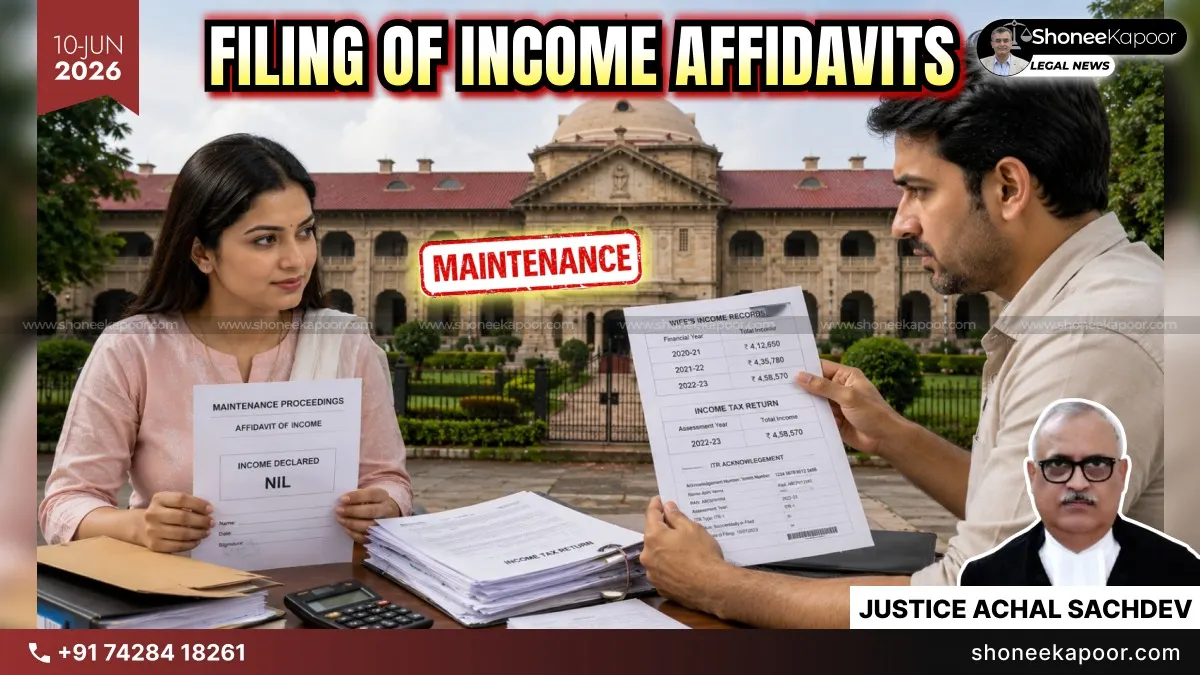
Can maintenance be awarded when a wife allegedly conceals her income? The Allahabad High Court said No, after finding contradictions in the wife’s income disclosures, the Court set aside her maintenance and directed the trial court to reconsider the matter.
PRAYAGRAJ: In a judgment delivered on 29 May 2026, Justice Achal Sachdev of the Allahabad High Court set aside the maintenance awarded to a wife and ordered a fresh examination of her claim after finding that important financial records were not properly considered by the Family Court. However, the Court continued the maintenance granted to the minor son.
The dispute arose from a maintenance case filed by the wife under Section 125 Cr.P.C. for herself and her son. The Family Court had directed the husband to pay ₹8,000 per month to the wife and ₹5,000 per month to the child. Both sides challenged the order before the High Court, with the husband seeking cancellation of the wife’s maintenance and the wife seeking enhancement of the amount.
Before the High Court, the husband argued that the maintenance order was obtained after concealment of material facts. According to him, the wife had informed the Family Court that she had no income, but in separate proceedings before the High Court she had disclosed annual earnings of more than ₹4.5 lakh and had also filed income tax records reflecting the same. These documents were produced before the Family Court but were allegedly ignored while deciding the maintenance case.
After examining the record, the High Court found a clear inconsistency between the wife’s financial disclosures before different courts. The Court noted that while she declared her income as nil before the Family Court, she had disclosed annual income of approximately ₹4,58,570 in another proceeding before the High Court. The Court observed that the Family Court failed to properly examine this documentary evidence before passing the maintenance order.
Referring to the Supreme Court’s decision in Rajnesh v. Neha, the High Court emphasized the importance of truthful financial disclosure in maintenance proceedings. The Court reiterated that:
“The pleadings made in the applications for maintenance and replies filed should be responsible pleadings; if false statements and misrepresentations are made, the court may consider initiation of proceeding under Section 340 CrPC, and for contempt of court.”
The Court further observed that maintenance proceedings depend heavily on accurate disclosure of income and assets by both parties. It noted that:
“The affidavit is not a mere formality; it is the foundation for determining fair maintenance.”
According to the Court, suppression of financial information can affect the entire maintenance determination process.
At the same time, the High Court clarified that merely because a wife has some income does not automatically disqualify her from receiving maintenance. The real question is whether that income is sufficient to maintain herself and the child while meeting reasonable living, medical and educational expenses.
Justice Achal Sachdev ultimately held that the Family Court had not adequately examined the conflicting financial disclosures. The Court observed that:
“The omission to consider such material evidence amounts to non-application of judicial mind.”
Consequently, the maintenance awarded to the wife was set aside and the matter was remanded for fresh consideration.
However, the High Court found no error in the maintenance awarded to the minor son and allowed that portion of the order to continue. The Family Court has now been directed to reassess the wife’s maintenance claim after properly examining her income, assets and liabilities and to pass a fresh reasoned order within three months.
EXPLANATORY TABLE: LAWS & SECTIONS MENTIONED
| Law / Section | Purpose | How Applied In This Case |
| Section 125 Cr.P.C. | Provides maintenance to wife, children and parents unable to maintain themselves | Wife sought maintenance for herself and minor son |
| Section 127 Cr.P.C. | Modification of maintenance on change in circumstances | High Court noted parties can seek modification before trial court |
| Section 146 BNSS | Corresponding provision for alteration of maintenance under BNSS | Mentioned as alternate remedy |
| Section 340 Cr.P.C. | Proceedings relating to false evidence and perjury | Husband alleged suppression of income and sought action |
| Section 307 IPC | Attempt to murder | Wife’s side stated an FIR had been lodged under this section |
| Sections 191-193 IPC | False evidence and punishment for perjury | Court discussed consequences of false disclosures |
| Order XI CPC | Discovery and production of documents | Referred to in Rajnesh v. Neha guidelines |
| Order X CPC | Examination of parties by court | Referred to in disclosure guidelines |
| Section 106 Evidence Act, 1872 | Facts especially within knowledge of a person must be proved by that person | Referred to regarding income disclosures |
| Section 165 Evidence Act, 1872 | Judge’s power to ask questions and seek evidence | Referred to in Supreme Court guidelines |
CASE DETAILS
- Case Title: Gaurav Verma v. State of U.P. and 2 Others
- Connected Case: Smt. Ashi Verma @ Honey Verma and Another v. State of U.P. and Another
- Court: High Court of Judicature at Allahabad
- Bench: Hon’ble Justice Achal Sachdev
- Case Number: Criminal Revision No. 4251 of 2024
- Connected Matter: Criminal Revision No. 5177 of 2024
- Neutral Citation: 2026:AHC:123920
- Date Of Judgment: 29 May 2026
- Counsels:
- For Revisionist: Shreyas Srivastava
- For State: Learned Government Advocate (G.A.)
- For Opposite Party No. 2 (Wife): Tanisha Jahangir Monir
KEY TAKEAWAYS
- Courts cannot blindly grant maintenance when there is evidence showing that the applicant may have an independent source of income.
- Financial disclosure affidavits are not a formality. Any concealment or false declaration can seriously affect the outcome of a maintenance case.
- If a party gives contradictory income statements before different courts, the court must carefully examine and reconcile those disclosures.
- Maintenance laws are meant to prevent genuine hardship, not to reward suppression of material facts or incomplete financial disclosure.
- Fairness in maintenance cases requires equal scrutiny of both parties’ income, assets and liabilities, not just the husband’s earning capacity.
This Could Change Your Case-Get FREE Legal Advice-Click Here!
Disclaimer: The views and opinions expressed in this article are those of the Indian courts and do not necessarily reflect the official policy or position of “ShoneeKapoor.com” or its affiliates. This article is intended for informational and educational purposes only. The content provided is not legal advice, and viewers should not act upon this information without seeking professional counsel. Viewer discretion is advised.
