
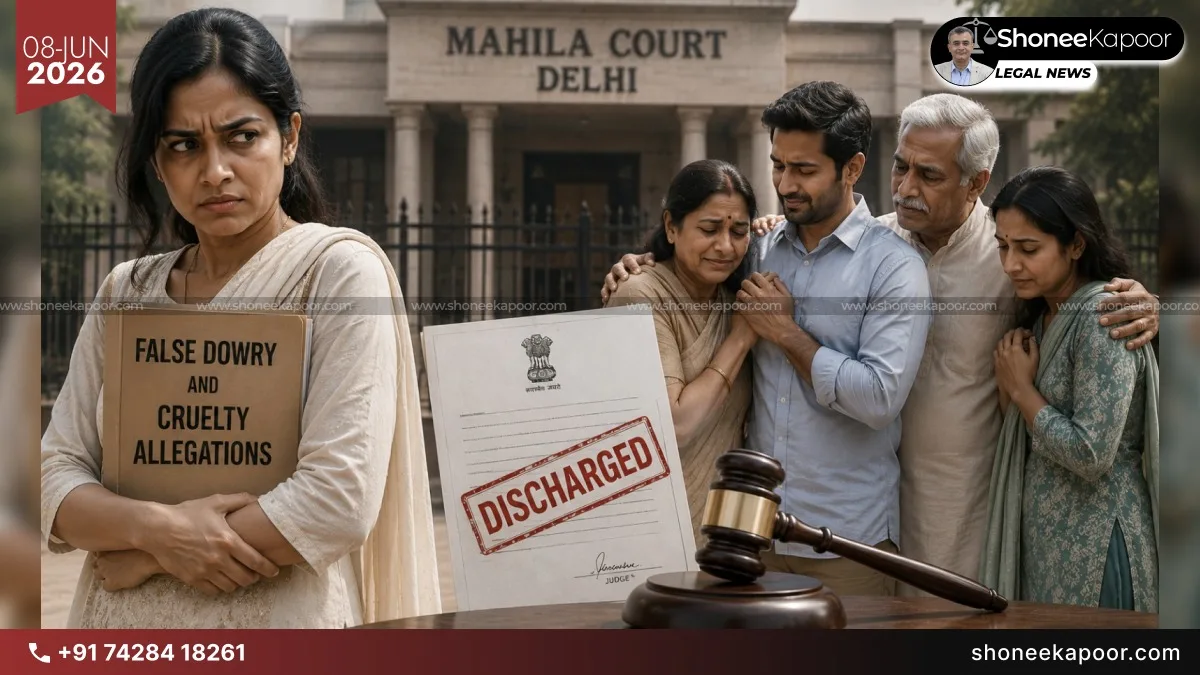
Can a husband’s entire family be forced into criminal litigation without any specific allegations against them? The Delhi Court answered in the negative, discharging the husband and his family after finding no specific evidence of cruelty or a clear dowry demand.
NEW DELHI: A Delhi Mahila Court presidedover by Ms Ritika Kansal, Judicial Magistrate First Class, discharged a husband and his family from charges under Sections 498A and 406 IPC after finding the allegations vague and unsupported by evidence.
The Court held that criminal proceedings cannot continue merely on the basis of general accusations. The allegation under Section 506 IPC was left to be dealt with by the competent court.
The accused persons were represented by Sh. Satyam Sondh, Advocate, and Ms Pritha Khanna, Advocate (Tripaksha Litigations), who filed discharge applications seeking discharge of all accused.
The defence argued that the allegations were false, vague and lacked specific details. It was contended that most of the family members never resided with the complainant, no dowry articles were exchanged during the marriage, and no specific role had been assigned to the relatives.
The defence further argued that several allegations appearing in the case were not part of the earlier complaints and that the essential ingredients of offences under Sections 498A and 406 IPC were completely absent.
After examining the record, the Court found several deficiencies in the prosecution case. Although the complainant alleged repeated physical assaults, she had not filed any contemporaneous complaint or produced supporting material. The Court observed:
“The record further reflects that the complainant even though has alleged frequent physical assault by accused Anuj, she had not filed even a single contemporaneous complaint regarding same.”
The Court also found the allegation regarding a demand of ₹15 lakh to be vague. It noted:
“She has not mentioned on what date or occasion, the demand of Rs. 15 lacs was raised.”
The Court further observed that there was nothing on record to show that the alleged demand was accompanied by any threat or harassment.
Regarding the offence under Section 406 IPC, the Court found no material showing entrustment or misappropriation of any dowry articles. It observed:
“Further, there is no reference to any dowry article handed over to any particular accused and not returned by the accused persons.”
The Court found merit in the defence submissions and concluded that the allegations lacked the specificity and supporting material required to put the accused on trial. Holding that the basic ingredients of cruelty, dowry harassment and criminal breach of trust were not made out, the Court concluded:
“Therefore, there appears to be insufficient material on record to proceed against all the aforementioned accused for the offence u/s 498A/406/34 IPC.”
Accordingly, all the accused were discharged from offences under Sections 498A, 406 and 34 IPC. The Court’s ruling reiterates that vague allegations, unsupported by specific incidents or evidence, cannot be sufficient to compel an accused person and his family members to undergo a criminal trial.
EXPLANATORY TABLE: LAWS AND SECTIONS INVOLVED
| Law & Section | Purpose | How It Applied In This Case |
| Section 498A, Indian Penal Code, 1860 | Punishes cruelty by a husband or his relatives towards a married woman. | The Court found no specific incidents, dates, particulars, or reliable evidence showing cruelty. The allegations were held to be vague and unsupported. |
| Section 406, Indian Penal Code, 1860 | Punishes criminal breach of trust, including dishonest misappropriation of entrusted property. | The Court found no evidence that any dowry articles were entrusted to any accused person or that such property was dishonestly retained or misappropriated. |
| Section 506, Indian Penal Code, 1860 | Punishes criminal intimidation and threats. | This allegation was not decided by the Mahila Court and was directed to be placed before the competent court for further proceedings. |
| Section 34, Indian Penal Code, 1860 | Creates joint liability where a criminal act is committed by several persons with a common intention. | Since the Court found insufficient material for the principal offences under Sections 498A and 406 IPC, the allegation under Section 34 IPC also could not survive. |
| Section 164, Code of Criminal Procedure, 1973 | Allows recording of statements before a Magistrate. | The complainant’s earlier statement under Section 164 CrPC formed part of the factual background considered by the Court. |
| Section 12, Protection of Women from Domestic Violence Act, 2005 | Provides civil remedies to an aggrieved woman alleging domestic violence. | The defence argued that several allegations raised in the criminal case did not even appear in the proceedings under the Domestic Violence Act. |
| Section 376, Indian Penal Code, 1860 | Punishes the offence of rape. | Mentioned only as part of the background history and earlier litigation between the parties. It was not the subject matter of the present discharge order. |
| Section 228, Indian Penal Code, 1860 | Punishes intentional insult or interruption to a public servant during judicial proceedings. | Referred to only because it formed part of an earlier FIR discussed in the factual background of the case. |
| Section 438, Code of Criminal Procedure, 1973 (Anticipatory Bail) | Provides protection against arrest before arrest takes place. | Mentioned in the factual narrative regarding earlier proceedings involving one of the accused persons. |
CASE DETAILS
- Case Title: State Vs. Anuj Kumar
- Case Number: CR Cases No. 219/2024
- FIR Number: FIR No. 102/2023
- Police Station: Mandawali, Delhi
- Court: Judicial Magistrate First Class (Mahila Court-02), Karkardooma Courts, Delhi
- Presiding Judge: Ms. Ritika Kansal, JMFC
- Date of Order: 05 June 2026
- Counsel:
- For Prosecution: Sh. Prabhat Kumar Tripathi, Learned APP for the State
- For Accused Persons: Sh. Satyam Sondh, Advocate, and Ms. Pritha Khanna, Advocate (Tripaksha Litigations)
KEY TAKEAWAYS
- An allegation alone is not evidence. Courts still require specific facts, supporting material, and legally admissible evidence before putting a family on trial.
- Vague and omnibus accusations against entire families are increasingly being scrutinized by courts. Mere naming of relatives is not enough to sustain criminal charges.
- Every dowry demand allegation must contain particulars. Courts expect details such as dates, circumstances, and evidence linking the demand to harassment or cruelty.
- Section 406 IPC requires proof of entrustment. Without showing what property was entrusted, to whom, and how it was misappropriated, criminal breach of trust cannot be established.
- Innocent families should not be forced to undergo years of trial when the basic ingredients of the alleged offences are missing.
This Could Change Your Case-Get FREE Legal Advice-Click Here!
Disclaimer: The views and opinions expressed in this article are those of the Indian courts and do not necessarily reflect the official policy or position of “ShoneeKapoor.com” or its affiliates. This article is intended for informational and educational purposes only. The content provided is not legal advice, and viewers should not act upon this information without seeking professional counsel. Viewer discretion is advised.
