
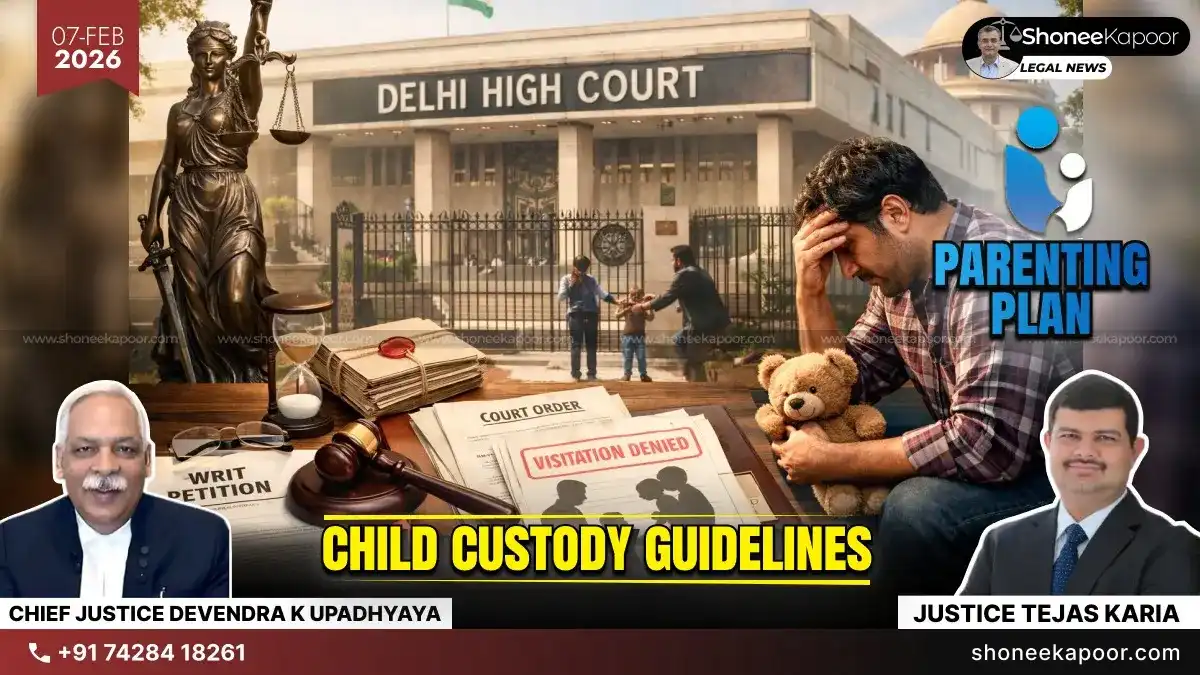
The Delhi High Court has asked petitioners seeking Child Custody and Parenting Plan guidelines to approach its Administrative Side for policy framing. The move highlights how lack of uniform rules continues to affect children and non-custodial parents in custody disputes.
Uniform Parenting: The Delhi High Court on Wednesday asked a PIL petitioner seeking the formulation of structured Child Access and Custody Guidelines along with a Parenting Plan to approach the High Court on its Administrative Side for policy formulation on the issue. The Court made it clear that such matters relating to policy and procedural uniformity fall within the administrative domain of the High Court rather than judicial adjudication in a writ petition.
A Bench headed by Chief Justice Devendra Kumar Upadhyaya and Justice Tejas Karia was hearing a PIL filed by Ayushman Initiative for Child Rights and Ekam Nyaay Foundation. The petition demanded the formulation of uniform Child Access and Custody Guidelines along with a Parenting Plan, to be followed by all courts in Delhi dealing with matrimonial and child custody disputes.
After hearing all parties, the Court noted that such policy decisions fall within the High Court’s administrative domain. The Bench observed that the matter should be examined by the appropriate committee constituted by the High Court itself.
While disposing of the petition, the Court granted liberty to the petitioners to submit a detailed representation to the Registrar General of the Delhi High Court.
The order clearly records the direction:
“On receipt of such representation, the Registrar General of this Court shall place the matter before the appropriate Committee/authority, which shall take a decision in terms of the prayers made in this writ petition for formulating such policy in consultation with the stakeholders.”
The Court further clarified that the representation must be exhaustive and should enclose all relevant documents and precedents relied upon in the writ petition. The petitioners have been given two weeks’ time to submit this representation.
In its order dated 4 February 2026, the Bench noted that the PIL raised serious concerns regarding the lack of standardized parameters governing child custody, guardianship, and visitation rights in Delhi. The absence of clear guidelines, the petitioners argued, results in inconsistent and subjective orders passed by different courts even in similar factual situations.
The petition emphasized that delays in deciding custody and visitation matters cause long-term emotional harm to children. It stressed that children often become tools in matrimonial disputes, leading to parental alienation and permanent damage to their emotional well-being.
The plea also highlighted that non-custodial parents frequently face harassment and practical difficulties in meeting their children due to arbitrary restrictions imposed by the custodial parent.
According to the petitioners, this not only affects the parents but also deprives children of love, care, and support from both sides of the family.
The petition relied heavily on precedents from other High Courts. It pointed out that the Calcutta High Court, exercising powers under Section 50(1)(j) of the Guardians and Wards Act, 1890, has already framed and adopted Child Access and Custody Guidelines, along with the Parenting Plan 2025. These guidelines were upheld in Antara, a non-profit society & Anr. v. The Hon’ble High Court at Calcutta.
It was also submitted that the Karnataka High Court has adopted these very guidelines through an interim order, directing trial courts in the State to follow them until formal rules are notified.
Further, the petition informed the Court that the Ministry of Women and Child Development, Government of India, has accepted and recognised the Child Access and Custody Guidelines along with Parenting Plan 2025.
The petitioners also referred to an earlier Delhi High Court judgment in Amit Sharma vs. Sugandha Sharma (2024), where the Court held that “Joint parenting is the norm”. However, the petition argued that this principle has not been effectively applied in family courts, which continue to pass inconsistent orders.
After examining the pleadings and documents, the Bench concluded that it would be appropriate to allow the High Court’s administrative machinery to consider the issue rather than issuing judicial directions.
Accordingly, the Court disposed of the PIL, recording:
“Having gone through the averments made in the writ petition and the documents enclosed therewith, we find it appropriate to permit the petitioners to approach this Court on the Administrative Side through Registrar General of this Court by way of making an exhaustive representation.”
The order finally stated:
“The writ petition along with pending applications stands disposed of with the aforesaid observations.”
With this, the responsibility now lies with the Delhi High Court’s administrative committee to examine whether uniform Child Access and Custody Guidelines should be framed, ensuring that children are not deprived of either parent’s love due to prolonged and uneven custody battles.
Explanatory Table: Laws / Provisions Involved
| Law / Provision | Purpose | How Applied in This Case |
| Guardian and Wards Act, 1890 – Section 50(1)(j) | Gives High Courts power to frame custody and guardianship rules | Cited as the legal basis used by Calcutta High Court to frame Child Access & Custody Guidelines |
| Administrative Powers of High Court | Enables High Court to create internal rules and policies | Delhi High Court held custody guidelines must be framed through its administrative mechanism |
| Parenting Plan 2025 | Provides a structured model for custody, access, and parenting roles | Referred as an already accepted framework adopted by Calcutta and Karnataka High Courts |
| Public Interest Litigation (PIL) | Tool to raise issues affecting public interest | Court held PIL is not the correct route for framing custody policy |
| High Court Administrative Committee System | Examines and approves policy matters | Registrar General directed to place representation before the appropriate committee |
Case Details
- Case Title: Ayushman Initiative for Child Rights & Anr. v. High Court of Delhi & Ors.
- Court: Delhi High Court
- Case Number: W.P.(C) 1565/2026, CM APPL. 7595/2026, CM APPL. 7596/2026
- Date of Order: 04 February 2026
- Bench: Hon’ble the Chief Justice Devendra Kumar Upadhyaya & Hon’ble Mr. Justice Tejas Karia
- Counsels
- For Petitioners: Mr. Manav Gupta, Mr. Sahil Garg, Mr. Ankit Gupta, Mr. Abhinav Jain, Mr. Mithil Malhotra, Mr. Aryan Pandey, and Mr. Akshat Bajpai
- For Respondents: Ms. Padma Priya with Ms. Poornima Gupta (for R-1), Ms. Radhika Bishwajit Dubey, CGSC with Mr. Gurleen Kaur Waraich and Mr. Kritarth Upadhyay (for R-2 & R-4), Mr. Sameer Vashisht, Senior Counsel with Ms. Harshita Nathrani, and Ms. Ojaswini Gupta, Government Pleader (for R-6)
Key Takeaways
- Child custody and access decisions affect fathers the most, yet Delhi still lacks uniform, enforceable guidelines.
- The Court acknowledged the problem but shifted responsibility to administrative committees, delaying real relief for non-custodial parents, mostly fathers.
- Without clear rules, family courts continue to pass subjective orders, enabling parental alienation and cutting children off from fathers.
- Other High Courts have already shown the way, but Delhi fathers are still asked to wait while their parent-child bond weakens.
- Until structured child access policies are framed, men will keep fighting inconsistent courtrooms instead of benefiting from predictable, child-centric justice.
This Could Change Your Case-Get FREE Legal Advice-Click Here!
Disclaimer: The views and opinions expressed in this article are those of the Indian courts and do not necessarily reflect the official policy or position of “ShoneeKapoor.com” or its affiliates. This article is intended for informational and educational purposes only. The content provided is not legal advice, and viewers should not act upon this information without seeking professional counsel. Viewer discretion is advised.
