
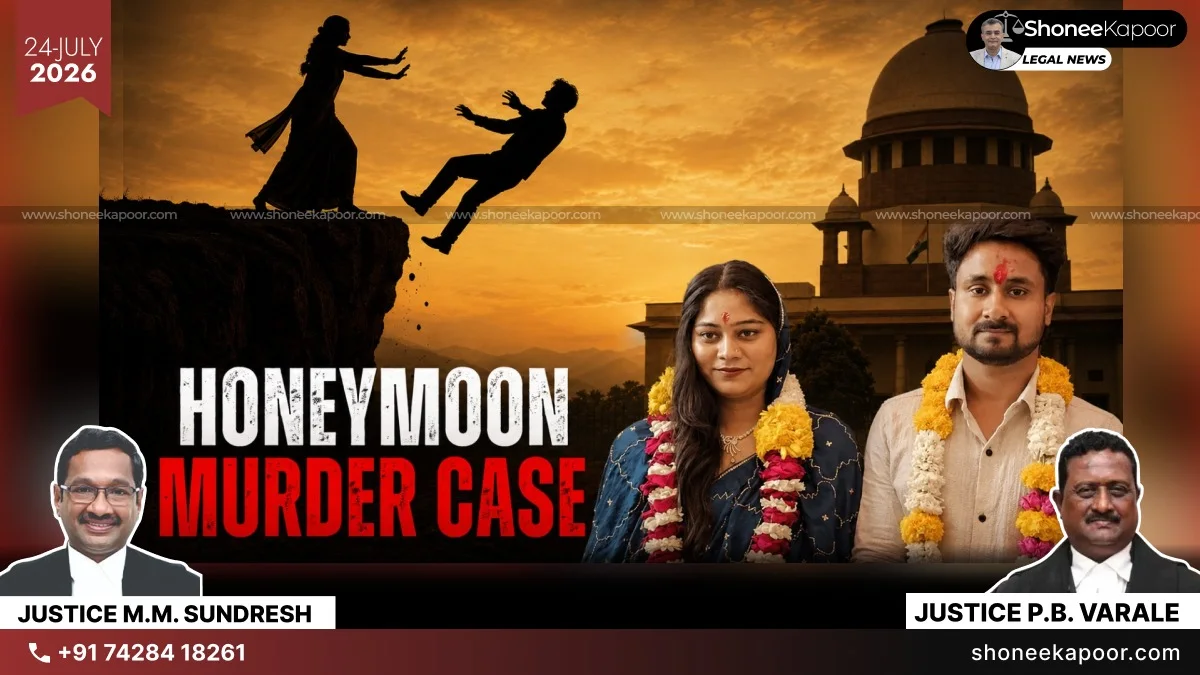
Why did the Supreme Court cancel Sonam Raghuvanshi’s bail in the Meghalaya honeymoon murder case involving her husband, Raja Raghuvanshi? The Court raised serious concerns about weakening marital trust, changing family structures and whether her release could affect the ongoing trial.
NEW DELHI: The Supreme Court has cancelled the bail granted to Sonam Raghuvanshi, who is accused of conspiring to murder her husband, Raja Raghuvanshi, during their honeymoon in Meghalaya.
While hearing the case, the Court also spoke about changing social values, weakening family support systems and the increasing emotional vulnerability of the younger generation.
The Supreme Court observed that incidents like the alleged murder of Raja Raghuvanshi by his wife were “bound to happen in a changing society,” while setting aside the bail order and directing Sonam to surrender before the police within three weeks.
A bench of Justice M.M. Sundresh and Justice P.B. Varale allowed the appeal filed by the Meghalaya Government against the bail granted to Sonam.
According to the prosecution, Sonam allegedly conspired with hired assailants to murder her husband during their honeymoon in Meghalaya in May 2025.
While discussing changing social behaviour, Justice Sundresh remarked:
“Such incidents are bound to happen in a changing society… Modern-day generation is restless. They want quick solutions to problems. We will have a lot of cases of personal laws.”
The Court observed that young people may have greater access to information today, but many are not properly prepared to deal with disappointment, rejection and emotional pressure.
Solicitor General Tushar Mehta, appearing for the Meghalaya Government, submitted that social media had increased access to information, but it had not necessarily increased real knowledge or understanding.
Justice P.B. Varale added:
“In today’s time, whatever is being shared on WhatsApp is being treated as knowledge.”
Mehta also referred to the decline of trust in modern marriages and stated:
“There are comic reels where husband goes to honeymoon with bodyguards. That trust or relationship between a man and a woman who become husband and wife is diminishing. Earlier, the joint family system used to take care of the relationship.”
The observation assumed significance in a case where a husband allegedly lost his life during a journey that was expected to mark the beginning of his married life. The proceedings also highlighted the need to take violence against husbands seriously and ensure that the rights and safety of male victims are not overlooked.
Responding to Mehta’s submission, the bench observed that the decline of the joint family system had affected the ability of people to face disappointment and adjust to difficult situations.
The Court stated:
“If you are a member of a joint family, you will learn to take disappointment and will adjust. In a nuclear family, you cry at small things. You get agitated if you do not get them.”
The Supreme Court also discussed the impact of excessive dependence on technology on children and their emotional development.
Justice Sundresh observed:
“Children will learn from uncles, aunts and grandparents. Recently, I saw a child was crying in a hotel and immediately, the parents gave a mobile phone and the child stopped crying.”
He further added:
“This is the larger problem. Instead of emotions, they are giving a gadget.”
The bench also remarked that “the present-day mind is an extremely animated one” and that people “get agitated for small things.”
While cancelling Sonam’s bail, the Supreme Court held that allowing her to remain out on bail could interfere with or obstruct the ongoing trial.
The bench set aside the Meghalaya High Court’s order dated June 29, which had granted her bail.
However, the Supreme Court allowed Sonam to approach the trial court for fresh bail if the trial is not completed within six months.
Allowing the Meghalaya Government’s appeal, the bench observed:
“We are inclined to observe that the continued enlargement of the respondent will hinder the ongoing trial.”
The Supreme Court therefore directed Sonam Raghuvanshi to surrender before the authorities within three weeks.
Sonam was arrested in June 2025 after the body of her husband, Raja Raghuvanshi, was recovered from a gorge in Meghalaya. The couple had gone missing only a few days after travelling to the State for their honeymoon.
The prosecution alleges that Sonam planned the murder with hired assailants for financial gain. These allegations are yet to be finally proved during the trial.
The case has once again raised serious questions about marital trust, the safety of husbands inside relationships and the importance of a fair trial that gives equal value to the life of a male victim.
EXPLANATORY TABLE OF LAWS AND SECTIONS
CONSTITUTIONAL AND PROCEDURAL PROVISIONS
| LAW/SECTION | WHAT IT MEANS | RELEVANCE TO THIS CASE |
| Article 21, Constitution of India | Protects life and personal liberty. A person cannot be deprived of liberty except through a legally valid procedure. | Sonam’s custody and the alleged defect in the arrest procedure were examined from the perspective of personal liberty. |
| Article 22(1), Constitution of India | Requires an arrested person to be informed, as soon as possible, of the grounds of arrest and permits consultation with a lawyer. | Sonam argued that the correct and complete grounds of arrest were not properly communicated to her. This was the principal legal ground on which bail had been granted. |
| Section 47, Bharatiya Nagarik Suraksha Sanhita, 2023 | Requires the arrested person to be informed of the full particulars of the offence and the grounds for arrest. | The dispute concerned whether the documents supplied to Sonam properly informed her why she had been arrested. |
| Section 483, Bharatiya Nagarik Suraksha Sanhita, 2023 | Gives the High Court and Court of Session special powers to grant bail and impose or modify bail conditions. | Sonam’s bail application before the Sessions Court was filed under this provision. |
| Section 50A, Code of Criminal Procedure, 1973 | Required police to inform a relative or nominated person about an arrest and required the Magistrate to verify compliance. | Discussed through precedents concerning arrest safeguards. The BNSS now contains corresponding arrest-intimation protections. |
| Article 136, Constitution of India | Gives the Supreme Court discretionary power to grant special leave to appeal against judgments or orders of courts and tribunals. | The State of Meghalaya approached the Supreme Court through a Special Leave Petition against the bail order. |
OFFENCES ALLEGED IN THE UNDERLYING CRIMINAL CASE
| LAW/SECTION | OFFENCE EXPLAINED IN SIMPLE LANGUAGE | RELEVANCE |
| Section 103(1), Bharatiya Nyaya Sanhita, 2023 | Punishment for murder. It provides for death or imprisonment for life and fine. | Principal charge concerning the alleged murder of Raja Raghuvanshi. |
| Section 238(a), Bharatiya Nyaya Sanhita, 2023 | Causing evidence of an offence to disappear or giving false information to protect an offender, where the underlying offence is punishable with death. | Relates to the allegation that evidence was concealed or steps were taken to prevent detection of the alleged murder. |
| Section 309(6), Bharatiya Nyaya Sanhita, 2023 | Enhanced punishment connected with robbery or dacoity where hurt or attempted grievous harm is caused. | The exact application depends on the prosecution’s charge-sheet allegations regarding valuables, property or robbery connected with the occurrence. |
| Section 3(6), Bharatiya Nyaya Sanhita, 2023 | Establishes joint criminal liability where several persons act in furtherance of a common intention. | Used to attribute responsibility to persons alleged to have acted together in planning or executing the offence. |
| Section 25(1A), Arms Act, 1959 | Punishes unlawful possession, acquisition or carrying of specified prohibited arms or ammunition. | Added in the supplementary charge sheet against certain accused, including Sonam, according to the trial-court record. |
| Section 35, Arms Act, 1959 | Allows criminal responsibility to be imposed where arms or ammunition are found in premises or vehicles jointly occupied or controlled by several persons, unless lack of knowledge is proved. | Used where weapons are allegedly linked to more than one accused through joint occupation, possession or control. |
CASE DETAILS
| PARTICULAR | DETAIL |
| Case Title | State of Meghalaya v. Sonam Raghuvanshi @ Bitti @ Bittu |
| Case Number | SLP (Criminal) No. 11944 of 2026 |
| Diary Number | Diary No. 38857 of 2026 |
| Court | Supreme Court of India |
| Nature of Case | Special Leave Petition filed by the State of Meghalaya challenging the bail granted to Sonam Raghuvanshi |
| Petitioner/Appellant | State of Meghalaya |
| Respondent | Sonam Raghuvanshi @ Bitti @ Bittu |
| Bench | Justice M.M. Sundresh and Justice P.B. Varale |
| Date of Final Hearing/Order | July 23, 2026 |
| Impugned Order | Meghalaya High Court order dated June 29, 2026, upholding the grant of bail |
| Supreme Court Decision | Bail set aside; respondent directed to surrender within three weeks |
| Trial Court Case | Sessions Case No. 41(T) of 2025 |
| Police Case | Sohra Police Station Case No. 7 of 2025 |
| Original Bail Application | Bail Application No. 93(T) of 2026 |
| Arrest Date | June 9, 2025 |
COUNSELS
| PARTY | COUNSEL |
| For the State of Meghalaya | Tushar Mehta, Solicitor General of India |
| Advocate-on-Record for the State | Avijit Mani Tripathi |
| For Sonam Raghuvanshi | The final news report does not provide the complete arguing-counsel team |
| Advocate-on-Record for Sonam Raghuvanshi | Abhay Singh |
| Before the Trial Court—For Sonam | Shri S. Rana, Deputy Legal Aid Defence Counsel |
| Before the Trial Court—For Prosecution | Shri K.C. Gautam, Special Prosecutor |
KEY TAKEAWAYS
- The Supreme Court cancelled Sonam Raghuvanshi’s bail and directed her to surrender within three weeks.
- The prosecution alleges that she conspired with hired assailants to murder her husband, Raja Raghuvanshi, during their honeymoon.
- The Court held that her continued release could hinder the ongoing trial.
- The case exposes the dangerous decline of trust within marriage, where even a husband’s safety can no longer be taken for granted.
- Men’s lives are not disposable. Violence against husbands deserves the same outrage, seriousness and justice as violence against women.
This Could Change Your Case-Get FREE Legal Advice-Click Here!
Disclaimer: The views and opinions expressed in this article are those of the Indian courts and do not necessarily reflect the official policy or position of “ShoneeKapoor.com” or its affiliates. This article is intended for informational and educational purposes only. The content provided is not legal advice, and viewers should not act upon this information without seeking professional counsel. Viewer discretion is advised.
