
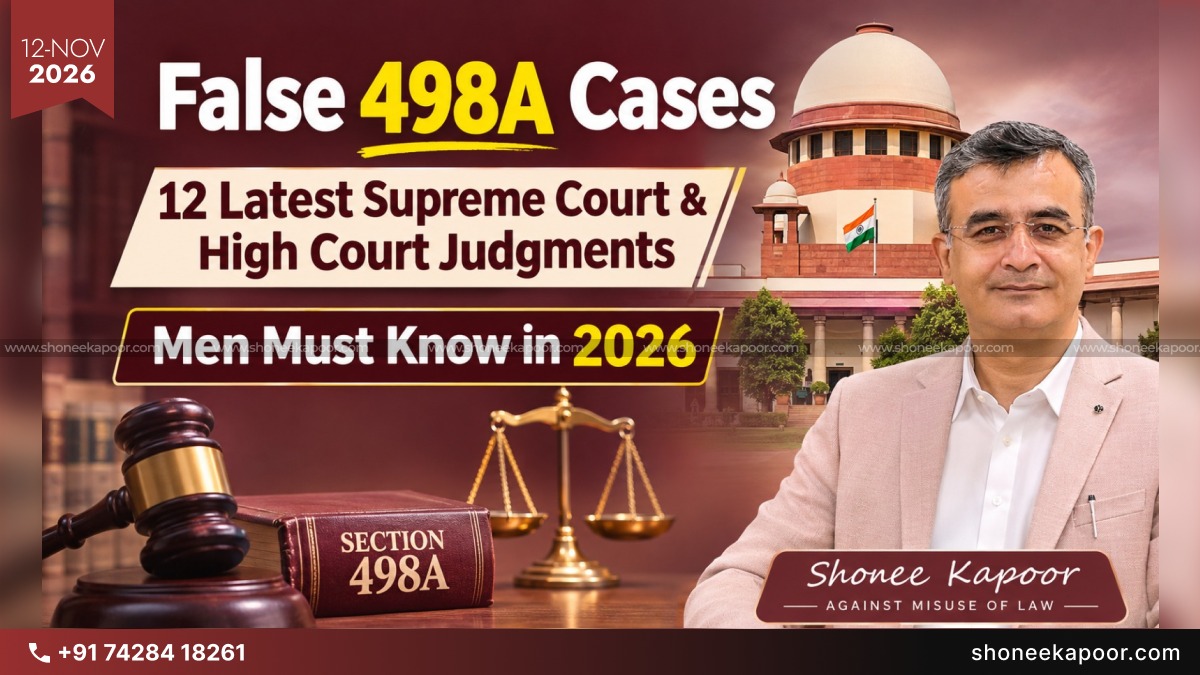
False 498A Case: Latest Judgments 2026

Written and analysed by Vaibhav Ojha
Head Of Legal CommunicationsNEW DELHI: A failed marriage is not proof of criminal cruelty. A complaint is not a conviction. And being related to a husband does not automatically make someone guilty.
The Supreme Court and various High Courts have delivered several significant judgments in 2026 examining the misuse of Section 498A IPC and its corresponding provision, Section 85 of the Bharatiya Nyaya Sanhita (BNS).
In some cases, husbands secured the quashing of criminal proceedings. In others, parents and relatives were protected from allegations that did not disclose their individual criminal involvement. The Supreme Court also overturned a husband's conviction where the prosecution failed to establish cruelty through reliable evidence.
These decisions matter because a matrimonial dispute can lead to years of criminal litigation, restrictions on travel, financial strain and reputational damage.
I have consistently argued that criminal law must be used to punish proven wrongdoing, not to exert pressure during matrimonial disputes.
However, an important legal distinction must be understood: quashing a case does not automatically mean the court has judicially declared the complaint deliberately false. The specific reason for quashing, and the precise person granted relief, must always be examined.
Here are 12 significant judgments from 2026, with links to court orders and detailed legal coverage.
Latest 498A Judgments In 2026: Quick Case Tracker
| Judgment | Date | Who obtained relief? |
|---|---|---|
| Piyush v. State of Maharashtra | 2 Nov 2026 | Husband; criminal proceedings quashed |
| Prasanta Kumar Dhar v. State of West Bengal | 5 Oct 2026 | Husband's parents |
| Prabha Devi v. State of Bihar | 8 Sep 2026 | Mother-in-law |
| Rahul v. State of Uttar Pradesh | 11 Aug 2026 | Husband; proceedings quashed |
| Arti Mehta v. State of Madhya Pradesh | 25 May 2026 | Four relatives |
| Jayesh Kanna v. Assistant Commissioner | 7 May 2026 | Husband; 498A conviction set aside |
| Sivaraman Nair v. State of Kerala | 24 Apr 2026 | Father-in-law, mother-in-law and sister-in-law |
| Dr. Sushil Kumar Purbey v. State of Bihar | 9 Mar 2026 | Father-in-law and mother-in-law |
| RH v. State of Karnataka | 4 Nov 2026 | Husband; proceedings quashed |
| Ursila Toppo v. State of Jharkhand | 3 Nov 2026 | Mother-in-law and sister-in-law |
| Vamshi Krishna Parepalli v. State of Telangana | 1 Oct 2026 | NRI husband; FIR quashed |
| Tanushree M. v. State of Karnataka | 28 Aug 2026 | Woman alleged to be husband's girlfriend |
Latest Supreme Court Judgments On False 498A Allegations
1. Supreme Court quashes 498A and dowry-death proceedings against husband: Piyush v. State of Maharashtra
Read Also:- Husband Calling Wife ‘Stupid, Useless’ Is Not Cruelty: Supreme Court Quashes 498A IPC And Dowry Death Case
Case: Piyush S/o Deepak Narlawar v. State of Maharashtra & Others
Judgment date: 2 November 2026
Neutral citation: 2026 INSC 1183
Bench: Justice B.V. Nagarathna and Justice Manmohan
This is one of the most important recent judgments for husbands facing allegations of criminal cruelty and dowry harassment.
The case arose after the wife died by suicide in Toronto in June 2023. Her father subsequently accused the husband and his family of dowry demands and harassment.
One allegation was that the husband had called his wife “stupid” and “useless” in connection with her difficulty finding employment.
The Supreme Court considered the deceased woman's suicide note, findings from Canadian authorities and the material connecting the alleged cruelty with her death.
The suicide note referred to distress associated with employment and education but did not accuse the husband or his family of causing her death.
What the Supreme Court decided
On the facts and evidence before it, the Court found that the necessary ingredients of the alleged offences were not established and quashed the criminal proceedings against the husband.
The legal principle: Insensitive words or marital conflict must be assessed in context. They do not automatically establish the statutory elements of Section 498A IPC or dowry death.
This is not a ruling that verbal or psychological abuse can never amount to cruelty. Serious mental cruelty may satisfy the law when its legal ingredients are established.
Case documents
- Download Supreme Court judgment PDF — 2026 INSC 1183
- Read detailed judgment analysis on ShoneeKapoor.com
2. Parents cannot face a 498A trial merely because they are the husband's parents: Prasanta Kumar Dhar
Case: Prasanta Kumar Dhar & Another v. State of West Bengal & Another
Judgment date: 5 October 2026
Neutral citation: 2026 INSC 1087
The husband's father and mother were accused of matrimonial cruelty, dowry harassment, criminal breach of trust and intimidation.
The complaint referred to dowry demands, including a vehicle, and an allegation concerning a declaration about the return of stridhan.
The Supreme Court examined the individual allegations against the parents and whether the material disclosed the necessary elements of each offence.
It found insufficient grounds to continue the prosecution against them.
What the Supreme Court decided
The criminal proceedings against the father-in-law and mother-in-law were quashed.
Important: The husband did not obtain relief through this judgment. His prosecution was not quashed by the order.
The legal principle: Individual criminal liability cannot be presumed from family relationships. The complaint must disclose the ingredients of the offence against the person being prosecuted.
Case documents
3. Mother-in-law gets 498A relief; husband's case continues: Prabha Devi
Case: Prabha Devi v. State of Bihar & Others
Judgment date: 8 September 2026
Case reference: Criminal appeal arising from SLP (Criminal) No. 3845 of 2026
A mother-in-law faced allegations concerning taunts, harassment and missing jewellery.
During investigation, statements from six neighbourhood witnesses did not support the allegations of harassment. The Court also considered the absence of material establishing an individual criminal role attributable to her.
What the Supreme Court decided
Proceedings against the mother-in-law were quashed because the allegations and accompanying material did not establish the necessary ingredients of the offences against her.
The Court specifically clarified that proceedings against the husband would continue to be assessed on their own merits.
The legal principle: A husband's alleged misconduct cannot automatically be attributed to his mother. At the same time, an order protecting the mother is not an acquittal of the husband.
Case documents
4. BSF husband's official duty records help defeat 498A and dowry-death prosecution: Rahul
Case: Rahul v. State of Uttar Pradesh & Another
Judgment date: 11 August 2026
Neutral citation: 2026 INSC 825
A Border Security Force personnel faced criminal proceedings arising from allegations of dowry harassment and his wife's death.
His defence included official BSF records showing his duty postings away from the place of occurrence.
The Supreme Court also considered the available medical and investigation material, the lack of corroborating call records for alleged telephonic dowry demands, and the acquittal of his parents.
What the Supreme Court decided
The Court quashed the criminal proceedings against Rahul.
The legal principle: Exceptionally reliable documentary material may be relevant even at the quashing stage where it demonstrates fundamental weaknesses in the prosecution's allegations.
But physical absence from the location of death is not, by itself, a universal defence to cruelty or dowry-death allegations. The entire evidentiary record mattered.
Case documents
5. Supporting the husband does not automatically make his relatives criminally liable: Arti Mehta
Case: Arti Mehta & Others v. State of Madhya Pradesh & Another
Judgment date: 25 May 2026
Neutral citation: 2026 INSC 533
Four relatives of the husband faced proceedings arising from allegations of dowry harassment and domestic violence.
The Supreme Court examined the criminal complaint, domestic violence proceedings and matrimonial pleadings.
Although the wife had made allegations concerning her husband's conduct, the Court found that the accusations against these four relatives did not sufficiently establish their individual liability.
The judgment cautioned:
“Criminal law cannot be permitted to become an instrument for venting personal grievances or settling familial scores.”
What the Supreme Court decided
The Court quashed the challenged proceedings against the four relatives.
However, it did not terminate the husband's prosecution. It also preserved the possibility of lawful action against relatives if sufficient evidence emerged during the trial.
The legal principle: A relative's failure to intervene in a marital dispute, or support for the husband, cannot automatically substitute for proof of a legally punishable act.
Case documents
6. Supreme Court sets aside husband's 498A conviction over unproved cruelty allegations: Jayesh Kanna
Case: Jayesh Kanna v. Assistant Commissioner, Law and Order (West) & Others
Judgment date: 7 May 2026
Neutral citation: 2026 INSC 615
The prosecution alleged that the husband had not spoken to his wife for approximately 13 days while he was abroad.
The alleged lack of communication was relied upon as evidence of mental cruelty.
But the Supreme Court found that the prosecution had not adequately proved the allegation or established criminal cruelty.
The Court examined the absence of supporting communication records and noted that the absence of WhatsApp messages did not necessarily mean the parties had not communicated through other methods.
What the Supreme Court decided
The husband's conviction and sentence under Section 498A IPC were set aside.
The legal principle: Criminal cruelty cannot be established through an assumption about marital silence where the allegation itself has not been proved.
This is a fact-specific judgment, not a declaration that prolonged emotional abuse can never amount to cruelty.
Case documents
7. Mere knowledge of alleged second marriage does not establish criminal liability of in-laws: Sivaraman Nair
Case: Sivaraman Nair & Others v. State of Kerala & Another
Judgment date: 24 April 2026
Neutral citation: 2026 INSC 412
A father-in-law, mother-in-law and sister-in-law faced allegations under Sections 498A and 494 IPC, read with Section 34 IPC.
The complaint contained allegations against the husband involving cruelty and a second marriage.
The Supreme Court examined whether the relatives had individually committed acts constituting criminal cruelty, or had the requisite role and intention concerning the alleged bigamy.
It found that general allegations of presence, knowledge or encouragement did not sufficiently establish the offences against these appellants.
What the Supreme Court decided
The proceedings were quashed against the three relatives.
The judgment did not grant relief to the husband.
The legal principle: Criminal responsibility must rest on legally relevant conduct and evidence. Family members cannot automatically be prosecuted for every alleged act of the husband.
Case documents
8. Parents get relief where identical allegations against sister-in-law were already rejected: Dr. Sushil Kumar Purbey
Case: Dr. Sushil Kumar Purbey & Another v. State of Bihar & Others
Judgment date: 9 March 2026
Neutral citation: 2026 INSC 212
The wife alleged cruelty and dowry demands against her husband, his parents and his sister.
The husband had previously instituted divorce proceedings.
The High Court quashed the criminal proceedings against the sister-in-law but declined equivalent relief to the parents.
The Supreme Court found that the allegations against the parents and sister-in-law were substantially alike and that applying different standards to similarly placed accused persons was unjustified.
What the Supreme Court decided
Proceedings against the father-in-law and mother-in-law were quashed.
The Court expressly stated that the husband's criminal proceedings would continue.
The legal principle: Where accused persons stand on an identical footing regarding the allegations, a court must provide a legally sustainable reason for treating them differently.
The fact that a criminal complaint follows a divorce petition may be relevant to the surrounding circumstances, but it does not automatically prove retaliation or falsity.
Case documents
Latest High Court Judgments On Section 498A IPC And Section 85 BNS
9. Karnataka High Court quashes 498A proceedings against husband after examining repeated matrimonial litigation
Read Also:- False 498A Case Filed By Woman Who Married ‘9 Times’: Karnataka High Court Quashes Cruelty Case Against ‘7th Husband’
Case: RH v. State of Karnataka & Another
Judgment date: 4 November 2026
Court: Karnataka High Court
Judge: Justice M. Nagaprasanna
Case number: Criminal Petition No. 4532 of 2024
The High Court examined a matrimonial dispute involving allegations of dowry harassment and criminal cruelty against the husband.
The record included disputed claims concerning the complainant's earlier marriages, matrimonial proceedings and financial settlements.
The husband relied on this litigation history in seeking quashing of the criminal case.
What the High Court decided
The Court quashed the proceedings against the petitioner-husband.
The legal principle: The surrounding litigation history may become relevant when a court examines whether continuation of a prosecution would amount to an abuse of process.
A necessary factual caution: The parties disputed aspects of the complainant's matrimonial history. Reports referring to nine marriages should not be presented as nine independently proved fraudulent marriages or nine judicially established false complaints.
Case documents
10. Refusing entry and insulting daughter-in-law did not establish Section 85 BNS offence against in-laws in this case
Case: Ursila Toppo & Another v. State of Jharkhand & Another
Judgment date: 3 November 2026
Neutral citation: 2026:JHHC:32186
Judge: Justice Anil Kumar Choudhary
The mother-in-law and sister-in-law faced allegations including refusal of entry into the matrimonial home and insulting the complainant.
The Jharkhand High Court examined whether the specific allegations against these two women established offences under Section 85 BNS and other invoked provisions.
What the High Court decided
The proceedings against the mother-in-law and sister-in-law were quashed.
The Court found that the allegations did not establish the required statutory elements of the offences against them.
The legal principle: Not every instance of insulting or unpleasant conduct is automatically a criminal offence under Section 85 BNS.
This does not mean that excluding a woman from her matrimonial home is necessarily lawful. Separate rights and remedies, including those under the Protection of Women from Domestic Violence Act, may arise depending on the circumstances.
Case documents
11. Telangana High Court quashes Section 85 BNS FIR against NRI husband over allegations relating to the USA
Case: Vamshi Krishna Parepalli v. State of Telangana & Another
Judgment date: 1 October 2026
Reported on ShoneeKapoor.com: 10 November 2026
Judge: Justice Juvvadi Sridevi
Case number: Criminal Petition No. 2910 of 2026
The wife accused her NRI husband of cruelty, assault and criminal intimidation.
The principal alleged incidents took place in the United States. The High Court noted that the complaint did not identify a specific criminal act committed by the petitioner in India and considered whether the allegations satisfied the ingredients of the invoked BNS offences.
The State opposed the petition, maintaining that the allegations disclosed prosecutable conduct.
What the High Court decided
The Court quashed the proceedings against the husband arising from Crime No. 39 of 2026 under Sections 85, 115(2), 351(2) and 352 BNS.
The legal principle: Criminal allegations must be assessed against the ingredients of each offence and the applicable law governing jurisdiction.
Important for NRIs: This judgment does not mean that offences committed abroad can never be prosecuted in India. Indian law provides for prosecution of certain extraterritorial offences, subject to applicable statutory conditions, including Section 208 BNSS.
Case documents
12. Husband's alleged girlfriend is not his relative under Section 85 BNS: Karnataka High Court
Case: Tanushree M. v. State of Karnataka & Another
Judgment date: 28 August 2026
Neutral citation: 2026:KHC:46939
Judge: Justice M. Nagaprasanna
A woman alleged to be in a relationship with a married man was named in a matrimonial criminal case.
The Karnataka High Court examined whether she could be prosecuted as a relative of the husband under Section 85 BNS.
Applying the Supreme Court's interpretation of the equivalent expression under Section 498A IPC, the Court held that an alleged girlfriend cannot be treated as the husband's relative merely because of that alleged relationship.
The Court also assessed the other invoked offences and found their ingredients were not disclosed against the petitioner.
What the High Court decided
The proceedings against this petitioner were quashed.
The order did not grant relief to the husband or automatically terminate proceedings against the other accused.
The legal principle: The category of persons covered by a penal provision cannot be expanded merely because of a relationship dispute.
Case documents
What Actually Happened In Court? Arguments Recorded In The Judgments
Courtroom debates are frequently converted into sensational headlines. But unless a reliable transcript exists, nobody should manufacture a judge's spoken words.
The published judgments themselves record important arguments advanced by both sides.
In Prasanta Kumar Dhar
The defence argued that the husband's parents had been implicated because of their family relationship, without sufficient individual allegations establishing the offences.
The State argued that the complaint described dowry demands and cruelty, and that disputed factual questions should ordinarily be decided at trial.
The complainant's counsel argued that mental cruelty need not always leave medical evidence and that the High Court should not conduct a trial of disputed facts at the quashing stage.
The Supreme Court's decision: After considering these competing submissions and the material, the Court quashed the proceedings against the parents.
Read the recorded submissions in the Supreme Court judgment
In Arti Mehta
The relatives' counsel argued that the accusations were general and that the relatives were being implicated merely because of their relationship with the husband.
The complainant's counsel argued that an FIR cannot be expected to contain an exhaustive account of every incident and that the allegations required a trial.
The Supreme Court's decision: The Court distinguished the allegations against the husband from those made against his relatives, granting relief only to the four appellants.
Read the rival submissions in the original judgment
In Dr. Sushil Kumar Purbey
The parents' counsel argued that the High Court had already quashed identical allegations against the sister-in-law and that the parents deserved equivalent treatment.
The complainant's counsel argued that the allegations were specific and that trial proceedings had already advanced.
The Supreme Court's decision: The Court granted relief to the parents, while expressly leaving the proceedings against the husband undisturbed.
Read the recorded arguments and final decision
These are summaries of submissions recorded in written judgments, not invented verbatim courtroom conversations.
Section 498A IPC Vs Section 85 BNS: What Is The Law In 2026?
The Bharatiya Nyaya Sanhita came into force on 1 July 2024.
The corresponding provisions dealing with cruelty by a husband or his relatives are now Sections 85 and 86 BNS.
| Provision | Legal position |
|---|---|
| Section 498A IPC | Earlier penal provision dealing with cruelty by a husband or his relatives |
| Section 85 BNS | Punishment for cruelty by a husband or his relative; imprisonment up to three years and fine |
| Section 86 BNS | Defines cruelty for the purpose of Section 85 |
| Section 35 BNSS | Governs arrest without warrant and relevant notice safeguards |
| Section 528 BNSS | Preserves the High Court's inherent powers to prevent abuse of process and secure justice |
Under Section 86 BNS, cruelty broadly covers two statutory categories:
- Specified wilful conduct of a nature likely to drive a woman to suicide or cause grave injury or danger to her life, limb or health, whether mental or physical.
- Harassment connected with coercing her or someone related to her to meet an unlawful demand for property or valuable security, or harassment arising from failure to meet such a demand.
The law does not require a dowry demand in every cruelty case. The first category is distinct from demand-linked harassment.
Although the BNS applies from 1 July 2024, Section 498A IPC remains relevant to earlier conduct and proceedings governed by the applicable transitional law.
Read the official Bharatiya Nyaya Sanhita, 2023
Can Police Arrest A Husband Immediately In A 498A Or Section 85 BNS Case?
An FIR does not automatically justify arrest.
The Supreme Court's decision in Satender Kumar Antil v. Central Bureau of Investigation & Another, dated 15 January 2026 and reported as 2026 INSC 115, addressed safeguards under Section 35 BNSS.
For offences punishable with imprisonment up to seven years, issuing a notice to appear is ordinarily the rule, while arrest is subject to the statutory conditions and a genuine assessment of necessity.
Because Section 85 BNS provides for punishment of up to three years, these safeguards are especially relevant.
However, a notice is not immunity from arrest. Police may still make a lawful arrest where the statutory grounds are satisfied. Other offences added to an FIR may also affect the legal position.
Read the Supreme Court's January 2026 arrest-safeguards judgment
How Can A Husband Challenge An Allegedly False 498A Case?
The strongest defence is built on documents, chronology, statutory ingredients and consistency.
1. Examine the exact accusations
Read the FIR, complaint, statements and charge-sheet, where available.
Identify the conduct attributed to each accused separately.
A vague allegation against an entire family raises different legal issues from a detailed allegation supported by evidence.
2. Preserve original evidence
Retain relevant WhatsApp conversations, emails, financial records, bank statements, travel records, official employment documents, medical documents and other lawful evidence.
Preserve original files and metadata wherever possible.
Never fabricate, alter or delete evidence.
3. Prepare a documented chronology
Record the relevant dates of marriage, separation, earlier complaints, legal notices, divorce proceedings, alleged incidents and police action.
The timing of a complaint can be relevant, but it must be assessed alongside the full evidentiary record.
4. Understand the correct remedy
Depending on the case and procedural stage, a husband or relative may need to consider anticipatory bail, a properly supported quashing petition, discharge or a trial defence.
For proceedings governed by the BNSS, Section 528 preserves the High Court's inherent powers. In older proceedings, the applicable CrPC framework and transitional provisions must also be considered.
Quashing is an exceptional judicial remedy. It is not a substitute for conducting a trial whenever material facts are genuinely disputed.
5. Do not confuse quashing with proof of a false complaint
A case may be quashed because the complaint does not disclose the ingredients of an offence, because allegations are legally insufficient, or because continuation would constitute an abuse of process.
An acquittal may result from failure to prove guilt beyond reasonable doubt.
Neither outcome automatically establishes that the complainant knowingly made a false accusation.
Any separate legal action arising from a demonstrably false complaint must be assessed on its own statutory requirements and evidence.
My View: Criminal Law Must Protect Victims, Not Become A Weapon In Matrimonial Disputes
I have spent years working with men and families facing the consequences of matrimonial litigation.
One principle remains non-negotiable.
A husband is not guilty merely because his wife files an FIR. His parents are not guilty because they raised him. His siblings are not guilty because they share his surname.
The 2026 judgments demonstrate the importance of examining allegations individually, testing the statutory ingredients and preventing criminal proceedings from continuing where the legal foundation is absent.
But fairness requires the same discipline in every direction. Genuine cruelty, violence and unlawful dowry demands must be investigated and prosecuted.
My demand is not immunity for husbands. It is accountability under the law.
Punish actual offenders. Protect genuine victims. Stop unsupported criminal prosecution.
That is equal justice.
FAQ’S: False 498A Case Latest Judgments
1. What is the latest Supreme Court judgment on false 498A cases in 2026?
Piyush v. State of Maharashtra, dated 2 November 2026, is a significant recent ruling in which the Supreme Court quashed proceedings against a husband.
2. Can a husband get a false 498A FIR quashed?
Yes, in appropriate cases where legal grounds for quashing are established. Relief is not automatic merely because allegations are denied.
3. Can parents and relatives be arrested in a 498A case?
Yes, if legal arrest conditions are satisfied. However, family relationship alone does not establish guilt, and statutory arrest safeguards apply.
4. Is Section 498A replaced by Section 85 BNS?
For the corresponding offence under the new penal law, Section 85 read with Section 86 BNS applies from 1 July 2024. Earlier IPC cases remain relevant under applicable law.
5. Does quashing a 498A case prove that the wife filed a false complaint?
No. Quashing means the court found a legal basis to terminate proceedings. Deliberate falsity requires a separate evidentiary and legal assessment.
DISCLAIMER: This article provides general legal information based on the cited judgments. Case outcomes depend on facts, evidence, procedural stage and applicable law. Obtain advice from an enrolled advocate before taking legal action.





Share Your Thoughts
Comments are moderated before publication.