
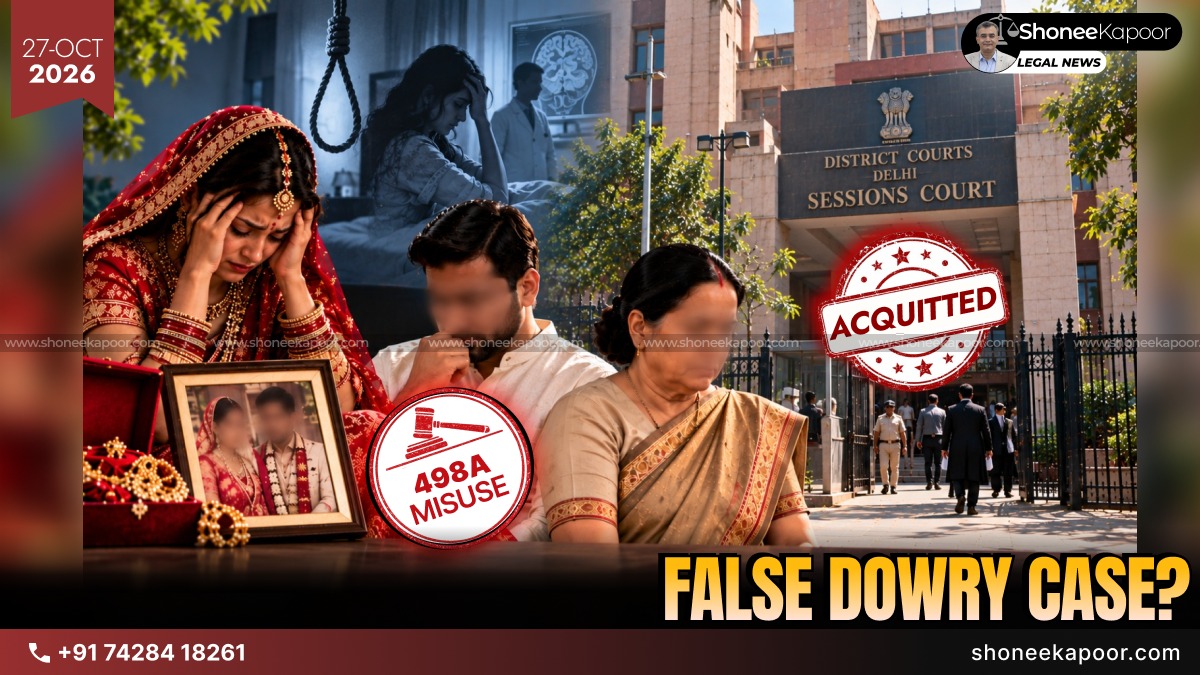
498A And Dowry Death Laws Misuse? Husband And His Mother Acquitted After 10 Years As Prosecution Fails To Prove Charges: Delhi Sessions Court

Curated by NEWS DESK
Editorial DeskNEW DELHI: A Delhi court has acquitted a husband and his mother in a dowry death case registered in 2016, holding that the prosecution failed to prove dowry-related harassment or cruelty shortly before the woman's death.
Additional Sessions Judge Hargurvarinder Singh Jaggi, in an order dated 24 October 2026, ruled that the allegations of dowry death, cruelty and abetment of suicide were not supported by sufficient evidence.
The case arose after a married woman was found hanging at her matrimonial home in South Delhi in September 2016, within seven months of her marriage. The postmortem report confirmed that she died due to asphyxia caused by hanging.
Following her death, her father alleged that she had suffered physical and mental harassment over dowry demands, loan repayments and jewellery. The prosecution claimed that her husband and in-laws had pressured her to obtain loans and misappropriated her wedding jewellery.
However, during the trial, the defence produced medical records showing that the woman had received psychiatric treatment for acute and transient psychosis between April and August 2016.
The Court noted that her psychiatrist had recommended immediate hospitalisation. However, her prescribed psychiatric medication was discontinued while she was staying at her parental home, and she was subjected to exorcism instead of receiving the recommended hospital treatment.
The Court also examined forensic evidence, which showed no signs of physical struggle before her death.
Financial records further revealed that the husband's gold loan was being repaid regularly, weakening the allegations of financial harassment.
After examining the evidence, the Court found that the prosecution had failed to establish any direct connection between the alleged dowry demands and the woman's death.
The Court observed:
"The prosecution has failed to prove any proximate dowry harassment ‘soon before death’. Furthermore, no evidence of abetment under IPC Section 306 or criminal breach of trust under Section 406 IPC has been adduced,"
The Court further held that the statutory presumption of dowry death had been rebutted by the defence evidence.
It also found that the allegations of dowry demands and financial harassment were vague and lacked sufficient supporting evidence.
Consequently, the Delhi court acquitted the husband and his mother of the criminal charges, holding that the prosecution had failed to establish their guilt beyond reasonable doubt.
EXPLANATORY TABLE OF LAWS AND SECTIONS
| Law / Section | What It Means | Relevance in This Case |
|---|---|---|
| Section 498A, IPC | Punishes cruelty by a husband or his relatives towards a married woman. | The husband and mother-in-law faced allegations of cruelty and dowry harassment. |
| Section 304B, IPC | Deals with dowry death where the required connection between dowry-related cruelty or harassment and an unnatural death within seven years of marriage is established. | The Court found that dowry-related harassment soon before death was not proved. |
| Section 306, IPC | Punishes abetment of suicide. | The prosecution failed to establish evidence of abetment. |
| Section 406, IPC | Punishes criminal breach of trust involving dishonest misuse or misappropriation of entrusted property. | The Court found no evidence supporting criminal breach of trust concerning the alleged jewellery misappropriation. |
| Section 113B, Indian Evidence Act, 1872 | Provides a statutory presumption of dowry death when the required foundational facts are established. | The Court held that the presumption of dowry death stood rebutted by defence evidence. |
CASE DETAILS
| Particular | Details |
|---|---|
| Case Title | State v. Husband & Mother-in-Law |
| Court | Delhi Sessions Court |
| Bench | Additional Sessions Judge Hargurvarinder Singh Jaggi |
| Order Date | 24 October 2026 |
| Accused | Husband, Mother-in-law |
| Marriage Date | 24 February 2016 |
| Date of Death | 20 September 2016 |
| Result | Husband and mother-in-law acquitted of the criminal charges |
KEY TAKEAWAYS
- 10 Years of Harassment, Finally Acquitted- A husband and his mother faced nearly a decade of criminal proceedings over charges the prosecution could not prove.
- Marriage Is Not Proof of Murder- A wife's unnatural death within seven years of marriage cannot automatically make her husband and in-laws guilty of dowry death.
- Evidence Exposed Weaknesses in the Case- Psychiatric records, forensic findings and financial evidence undermined the prosecution's allegations.
- Allegations Are Not Evidence- Vague dowry harassment claims cannot replace proof of cruelty, abetment or criminal wrongdoing.
- Acquitted After 10 Years, But Who Pays the Price? Who will compensate the husband and his mother for years of legal battles, damaged reputation and mental suffering?
Share Your Thoughts
Comments are moderated before publication.