
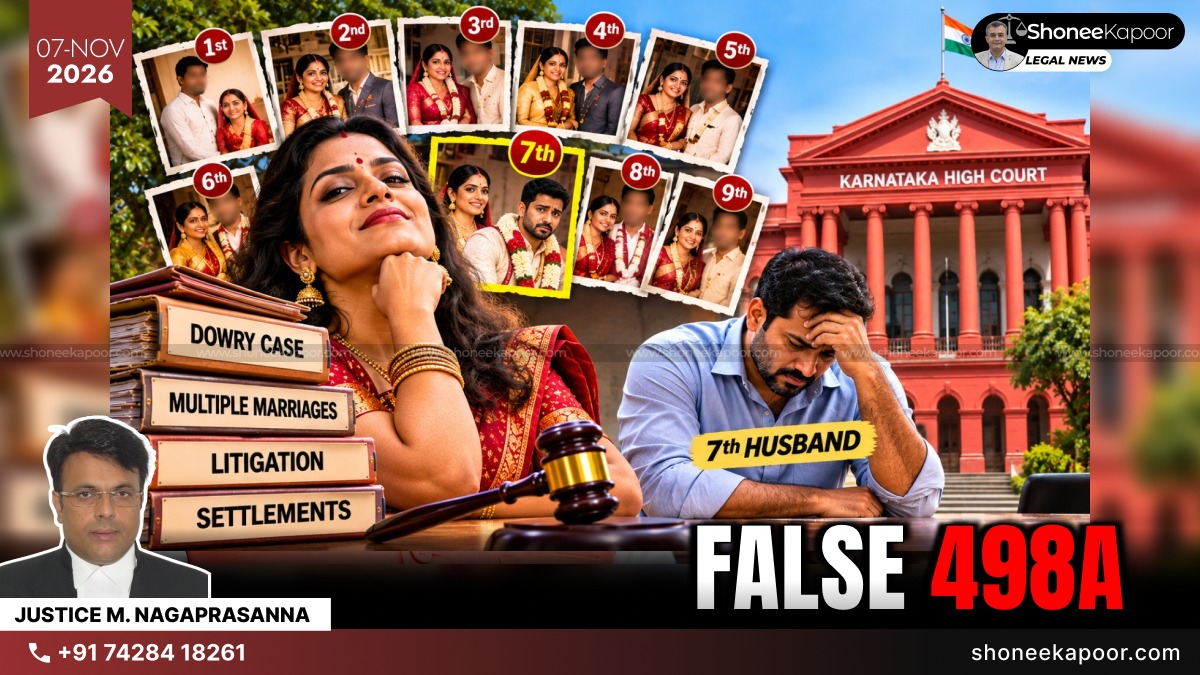
False 498A Case Filed By Woman Who Married ‘9 Times’: Karnataka High Court Quashes Cruelty Case Against ‘7th Husband’

Curated by NEWS DESK
Editorial DeskKARNATAKA: The Karnataka High Court has quashed criminal proceedings against a 47-year-old husband accused of dowry harassment and matrimonial cruelty by his 30-year-old wife. The Court examined allegations that the woman had married nine times, with the accused being her seventh husband.
Justice M. Nagaprasanna allowed the husband's petition to quash the criminal case. The Court considered the woman's alleged history of multiple marriages, matrimonial disputes, criminal complaints and financial settlements.
The couple married in 2022 through a mutual friend and briefly lived together with the husband's family. However, matrimonial disputes soon arose, following which the wife filed a dowry harassment and cruelty complaint against her husband and his family members.
During the investigation, the police filed a charge sheet against the husband but dropped the other family members from the case. The trial court subsequently took cognisance of the alleged offences, prompting the husband to approach the Karnataka High Court.
The husband argued that his wife had repeatedly entered into marriages, followed by matrimonial litigation and financial settlements. He alleged that this pattern indicated misuse of criminal proceedings for monetary benefit.
The High Court observed:
“The sequence, as projected by the petitioner, is striking. One marriage follows another; matrimonial discord is followed by litigation, which in several instances is followed by settlement; and the matrimonial journey thereafter proceeds to yet another alliance.”
The Court further recorded the husband's allegation:
“The petitioner contends that this recurring course of conduct is not an accidental concatenation of matrimonial misfortunes, but discloses a pattern in which a criminal process is allegedly employed to secure monetary advantage,”
However, the wife's counsel denied these allegations, claiming that the marriage certificates were fake and the photographs were morphed. She also alleged that the husband, being a politician, had the means to manipulate such documents.
Her counsel acknowledged four marriages but maintained that the woman had legally ended her previous marriages through divorce, talaq or khula before marrying again.
The wife further argued that sufficient evidence existed to establish dowry-related cruelty and that the criminal proceedings should continue.
The Karnataka High Court examined whether the complaint and investigation material disclosed the essential ingredients of the alleged offences. The Court observed that forcing an accused person to face a criminal trial without sufficient legal grounds serves no legitimate purpose, particularly when the allegations and available material fail to establish the necessary ingredients of the offences.
Accordingly, the High Court quashed the criminal proceedings against the husband, granting him relief from the dowry harassment and matrimonial cruelty case.
EXPLANATORY TABLE OF LAWS AND SECTIONS
| Law / Section | What It Means | Relevance To This Case |
|---|---|---|
| Section 498A IPC | Cruelty against a married woman by her husband or his relatives. | Main cruelty allegation against Hussain. |
| Section 323 IPC | Punishment for voluntarily causing hurt. | Alleged physical assault. |
| Section 504 IPC | Intentional insult intended or likely to provoke breach of peace. | Alleged abusive conduct. |
| Section 506 IPC | Punishment for criminal intimidation. | Alleged threats against the complainant. |
| Section 34 IPC | Joint criminal liability for acts done with common intention. | Invoked with the original allegations involving family members. |
| Section 482 CrPC | High Court's inherent power to prevent abuse of judicial process and secure justice. | The husband used it to seek quashing. |
| Sections 384, 420, 494 and 495 IPC | Extortion, cheating, bigamy and concealment of an earlier marriage. | Invoked in the separate criminal complaint filed by Hussain. |
| Sections 418, 419 and 464 IPC | Cheating with knowledge of likely wrongful loss, cheating by personation and making a false document. | Mentioned in earlier matrimonial litigation. |
| Protection of Women from Domestic Violence Act, 2005 | Provides civil remedies for domestic violence. | Mentioned in proceedings involving an earlier marriage. |
CASE DETAILS
| Particular | Details |
|---|---|
| Case Title | RH v. State of Karnataka & Another |
| Court | Karnataka High Court, Bengaluru |
| Bench | Justice M. Nagaprasanna |
| Case Number | Criminal Petition No. 4532 of 2024 |
| Judgment Date | 4 November 2026 |
| Reserved On | 18 August 2026 |
| Petitioner's Counsel | Sri Parameswarappa C. |
| State Counsel | Sri K. Nageshwarappa, HCGP |
| Complainant's Counsel | Smt. Haleema Ameen |
| Police Station | Udupi Women Police Station |
| Trial Court Case | C.C. No. 2125/2023 |
| Outcome | Criminal proceedings quashed |
KEY TAKEAWAYS
- Karnataka HC Quashes 498A Case: Seventh husband gets relief from dowry harassment and cruelty allegations.
- Nine Marriages, Multiple Cases: Court examined the woman's history of repeated marriages, matrimonial disputes and settlements.
- Criminal Law Cannot Become a Money-Making Tool: Husband alleged that matrimonial complaints were used to secure financial settlements.
- Allegations Alone Cannot Justify Trial: The Court stressed that criminal prosecution requires material disclosing the essential ingredients of an offence.
- Men Deserve Protection Against Legal Misuse: Matrimonial laws must protect genuine victims, not become instruments of harassment against husbands.
Share Your Thoughts
Comments are moderated before publication.