
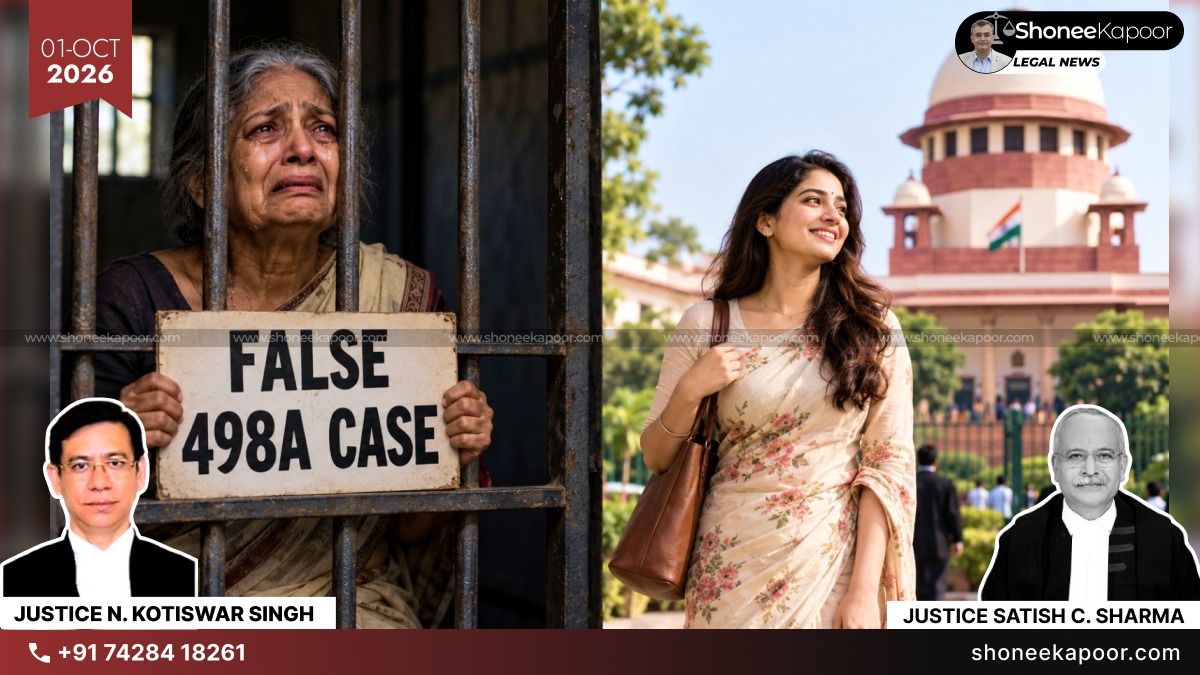
498A Is Not A Licence To Drag The Husband’s Entire Family To Court; Mere Taunts Not Enough To Prosecute Mother-In-Law: Supreme Court

Written and analysed by Vaibhav Ojha
Head Of Legal CommunicationsNEW DELHI: The Supreme Court has quashed criminal proceedings against a mother-in-law in a matrimonial dispute after finding that the allegations against her were general and the investigation did not disclose any specific act that could satisfy the ingredients of the offences alleged.
A Bench of Justices Satish Chandra Sharma and N. Kotiswar Singh dealt with the case of Prabha Devi, who had been booked along with her son and other family members under Sections 341, 323, 498A and 504 read with Section 34 of the Indian Penal Code. The corresponding provisions under the Bharatiya Nyaya Sanhita are Sections 126(2), 115(2), 85 and 352 read with Section 3(5).
The Court stressed the need for caution before relatives of a husband are made to face a criminal trial in a matrimonial dispute on the basis of broad or omnibus allegations. A criminal case against a particular accused must be supported by allegations and material that disclose the essential ingredients of the offences alleged against that person.
The complainant had married the appellant’s son on November 22, 2015. The couple ordinarily lived in Pune. According to the allegations, during the Covid-19 period in 2020, they shifted to the family residence in Saran district, where the complainant alleged that she was harassed.
She accused her husband, father-in-law, brother-in-law and mother-in-law of beating her. She also alleged that jewellery kept in an almirah had gone missing.
However, while examining the material collected during the investigation, the Supreme Court found no specific demand for property attributed to Prabha Devi and no particular act showing cruelty of the nature required under Section 498A IPC.
The Court explained that Section 498A requires a factual foundation showing wilful conduct of such a nature as is likely to drive a woman to suicide or cause grave injury or danger to her life, limb or health.
The Bench specifically observed:
“Mere collective allegations of taunting or opposition to a marriage without specific individual acts do not suffice to sustain a criminal charge,”
The statements of the complainant’s parents mainly related to the matrimonial dispute between the husband and wife. The Court noted that these statements did not attribute any specific property demand or distinct act causing hurt to the mother-in-law.
The investigation also included statements from six persons from the neighbourhood. They stated that the complainant ordinarily lived in Pune and that they had neither seen nor heard about harassment by the in-laws. The record also showed no recovery of the allegedly missing jewellery and no injury report.
Read Also:- Section 498A Ipc Judgements
Despite this material, a common charge sheet had been filed against the husband and four of his relatives.
The accused family members approached the Patna High Court seeking quashing of the criminal proceedings. The High Court quashed the proceedings against the father-in-law, brother-in-law and sister-in-law after finding that the allegations against them were general and omnibus.
However, the proceedings against Prabha Devi were not quashed. The High Court also directed her and her son to participate in mediation, granted interim protection for four months and linked continuation of that protection to responsibility for failure of the mediation process.
Prabha Devi challenged the High Court’s November 10, 2025 order before the Supreme Court.
While considering Section 498A IPC, the Supreme Court referred to the principles laid down in State of Haryana v. Bhajan Lal (1992) and Kahkashan Kausar alias Sonam v. State of Bihar (2022).
The Court found that the necessary ingredients of Section 498A were not disclosed against the mother-in-law. No unlawful demand was specifically attributed to her and the general allegations did not identify conduct reaching the statutory threshold of cruelty.
The Bench observed:
“The collective allegations of taunting, opposition to the marriage and harassment do not state the particular conduct of the appellant or disclose wilful conduct of the degree contemplated by the provision,”
The Court also considered the later allegation that the mother-in-law had failed to restrain her son. It held that such an assertion, without a supporting factual foundation in the FIR or investigation material, could not by itself establish cruelty or common intention.
The Supreme Court separately examined the other offences alleged against Prabha Devi.
For Section 341 IPC, relating to wrongful restraint, the Court found that no specific act of wrongful restraint had been attributed to her.
Regarding Section 323 IPC, the detailed allegations of physical assault were attributed to the father-in-law and brother-in-law. The High Court had already quashed the proceedings against them.
Read Also:- How to benefit from recent Supreme Court Judgment on False IPC 498A
For Section 504 IPC, the Supreme Court explained that intentional insult requires specific words or facts showing an intentional insult of the nature likely to provoke a breach of peace.
The Bench said:
“Vague allegations in the FIR that do not specify these elements fail to satisfy the legal requirements for this charge,”
No specific act of intentional insult likely to provoke a breach of peace was attributed to Prabha Devi.
The Court further found that the remaining allegations against all the accused were undifferentiated. They did not identify any particular act committed by the mother-in-law, and the investigation had not produced material that could particularise those allegations against her.
The Supreme Court also questioned why the High Court had granted relief to the other relatives but not to the mother-in-law despite the nature of the allegations.
Read Also:- Section 498a: Myth Buster | FAQs on 498A | Detailed Information on 498A IPC
The Bench observed:
“However, the high court, while quashing the proceedings against the other in-laws, did not distinguish the case of the appellant or record any reason for denying the relief of quashing qua the appellant,”
The Supreme Court accordingly allowed Prabha Devi’s appeal, set aside the High Court order insofar as it concerned her, and quashed the FIR and consequential criminal proceedings against her.
Importantly, the Court clarified that the relief granted to the mother-in-law would not affect the criminal proceedings against the husband. His case will be considered independently on its own merits.
Read Also:- False 498A Case | Lack Of Communication Or Refusal To Cohabit Is Not Cruelty: Jharkhand High Court Sets Aside Husband’s Conviction
EXPLANATORY TABLE- LAWS & SECTIONS EXPLAINED
| SECTION | LAW | WHAT IT COVERS | WHAT SUPREME COURT FOUND |
|---|---|---|---|
| Section 498A IPC | Indian Penal Code, 1860 | Cruelty by husband or his relatives | No unlawful demand or specific wilful conduct of the required degree was attributed to the mother-in-law. |
| Section 341 IPC | IPC | Wrongful restraint | No act of wrongful restraint was attributed to Prabha Devi. |
| Section 323 IPC | IPC | Voluntarily causing hurt | Specific assault allegations were against the father-in-law and brother-in-law; allegations against all accused collectively were undifferentiated. |
| Section 504 IPC | IPC | Intentional insult with intent/knowledge likely to provoke breach of peace | Neither specific words nor facts showing the required intentional insult were stated against her. |
| Section 34 IPC | IPC | Acts done by several persons in furtherance of common intention | Could not supply the missing essential facts of the principal offences. |
| Section 354 IPC | IPC | Assault/criminal force to woman with intent to outrage modesty | Appeared in the original FIR, but was not included in the charge-sheet mentioned by the Court. |
| Section 379 IPC | IPC | Theft | Appeared in the original FIR. After investigation, no charge under Section 379 was filed and no jewellery was recovered. |
CASE DETAILS
| Case Title: | Prabha Devi v. The State of Bihar & Ors. |
| Court: | Supreme Court of India, Criminal Appellate Jurisdiction |
| Case: | Criminal Appeal arising out of SLP (Criminal) No. 3845 of 2026 |
| Date of Order: | 8 September 2026 |
| Impugned Order: | Patna High Court order dated 10 November 2025 in Criminal |
| FIR: | FIR No. 20 of 2024 dated 27 March 2024, Mahila Police Station, Saran. |
| Charge-sheet: | Charge-sheet No. 36 of 2024 dated 22 July 2024. |
| Trial Case: | T.R. No. 3763 of 2024. |
| Bench: | Justice Satish Chandra Sharma & Justice Nongmeikapam Kotiswar Singh |
COUNSELS
For Petitioner/Appellant:
- Ms. Surabhi Sanchita, AOR
- Mr. Pratap Singh, Advocate
For Respondents:
- Mr. Azmat Hayat Amanullah, AOR
- Ms. Vanshita Gupta, Advocate
- Mr. S. Parthasarathi, AOR
KEY TAKEAWAYS
- 498A Is Not A Family Package: A husband’s relatives cannot be dragged into criminal trial merely because they are related to him.
- General Allegations Are Not Enough: The Supreme Court found no specific unlawful demand or qualifying act of cruelty attributed to the mother-in-law.
- Investigation Found Crucial Gaps: Six neighbours did not support the harassment allegations, while there was no injury report or recovery of jewellery.
- Yet A Common Chargesheet Followed: Despite the lack of individualised material, the husband and four in-laws were chargesheeted together.
- Supreme Court Finally Quashed It: The Court held that continuing prosecution against the mother-in-law would be an “abuse of the process of law.” The husband, however, must still face his case separately on merits.
Share Your Thoughts
Comments are moderated before publication.