
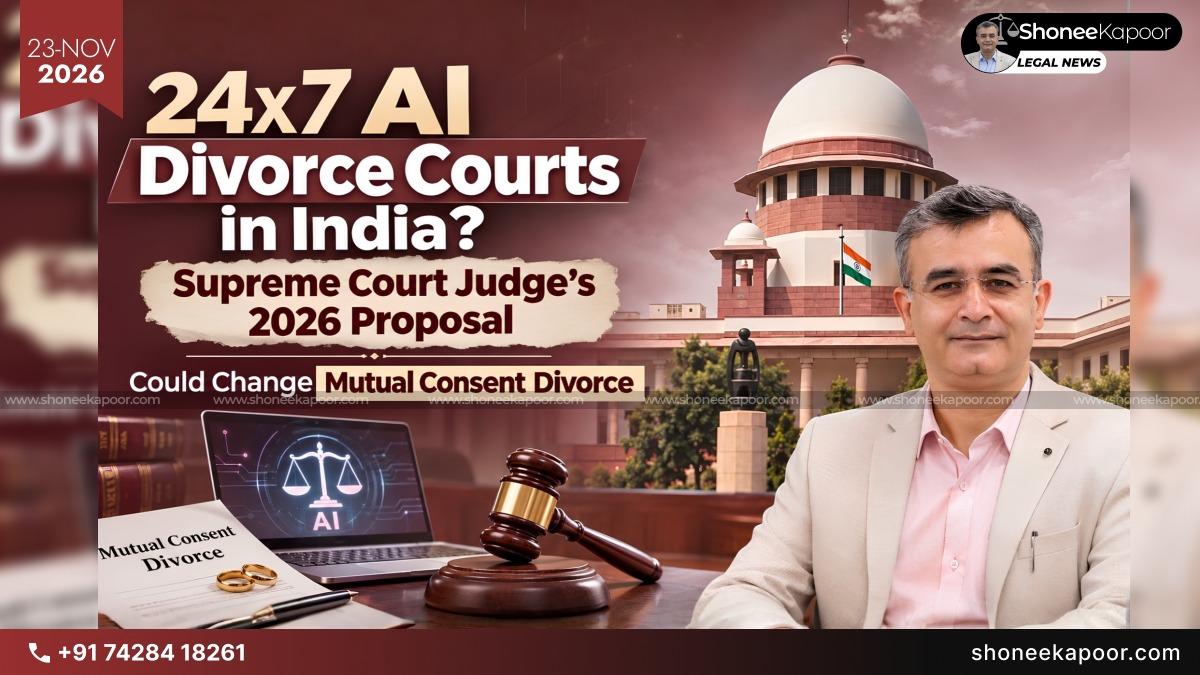
24x7 AI Divorce Courts in India? Supreme Court Judge's 2026 Proposal Could Change Mutual Consent Divorce

Written and analysed by Vaibhav Ojha
Head Of Legal CommunicationsNEW DELHI: Can artificial intelligence make divorce faster without compromising justice?
On 21 November 2026, Supreme Court Justice Joymalya Bagchi proposed the creation of 24×7 AI divorce courts for mutual consent divorce cases. Speaking at the Just Tech National Conclave organised by Dharmashastra National Law University in Jabalpur, the judge suggested using artificial intelligence to reduce routine judicial work and improve access to justice.
His suggestion could become one of the most significant conversations about the future of matrimonial litigation in India.
For thousands of couples whose marriages have already broken down, every additional hearing can mean more expenses, uncertainty and emotional distress. For husbands facing prolonged matrimonial litigation, repeated adjournments and unresolved settlements can also become serious financial and legal burdens.
But there is one fact that must not be ignored.
India has not introduced 24×7 AI divorce courts. This is a judicial proposal, not an operational court system or a binding Supreme Court judgment.
The real question is whether India's existing divorce laws, Supreme Court judgments and judicial safeguards can support such a change.
What Did Justice Joymalya Bagchi Say About 24×7 AI Divorce Courts?
Justice Bagchi made the proposal at the Just Tech National Conclave in Jabalpur on 21 November 2026.
According to the contemporaneous report published by Bar & Bench, he suggested that mutual consent divorce matters could be separated from other judicial work and handled through dedicated AI-driven systems.
He specifically spoke of the need to:
"Hive off the mutual divorce cases and have 24/7 AI divorce courts"
The proposal was based on the idea that judges should spend less time on predictable procedural work and more time deciding disputes requiring human reasoning.
Justice Bagchi also discussed possible AI assistance with hearing schedules, procedural directions, filing-related work and case management.
However, he emphasised the importance of preserving human judgment in substantive adjudication, particularly constitutional matters.
Important distinction: These observations were made at a public legal conclave, not during the delivery of a Supreme Court judgment. There is therefore no Supreme Court order copy establishing AI divorce courts to download.
What Are 24×7 AI Divorce Courts?
The proposed system would use artificial intelligence to assist in processing mutual consent divorce matters without restricting every procedural step to ordinary court working hours.
In a carefully designed system, AI could potentially assist with:
- Checking whether the divorce petition and accompanying documents are complete.
- Identifying missing affidavits, declarations and settlement documents.
- Assisting with hearing dates, reminders and case scheduling.
- Organising settlement terms relating to maintenance, permanent alimony and child custody.
- Preparing procedural drafts for examination by authorised court personnel.
- Reducing repetitive administrative work that presently consumes judicial resources.
However, document processing and judicial decision-making are not the same thing.
A divorce decree affects marital status, legal rights, finances, children and future relationships. Authentic consent and compliance with statutory requirements must be examined by a legally competent court.
A computer cannot simply declare two people divorced because they have uploaded an agreement.
Is Mutual Consent Divorce Through AI Legal in India in 2026?
No independent, fully automated AI divorce court has been established under the existing Indian matrimonial law framework.
Mutual consent divorce continues to be governed by the applicable marriage statute and judicial procedure.
For Hindu marriages, Section 13B of the Hindu Marriage Act, 1955, provides the principal legal framework.
For marriages governed by the Special Marriage Act, 1954, the relevant provision is Section 28.
Under Section 13B of the Hindu Marriage Act, the ordinary requirements include agreement between the spouses to dissolve the marriage, their inability to live together, and the prescribed separation period.
The law also provides for a second motion and judicial satisfaction before a divorce decree is granted.
The normal statutory timetable includes a one-year separation requirement before the first motion and a six-month interval before the second motion, subject to the important judicial developments discussed below.
Another provision, Section 14 of the Hindu Marriage Act, generally restricts presentation of a divorce petition within one year of marriage, while permitting an exception for exceptional hardship or exceptional depravity.
These are distinct legal requirements and should not be confused.
An AI platform cannot independently waive statutory requirements. Waiver depends on the applicable law and the jurisdiction of the competent court.
Read the actual statutes:
Hindu Marriage Act, 1955 — Official India Code PDF
Special Marriage Act, 1954 — Official India Code PDF
Family Courts Act, 1984 — Official India Code PDF
For the present procedure, documents and practical requirements, read my detailed guide: Mutual Consent Divorce in India 2026 — Process, Documents, Costs and Timeline.
Supreme Court Judgments That Have Already Made Mutual Consent Divorce Faster
Long before the latest AI court proposal, the Supreme Court recognised that a statutory waiting period should not always prolong a marriage that has genuinely broken down.
The following judgments are especially important.
1. Amardeep Singh v. Harveen Kaur (2017): Six-Month Cooling-Off Period Can Be Waived
Supreme Court | 12 September 2017 | (2017) 8 SCC 746
In this landmark judgment, the Supreme Court held that the six-month waiting period under Section 13B(2) of the Hindu Marriage Act is directory, not mandatory.
The Court explained that the purpose of the cooling-off period is to allow reconciliation, not to unnecessarily prolong the suffering of spouses when reunion is no longer possible.
The Court identified relevant considerations, including unsuccessful reconciliation efforts, genuine settlement of disputes, and whether further waiting would serve any purpose.
It also recognised that an application seeking waiver could be filed after the first motion, subject to judicial discretion.
What this means for husbands: Where the marriage has genuinely failed and both spouses have voluntarily settled their disputes, a husband need not automatically accept six additional months of waiting without exploring a lawful waiver application.
However, waiver is not automatic. The court must examine the facts.
Original judgment: Supreme Court — Amardeep Singh v. Harveen Kaur, 12 September 2017 (PDF)
2. Amit Kumar v. Suman Beniwal (2021): Supreme Court Corrects a Rigid Interpretation
Supreme Court | 11 December 2021 | Civil Appeal No. 7650 of 2021
This case demonstrates how a rigid interpretation of procedural requirements can prolong a marriage unnecessarily.
An IPS officer and an IFS officer married on 10 September 2020 but separated just three days later.
After more than a year of separation, they sought divorce by mutual consent.
The Family Court refused to waive the six-month cooling-off period. The Punjab and Haryana High Court also declined relief because the couple had not completed one-and-a-half years of separation before the first motion.
The Supreme Court disagreed with this mechanical interpretation.
It clarified that the considerations identified in Amardeep Singh were illustrative, not exhaustive, and that the judgment should not be applied as though every factor were an inflexible statutory condition.
Considering the circumstances, the Supreme Court granted the parties a divorce by exercising its powers under Article 142.
What this means for husbands: Courts must examine the substance of a failed marriage rather than mechanically applying an additional waiting requirement that the Supreme Court has not made absolute.
This judgment does not mean every couple is entitled to an immediate divorce. The facts, settlement and possibility of reconciliation remain relevant.
Original judgment: Supreme Court — Amit Kumar v. Suman Beniwal, 11 December 2021 (PDF)
3. Shilpa Sailesh v. Varun Sreenivasan (2023): Supreme Court Can Dissolve a Marriage Under Article 142
Supreme Court Constitution Bench | 1 May 2023
A five-judge Constitution Bench examined the Supreme Court's extraordinary constitutional powers in matrimonial disputes.
The Court held that it can exercise Article 142 of the Constitution to dissolve a marriage on the ground of irretrievable breakdown in an appropriate case, after considering the relevant circumstances.
Such relief may be granted even where one spouse opposes dissolution, provided the Court is satisfied that the exceptional exercise of its power is justified.
The judgment also dealt with the Supreme Court's ability to address connected matrimonial proceedings when necessary to do complete justice.
What this means for husbands: The Supreme Court can intervene in exceptional matrimonial situations where continuing the legal relationship would serve no meaningful purpose.
But Article 142 is an extraordinary power of the Supreme Court. It does not give Family Courts, High Courts or an AI system the same authority to dissolve every broken marriage merely because reconciliation appears impossible.
Original judgment: Supreme Court Constitution Bench — Shilpa Sailesh v. Varun Sreenivasan, 1 May 2023 (PDF)
Delhi High Court's Major Ruling: Even One-Year Separation Can Be Waived in Exceptional Cases
Shiksha Kumari v. Santosh Kumar (2025)
Delhi High Court Full Bench | 17 December 2025 | MAT.APP.(F.C.) 111/2025
A Full Bench of the Delhi High Court delivered an important judgment concerning the one-year separation requirement under Section 13B(1) of the Hindu Marriage Act.
The judgment opened with a striking judicial question about whether courts must keep unwilling spouses in a matrimonial relationship rather than allowing a lawful exit.
The Court used the phrase:
"not into marital bliss, but into a matrimonial abyss"
The Bench, comprising Justices Navin Chawla, Anup Jairam Bhambhani and Renu Bhatnagar, held that the one-year separation requirement for presenting the first motion may be waived by applying the proviso to Section 14(1).
Crucially, the Full Bench also clarified that:
- The one-year separation requirement and the six-month cooling-off period are separate matters.
- Both may be considered for waiver independently.
- In an appropriate case, a divorce decree need not be postponed merely to complete the otherwise prescribed separation period.
- Waiver cannot be obtained simply because the parties request it.
The Court emphasised exceptional hardship or exceptional depravity and the need for judicial examination of the circumstances.
What this means for husbands: An appropriate case involving genuine hardship may warrant consideration of an earlier divorce. But this is a Delhi High Court ruling applying specific statutory provisions, not a general declaration that all waiting periods throughout India have disappeared.
Original judgment: Delhi High Court Full Bench — Shiksha Kumari v. Santosh Kumar, 17 December 2025 (Official PDF)
Detailed coverage: One-Year Separation for Mutual Consent Divorce: Delhi High Court Explains Waiver
A Real 2026 Courtroom Exchange Shows Why AI Cannot Replace Judicial Scrutiny
Manpreet Singh v. Harleen Kaur Khurana (2026)
Delhi High Court | 14 October 2026 | CONT.CAS(C) 752/2022
This case illustrates a problem that an automated divorce system cannot safely resolve by checking documents alone.
The dispute concerned a matrimonial settlement, a court-recorded undertaking and ₹20 lakh paid by the husband.
The parties had pursued mutual consent divorce proceedings, but further disagreements arose and the divorce did not proceed as originally contemplated.
During the arguments, the Court examined the wife's position.
The actual judicial order records that she was asked whether she wanted to live with her husband or wanted a divorce. Her answer to both questions was negative.
This is not a reconstructed dialogue or an invented courtroom exchange. It is recorded in paragraph 48 of the signed judgment.
Justice Neena Bansal Krishna examined the conduct of the parties and held the wife guilty of contempt for wilfully breaching her court-recorded undertaking.
The Court directed her to refund ₹20 lakh within six weeks, without ordering interest.
The judgment is significant for another reason.
A spouse cannot simply be forced to give consent to a mutual divorce. However, withdrawal of consent does not necessarily eliminate the legal consequences of a separate, wilfully breached undertaking given to the court.
The consequences depend on the settlement, the undertaking and the particular facts. It would be incorrect to suggest that every withdrawal of consent amounts to contempt.
From a men's rights perspective, this case highlights the danger of paying substantial settlement money before ensuring that enforceable safeguards and payment milestones are properly structured.
An automated platform might verify that ₹20 lakh was paid. But determining whether a court undertaking was wilfully breached, whether a spouse acted voluntarily, and what relief is legally justified requires judicial assessment.
Court order copy: Delhi High Court — Manpreet Singh v. Harleen Kaur Khurana, 14 October 2026 (Signed Order PDF)
Detailed case report: Delhi High Court Orders Wife to Refund ₹20 Lakh After Divorce Settlement Dispute
Can a Spouse Withdraw Consent After Filing Mutual Consent Divorce?
This is another serious question for any proposed AI divorce court.
In Sureshta Devi v. Om Prakash, (1991) 2 SCC 25, the Supreme Court explained that mutual consent must remain legally relevant until the divorce decree is passed.
The Court also clarified that spouses can be considered to be living separately even when they reside under the same roof, provided they are not living as husband and wife.
The law does not treat a signed divorce agreement as an automatic dissolution of marriage.
Subsequent judgments have addressed withdrawal of consent, court-recorded undertakings and the Supreme Court's extraordinary powers in different factual settings.
Therefore, an AI platform should not presume continuing consent merely because both spouses signed the first motion months earlier.
Judgment text: Sureshta Devi v. Om Prakash — Supreme Court Decision
Supreme Court's 2026 Draft AI Regulations: Human Judges Must Remain in Control
There is an important development that must be considered alongside Justice Bagchi's latest proposal.
In June 2026, the Supreme Court published proposed regulations governing the use of artificial intelligence in judicial processes.
The document is titled Draft Guidelines/Regulations for Use of AI in Courts, and its provisions address human oversight, transparency, privacy and accountability.
The draft envisages AI assisting with functions such as case management, document examination, transcription, translation and legal research.
But it also states that judicial authority must remain with human judges and proposes prohibitions against decisions being reached solely through algorithmic systems.
It specifically addresses risks involving unreliable outputs, bias, privacy and automated adjudication.
This document is a draft regulatory proposal, not a final enactment authorising AI to issue divorce decrees independently.
Its approach is relevant because it illustrates the distinction between:
AI-assisted justice: Technology helps a court process matters efficiently.
AI-only justice: An algorithm independently makes a judicial determination.
The second proposition raises far more serious legal and constitutional concerns.
Official document: Supreme Court of India — Draft AI Regulations, June 2026 (PDF)
Why Men Should Support Faster Divorce but Demand Stronger Safeguards
As a men's rights activist, I support every genuine reform that reduces avoidable litigation and gives both spouses a fair opportunity to rebuild their lives.
But faster divorce must not become faster injustice.
Consider a husband who has agreed to a financial settlement after years of litigation. He may also be dealing with maintenance proceedings, child visitation disputes or separate criminal allegations.
If an AI divorce platform focuses only on obtaining electronic consent, it may overlook unresolved legal risks.
The system must not treat a settlement as fair merely because a document has been uploaded.
Five Safeguards Husbands Must Demand in AI Divorce Courts
1. Verified and Free Consent
Both parties must give genuine, informed and voluntary consent. Identity verification and safeguards against impersonation, coercion and manipulated digital records are essential.
2. Financial Settlement Protection
Alimony, maintenance, property transfer and refund obligations must be clearly recorded. Staggered payments or other lawful safeguards should be considered so that one party is not exposed unnecessarily when later obligations remain unfulfilled.
3. Child Custody and Father's Rights
Parenting arrangements, visitation, access and child support cannot be reduced to a routine automated checklist. The child's welfare remains paramount, and a father's relationship with his child deserves proper consideration.
4. Separate Criminal Cases Must Be Addressed Lawfully
A mutual divorce settlement does not automatically quash an FIR or terminate criminal proceedings.
Where quashing of connected proceedings is contemplated, appropriate relief must be sought before a competent court under the applicable law. A divorce decree alone is not a substitute.
5. Human Review, Privacy and Appeal Safeguards
Matrimonial records contain sensitive financial, medical and personal information. Access controls, reliable recordkeeping, meaningful judicial review and legally available remedies must remain central to any AI-assisted system.
These safeguards protect both spouses. Their importance is especially obvious when a husband's financial future, reputation or relationship with his children is at stake.
Will AI Divorce Courts Reduce False Cases, Maintenance Disputes and Custody Battles?
Not automatically.
AI could potentially reduce the time spent on incomplete filings, repeated scheduling and routine administrative processing.
But it cannot establish the truth of disputed allegations simply by analysing words in a petition.
A voluntary settlement can help resolve connected disputes. Yet contested allegations, maintenance claims, protection orders and custody issues may require separate judicial consideration.
There is also a practical distinction between a case genuinely suitable for mutual consent divorce and a case where consent is disputed.
If either spouse disputes the settlement, alleges coercion, raises an unresolved child welfare issue or withdraws consent, the matter may no longer be suitable for the same streamlined process.
An automated system must be able to recognise such situations and refer them for appropriate human judicial consideration.
Otherwise, technology could merely accelerate existing procedural unfairness instead of correcting it.
Could 24×7 AI Divorce Courts End Years of Matrimonial Litigation?
They could improve access to court services and reduce certain procedural delays if a lawful system is eventually designed and implemented.
Online document filing, automated scrutiny, case-status updates and better scheduling could provide genuine benefits, including for parties living in different states or abroad.
But an AI platform cannot remove every legal cause of delay.
Many matrimonial matters involve disputed income, unpaid settlement amounts, disagreements concerning children, and litigation pending before different courts.
These disputes require more than efficient software.
The need for judicial intervention will not disappear simply because some administrative functions become available throughout the day.
The real reform would be to make uncontested matters move faster without weakening scrutiny where a genuine dispute exists.
My View: A Failed Marriage Should Not Become a Lifelong Legal Punishment
A marriage may break down. That does not mean two people should spend years trapped in a legal process they both want to leave.
For many husbands, the cost is not limited to court fees.
There can be repeated travel, lost working days, legal expenditure, prolonged uncertainty and continuing disputes over finances or children.
Courts must protect genuine legal rights. But procedure should never become punishment.
Justice Bagchi's proposal is worth examining because it recognises the burden of routine judicial work.
However, an AI divorce court that merely processes consent without examining its authenticity could become another instrument of injustice.
The priority must be clear: faster procedures, reliable consent, enforceable settlement protections and meaningful judicial accountability.
Technology should reduce harassment through legal procedure, not give it a faster platform.
India needs an efficient matrimonial justice system in which a husband does not have to surrender his financial security, dignity or parental rights merely to obtain a lawful exit from a failed marriage.
And equally, neither spouse should be deprived of the opportunity to be heard where genuine rights remain disputed.
My conclusion is simple: Use AI to cut delays. Never use it to cut justice.
FAQs
1. Are 24×7 AI divorce courts available in India in 2026?
No. Justice Joymalya Bagchi proposed the idea in November 2026. It has not been implemented as an independent court system.
2. Can AI grant mutual consent divorce without a judge?
No such independent AI power currently exists under the applicable Indian matrimonial laws.
3. Can the six-month divorce cooling-off period be waived?
Yes. Courts may waive it in appropriate cases under Amardeep Singh and Amit Kumar. Waiver is not automatic.
4. Can mutual divorce be filed before completing one year of separation?
The Delhi High Court Full Bench has recognised exceptional waiver under Section 14(1). The ordinary statutory requirement otherwise remains relevant.
5. Can a wife or husband withdraw consent after the first motion?
Withdrawal of consent is legally significant before the decree. However, separate court-recorded settlement undertakings may carry legal consequences.
DISCLAIMER: This article distinguishes proposals from operative law and discusses judgments as of 23 November 2026. Its purpose is legal awareness, not advice for any specific pending case. The facts, governing marriage statute, territorial jurisdiction and latest court orders must be examined individually.





Share Your Thoughts
Comments are moderated before publication.