
144 BNSS Maintenance: Latest 2026 Supreme Court & High Court Judgments Every Husband Must Know

Written and analysed by Vaibhav Ojha
Head Of Legal CommunicationsNEW DELHI: Marriage does not give anyone an unconditional right over another person's earnings. Maintenance is a statutory remedy intended to provide financial support to eligible dependants, not an automatic financial liability arising merely from marriage.
Since Section 144 of the Bharatiya Nagarik Suraksha Sanhita, 2023 (BNSS), replaced Section 125 CrPC on 1 July 2024, several High Courts have examined the financial independence of wives, the rights of husbands to contest maintenance, retrospective arrears and the importance of proper financial disclosures.
From the Karnataka High Court setting aside a ₹20,000 monthly maintenance order in favour of an employed wife to the Supreme Court protecting a husband's right to have his adultery-related objections considered, recent judgments offer important legal remedies to men facing disputed maintenance claims.
However, husbands must understand the difference between challenging maintenance on legally sustainable grounds and simply refusing to fulfil their lawful obligations.
What is Section 144 BNSS?
Read Also:- Magistrate can Review Order passed u/s 125 CrPC
Section 144 BNSS provides maintenance for eligible wives, children and parents where a person having sufficient means neglects or refuses to maintain them.
For a wife claiming maintenance under Section 144(1)(a), her inability to maintain herself is an essential consideration.
Section 144 BNSS does not prescribe any fixed percentage of the husband's salary as maintenance.
The court must examine the applicable statutory conditions, financial circumstances, reasonable requirements and evidence presented by the parties.
Proceedings already pending before 1 July 2024 may continue under the old CrPC pursuant to the saving provisions of Section 531 BNSS.
Read the official BNSS, 2023 – Government of India
Read also: Section 125 CrPC Maintenance: 8 Judgments Favouring Husbands in 2026
When can a husband legally contest maintenance under Section 144 BNSS?
| Legal provision | Defence or legal remedy |
|---|---|
| Section 144(1)(a) BNSS | Wife has sufficient independent income to maintain herself. |
| Section 144(4) BNSS | Wife is living in adultery. |
| Section 144(4) BNSS | Wife refuses to live with her husband without sufficient reason. |
| Section 144(4) BNSS | Husband and wife are living separately by mutual consent, subject to applicable legal interpretation. |
| Section 144(5) BNSS | Cancellation of an existing maintenance order upon proof of statutory disqualification. |
| Section 145(2) BNSS | Application to set aside an ex parte maintenance order on sufficient grounds. |
| Section 146(1) BNSS | Modification of maintenance following a material change in circumstances. |
| Section 146(3) BNSS | Cancellation of maintenance in specified circumstances following divorce, including remarriage. |
These defences must be established through evidence. Allegations alone cannot defeat a lawful maintenance claim.
Latest Section 144 BNSS judgments granting relief to husbands
1. Financially independent wife cannot demand maintenance merely because her husband earns more: Karnataka High Court
Case: Shubhrath A.R. v. Chaithra M.
Court: Karnataka High Court
Judgment date: 30 October 2026
Bench: Justice Dr Chillakur Sumalatha
Case number: RPFC No. 231 of 2025
Provision: Section 144 BNSS
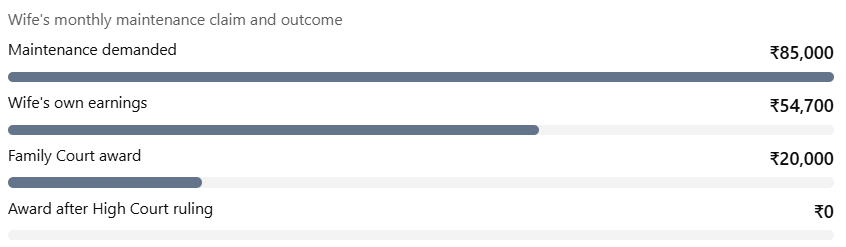
The wife approached the Family Court demanding ₹85,000 per month in maintenance despite earning ₹54,700 per month herself.
Her husband, a software professional, earned approximately ₹2 lakh per month and suffered from chronic medical conditions.
The Family Court directed him to pay ₹20,000 monthly maintenance primarily because his income was higher than his wife's.
The husband challenged the decision before the Karnataka High Court.
The High Court observed:
"Inability to maintain herself is a pre-condition to claim maintenance."
The Court examined the wife's financial disclosures, including her claim that she spent approximately ₹35,000 per month supporting her parents.
It held that the difference between the spouses' salaries did not, by itself, establish her financial dependence.
Final decision: The husband's revision was allowed, and the ₹20,000 monthly maintenance order was set aside. However, the husband was directed not to recover maintenance already paid.
Legal takeaway for husbands: A higher salary does not automatically make a man liable to maintain a financially self-sufficient wife.
Download Karnataka High Court judgment PDF
Read detailed judgment analysis on ShoneeKapoor.com
2. Husband granted relief from retrospective interim maintenance arrears: Allahabad High Court
Case: Raman Kumar v. State of U.P. & Another
Judgment date: 6 November 2026
Neutral citation: 2026:AHC:231943
Case number: Criminal Revision Defective No. 2072 of 2026
Provision: Section 144 BNSS
The Family Court at Kanpur Nagar directed the husband to pay ₹20,000 per month as interim maintenance from the date of application.
The husband challenged the order, arguing that the maintenance amount was disproportionate to his income.
During the High Court proceedings, his counsel requested that the retrospective arrears be kept in abeyance until the final disposal of the maintenance case.
The Allahabad High Court accepted this limited request.
Final decision: Recovery of interim maintenance arrears for the period preceding the Family Court's order dated 2 July 2026 was stayed until final adjudication.
The husband was required to continue paying monthly maintenance and clear the dues accruing from the date of that order. The Family Court was also directed to decide the main application preferably within six months.
Legal takeaway for husbands: Courts may grant conditional protection against immediate recovery of accumulated retrospective interim maintenance arrears. Such protection is not equivalent to permanent cancellation.
Read the complete Allahabad High Court order
3. Retrospective maintenance arrears stayed pending final decision: Allahabad High Court
Case: Shivendra Narayan v. State of U.P. & Others
Judgment date: 27 October 2026
Provision: Section 125 CrPC / Section 144 BNSS, as referred to in the order
The Family Court at Auraiya awarded the wife ₹10,000 per month as interim maintenance with effect from 12 November 2025.
The husband approached the High Court, disputing the financial burden imposed upon him.
The High Court stayed recovery of the retrospective interim maintenance arrears for the period between 12 November 2025 and 24 July 2026, subject to compliance with the continuing maintenance directions.
It also directed the Family Court to conclude the main maintenance proceedings preferably within six months.
Final decision: Conditional relief against retrospective arrears. The monthly maintenance award was not cancelled.
Legal takeaway for husbands: A properly framed application may provide temporary financial protection while the main maintenance dispute is adjudicated.
Read the complete High Court order
Important Supreme Court and High Court judgments applicable to Section 144 BNSS
The following judgments concern the corresponding provisions of the old CrPC or related procedural remedies. Their legal principles remain relevant to maintenance litigation under BNSS.
4. Wife living in adultery can lose interim and final maintenance: Supreme Court
Case: Himanshu Chordia v. State of Rajasthan & Another
Judgment date: 31 July 2026
Bench: Justice Sanjay Karol and Justice Vipul M. Pancholi
Neutral citation: 2026 INSC 778
Provision: Section 125(4) CrPC, corresponding to Section 144(4) BNSS.
The husband raised objections against his wife's maintenance claim and produced material concerning her alleged adulterous relationships.
The lower courts deferred consideration of the disputed adultery allegations until final adjudication of the maintenance proceedings.
The Supreme Court examined whether such statutory objections could be ignored at the interim stage.
The Court observed:
"If adultery is proved, the wife would neither be entitled to interim nor final maintenance"
The Supreme Court clarified that mere allegations of adultery cannot automatically defeat maintenance. However, clear and cogent evidence supporting a statutory disqualification deserves consideration at the appropriate stage.
Final decision: The husband's appeal was allowed, the Rajasthan High Court order was set aside and the matter was remanded for fresh adjudication. The Supreme Court did not conclusively establish adultery in this particular case.
Legal takeaway for husbands: Evidence supporting Section 144(4) BNSS objections should be placed before the court at the earliest appropriate stage.
Download Supreme Court judgment PDF
Read detailed Supreme Court judgment analysis
5. Husband can summon wife's employment and salary records: Rajasthan High Court
Case: Arvind Kumar v. Smt. Namita
Judgment date: 6 April 2026
Bench: Justice Baljinder Singh Sandhu
Neutral citation: 2026:RJ-JD:15612
Provisions: Sections 94 and 528 BNSS.
The husband alleged that his wife was employed as a nurse at a private hospital and earned approximately ₹80,000 per month.
However, the hospital refused to provide her employment details without her consent.
The husband filed an application under Section 94 BNSS seeking production of her employment and salary records. The Family Court rejected his application.
The Rajasthan High Court observed:
"If the petitioner had access to such documents, there would have been no need to invoke Section 94 BNSS."
The Court recognised that the wife's actual income was directly relevant to determining maintenance.
Final decision: The Family Court's rejection order was set aside, and the trial court was directed to obtain the relevant employment and salary information from the hospital.
Legal takeaway for husbands: If a wife allegedly conceals her employment or income, seek production of relevant financial records through the court instead of attempting to obtain confidential documents illegally.
Download Rajasthan High Court order PDF
Read detailed judgment analysis
6. Maintenance order set aside for fresh financial assessment: Gauhati High Court
Case: Chand Mahammad Ali v. Nurjahan Begum
Judgment date: 16 November 2026
Bench: Justice Michael Zothankhuma and Justice Nchumbemo Mozhui
Neutral citation: 2026:GAU-AS:16813
Case number: Crl. Rev. P. No. 491/2025
A 62-year-old husband challenged a Family Court order directing him to pay ₹3,000 monthly maintenance to his wife.
He claimed that he had no source of income and was unable to bear the financial liability imposed upon him.
The Gauhati High Court directed that both parties submit affidavits disclosing their assets and liabilities. It also directed that they be given an opportunity to cross-examine each other concerning their financial disclosures.
Final decision: The maintenance order dated 11 September 2025 was set aside and the matter was remanded for fresh consideration. The wife's ultimate entitlement was left open for adjudication.
Legal takeaway for husbands: Maintenance must be assessed through proper financial disclosure and fair consideration of the evidence.
Read complete Gauhati High Court order
7. Qualified dentist wife denied personal maintenance: Madhya Pradesh High Court
Case: RD v. GD
Judgment date: 12 October 2026
Bench: Justice Alok Awasthi
Neutral citation: 2026:MPHC-IND:29880
Case number: Criminal Revision No. 135 of 2026
A qualified dentist sought ₹2 lakh monthly maintenance from her husband.
The Family Court rejected her personal maintenance claim but awarded ₹30,000 monthly maintenance for their minor son.
The wife challenged the refusal, arguing that she had sufficient reasons to reside separately and that childcare responsibilities prevented her from working.
The Madhya Pradesh High Court upheld the Family Court's assessment of her individual circumstances and refused to interfere.
Final decision: Personal maintenance to the wife remained denied, while the child's ₹30,000 monthly maintenance was retained.
Legal takeaway for husbands: A wife's sufficient reason to live separately does not automatically establish her financial eligibility for maintenance. However, educational qualifications alone are not universally sufficient to defeat maintenance.
Read detailed judgment and access order copy
8. Financial disclosure and adjustment of multiple maintenance awards: Supreme Court
Case: Rajnesh v. Neha & Another
Judgment date: 4 November 2020
Citation: (2021) 2 SCC 324
Bench: Justice Indu Malhotra and Justice R. Subhash Reddy
Although delivered before BNSS came into force, this remains a foundational Supreme Court judgment governing maintenance proceedings in India.
The Supreme Court issued comprehensive directions concerning financial disclosure, overlapping maintenance proceedings, determination of maintenance amounts and enforcement.
The guidelines require consideration of:
- Income, assets and liabilities of both parties.
- Previous maintenance proceedings and existing awards.
- Independent income of the applicant.
- Reasonable expenses and financial responsibilities.
- Adjustment or set-off of overlapping maintenance awards.
- Relevant financial circumstances of the parties.
Legal takeaway for husbands: A wife may pursue maintenance under different applicable statutes, but previous awards must be disclosed and appropriate adjustment considered. Multiple proceedings should not result in unjustified double recovery.
Download original Supreme Court judgment PDF
Read complete judgment on ShoneeKapoor.com
Section 144 BNSS: important judgments at a glance
| Court and judgment | Relief or legal protection |
|---|---|
| Allahabad HC – Raman Kumar, November 2026 | Retrospective interim arrears conditionally stayed. |
| Gauhati HC – Chand Mahammad Ali, November 2026 | Maintenance order set aside for fresh assessment. |
| Karnataka HC – Shubhrath A.R., October 2026 | ₹20,000 monthly maintenance order set aside. |
| Allahabad HC – Shivendra Narayan, October 2026 | Conditional stay on retrospective arrears. |
| Madhya Pradesh HC – RD v. GD, October 2026 | Wife's personal maintenance denied. |
| Supreme Court – Himanshu Chordia, July 2026 | Adultery-related statutory objections must receive proper consideration. |
| Rajasthan HC – Arvind Kumar, April 2026 | Husband permitted to summon wife's salary records. |
| Supreme Court – Rajnesh v. Neha, November 2020 | Financial disclosure and adjustment of overlapping awards. |
When can maintenance be denied to a wife under Section 144(4) BNSS?
Section 144(4) specifically provides three statutory grounds of disqualification:
- Living in adultery.
- Refusing to live with the husband without sufficient reason.
- Living separately by mutual consent.
Under Section 144(5), an existing maintenance order must be cancelled when the applicable statutory disqualification is established.
However, separation alone is not sufficient. A wife may have legally sufficient reasons to reside separately, including cruelty or other circumstances recognised by law.
The statutory grounds must also be interpreted carefully where the claimant is a divorced wife.
Read also: Indian Law Every Husband Must Know: Reduction and Cancellation of Maintenance
Does a husband have to pay maintenance if his wife is earning?
Not necessarily.
The Karnataka High Court's October 2026 judgment demonstrates that a financially self-sufficient wife cannot establish maintenance entitlement merely by pointing to her husband's higher income.
However, employment does not automatically disqualify every wife.
In November 2026, the Gauhati High Court awarded ₹2,000 monthly maintenance to a working wife after examining her inadequate income and financial circumstances.
Therefore, husbands must establish actual financial independence rather than relying exclusively on educational qualifications, employment status or social media photographs.
Read also: Can Husband Stop Maintenance If Wife Is Working?
Is 25% of the husband's salary compulsory maintenance?
No. Section 144 BNSS does not prescribe a compulsory 25% salary formula.
Maintenance depends upon the facts of each case, including the income of both parties, reasonable needs, standard of living, dependants and legitimate financial liabilities.
However, husbands cannot create artificial financial liabilities to avoid maintenance.
In Deepa Joshi v. Gaurav Joshi, decided on 16 April 2026, the Supreme Court increased maintenance to ₹25,000 per month and held that loan repayments towards asset creation could not override the primary obligation to maintain an eligible spouse.
Download original Supreme Court judgment
How should husbands defend a Section 144 BNSS maintenance case?
| Evidence | Legal importance |
|---|---|
| Salary slips and ITRs | Establish actual income. |
| Wife's employment records | Establish independent earnings. |
| Bank statements | Identify relevant financial transactions. |
| Medical records | Establish genuine medical expenses or incapacity. |
| Previous maintenance orders | Seek appropriate adjustment of overlapping awards. |
| Lawfully obtained electronic evidence | Support statutory disqualification arguments. |
| Payment receipts | Establish maintenance already paid. |
| Evidence of dependent parents and children | Demonstrate genuine financial responsibilities. |
| Termination letter or revised salary records | Support modification where circumstances have materially changed. |
A husband should also file a complete and truthful financial affidavit in accordance with the Supreme Court's directions in Rajnesh v. Neha.
Concealing his own income, deliberately avoiding employment or ignoring court orders can seriously damage his defence.
Read also: How to Summon Wife's Salary, ITR, Bank and Employment Records
Conclusion: Maintenance is financial protection, not financial punishment
A husband's income must not become the sole basis for determining maintenance while the wife's independent earnings and the man's genuine financial responsibilities remain unexamined.
Recent judgments establish that husbands have legal remedies against unsupported maintenance demands, concealment of income, procedural unfairness and proven statutory disqualifications.
But rights must be exercised through evidence, proper pleadings and appropriate judicial remedies.
A man is responsible for his lawful obligations. He is not an unlimited source of income merely because he is married.
FAQ’S
1. Can a working wife claim maintenance under Section 144 BNSS?
Yes, if her income is insufficient and the other statutory conditions are satisfied. A financially self-sufficient wife may be denied maintenance.
2. Can adultery stop a wife's maintenance?
Yes. Proven living in adultery can attract disqualification under Sections 144(4) and 144(5) BNSS.
3. Can a husband reduce maintenance under BNSS?
Yes. Section 146 BNSS permits modification upon proof of a material change in circumstances.
4. Can a husband claim maintenance from his wife under Section 144 BNSS?
Not in his capacity as a husband. However, eligible husbands may seek maintenance under Sections 24 and 25 of the Hindu Marriage Act, where applicable.
5. Can a wife receive maintenance under multiple laws?
She may seek relief under different applicable laws, but existing maintenance awards must be disclosed and appropriate adjustment considered.




Share Your Thoughts
Comments are moderated before publication.