

Husbands Killed By Wives In India: 5-Year Murder Data (2022–2026), Shocking Cases And Legal Loopholes

Written and analysed by Vaibhav Ojha
Head Of Legal CommunicationsNEW DELHI: A husband murdered by his wife is not merely a matrimonial dispute. He is a victim of violent crime whose life deserves the same recognition, protection and justice as any other citizen.
From extramarital affairs and domestic disputes to financial conflicts and criminal conspiracies, several reported incidents across India have exposed the reality of violence against husbands.
Yet, ask one simple question: How many husbands are murdered by their wives in India every year?
There is no comprehensive, separately published official nationwide figure answering this question.
The National Crime Records Bureau (NCRB) publishes murder statistics, but its public murder tables do not provide a dedicated classification of husbands killed by wives.
Independent research, media reports and court judgments, however, establish that male victims of intimate-partner violence cannot be ignored.
Husbands Killed By Wives In India: Last 5 Years Of Available Data
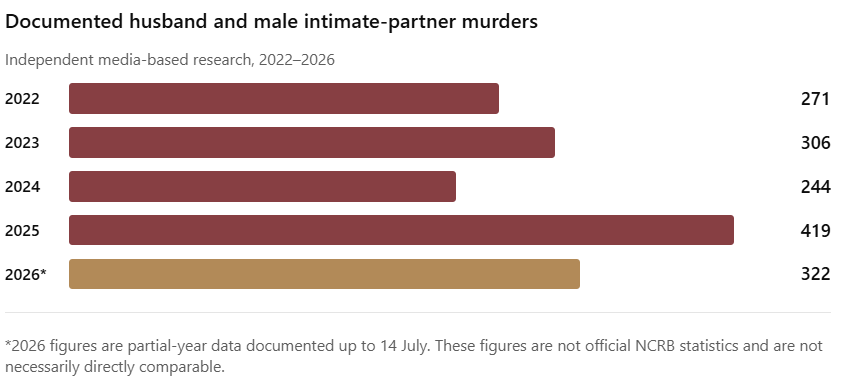
Independent research by men's rights activist Deepika Narayan Bhardwaj and the Ekam Nyaay Foundation has documented hundreds of husband and male intimate-partner murder incidents through newspaper and digital media reports.
The following figures cover five calendar years, including the available partial data for 2026.
| Year | Documented murders | Data source |
|---|---|---|
| 2022 | 271 | Media-based research by Deepika Narayan Bhardwaj |
| 2023 | 306 | Ekam Nyaay Foundation research report |
| 2024 | 244 | Ekam Nyaay Foundation research |
| 2025 | 419 | Ekam Nyaay Foundation research |
| 2026 | 322 | Partial-year documentation up to 14 July |
Important: These are independently documented incidents, not official NCRB figures or a verified nationwide count of convictions. Some reports include unmarried intimate partners and cases involving a wife's alleged accomplices.
The figures cannot be treated as a uniform national crime database because reporting coverage and research methodology may differ across years.
For 2021, a comparable nationwide count could not be independently verified.
Research sources:
- 2022 husband murder research – The New Indian Express
- Download original Ekam Nyaay Foundation 2023 research report
- 2024 and 2025 husband murder research findings
- 2026 husband murder research findings – India Today
These figures raise an uncomfortable question. If independent organisations can identify hundreds of such cases through newspapers, why does India not publish a dedicated national statistical record of male victims of intimate-partner homicide?
What Does Official NCRB Murder Data Reveal?
The latest available NCRB annual crime report identified for this analysis covers 2024.
Its murder statistics provide important context for understanding violent crimes associated with romantic relationships and domestic conflicts.
| Year | Total registered murder cases | Murder cases involving love affairs or illicit relationships |
|---|---|---|
| 2020 | 29,193 | 3,031 |
| 2021 | 29,272 | 3,125 |
| 2022 | 28,522 | 2,821 |
| 2023 | 27,721 | 2,830 |
| 2024 | 27,049 | 2,802 |
| Total | 1,41,757 | 14,609 |
Source: NCRB Crime in India reports, murder motive tables, compiled for 2020–2024.
Access official NCRB annual crime reports
Access year-wise NCRB statistical compilation
The figures establish that romantic conflicts and illicit relationships remain recurring recorded motives for murder in India.
However, these 14,609 murder cases cannot be described as husbands murdered by wives. They include victims and offenders of different genders and relationship categories.
Any article presenting these figures as exclusive husband murder statistics would be misleading.
Nearly 73% Of Murder Victims In India Were Male In 2024
According to NCRB's 2024 murder victim statistics:
| Victim category | Number |
|---|---|
| Male | 20,287 |
| Female | 7,535 |
| Transgender | 9 |
| Total victims | 27,831 |
Male victims constituted approximately 72.9% of all recorded murder victims in India during 2024.
This does not mean that women were responsible for these murders. It establishes the considerable extent of male victimisation and the need to understand its different causes.
Among these male victims, how many were murdered by their wives, girlfriends or other intimate partners?
The published national figures do not separately answer that question.
A murder victim's gender is recorded. Why should the relationship between the victim and the murderer remain statistically invisible?
Why Are Husbands Being Murdered By Their Wives?
The Ekam Nyaay Foundation's original 2023 research report analysed the reported motives behind 306 documented husband and male intimate-partner murders.
| Reported motive | Incidents | Percentage |
|---|---|---|
| Extramarital relationships | 213 | 69.6% |
| Domestic disputes | 55 | 18.0% |
| Monetary disputes | 9 | 2.9% |
| Suspicion | 5 | 1.6% |
| Other reasons | 24 | 7.8% |
Extramarital relationships represented the largest reported motive within this particular dataset.
The foundation's partial-year 2026 research similarly identified alleged adultery as a leading motive, accounting for 194 of its 322 documented murder incidents.
Domestic disputes accounted for another 88 incidents.
These findings are based on media documentation and reported motives. They do not establish that every allegation was subsequently proved before a criminal court.
Read the original 2023 research report
A person has every legal right to leave an unhappy marriage through lawful separation or divorce. Nobody has the right to take another person's life to escape a marriage.
Marriage is a relationship, not a licence to commit violence.
Husband Murder Cases In India: Real Incidents And Court Judgments
1. Odisha husband murder case: wife sentenced to life imprisonment
Incident: 20 July 2021
Court: Additional District and Sessions Court, Jajpur
Decision reported: September 2026
A woman was convicted of murdering her husband following a domestic dispute.
The court sentenced her to life imprisonment under Section 302 IPC and imposed a fine of ₹1 lakh.
Two other accused persons were acquitted because the evidence against them was insufficient.
The case establishes that criminal responsibility must be determined individually on the strength of evidence, irrespective of the gender of the accused.
Read detailed case coverage on ShoneeKapoor.com
2. Muzaffarnagar husband murder case: wife and husband's brother sentenced to life
Incident: 6 June 2023
Court: Muzaffarnagar Sessions Court
Sentencing: 14 October 2026
The prosecution alleged that a man's murder was connected to an extramarital relationship between his wife and his own brother.
The court convicted both accused under Sections 302 and 201 IPC and sentenced them to life imprisonment, with a fine of ₹55,000 each.
The case exposed a devastating instance of violence and betrayal within a family.
Read detailed Muzaffarnagar husband murder case coverage
3. Begusarai husband murder case: wife and lover convicted of criminal conspiracy
Incident: 7 January 2024
Court: Additional District and Sessions Court, Manjhaul, Bihar
Conviction: 25 March 2026
A court convicted Rani Kumari and Mohammad Shehzad for the murder of Maheshwar Rai.
The accused were convicted under Sections 302/34 and 302/120B IPC and sentenced to life imprisonment.
The court also imposed a fine of ₹20,000 on each convict.
The case demonstrates that a person participating in a criminal conspiracy to murder a spouse can face serious criminal liability even where several individuals are involved.
Read detailed Begusarai murder case coverage
4. Raja Raghuvanshi murder case: Supreme Court sets aside wife's bail
The alleged murder of Raja Raghuvanshi during his honeymoon in Meghalaya in May 2025 attracted nationwide attention.
The prosecution alleged the involvement of his wife, Sonam Raghuvanshi, and other accused persons in a criminal conspiracy.
The Supreme Court subsequently set aside the bail granted to Sonam, according to proceedings reported in July 2026.
It is important to clarify that cancellation of bail is not a conviction. The allegations must be established through evidence before the competent criminal court.
Read the Supreme Court proceedings and detailed legal analysis
When A Husband Is Murdered But The Prosecution Fails To Prove Guilt
State of Maharashtra v. Monika Kiran Suryawanshi & Ors.
Neutral citation: 2026 INSC 685
Judgment date: 13 July 2026
Bench: Justice Sanjay Karol and Justice Prasanna B. Varale
In a case concerning the murder of Kiran Suryawanshi in 2007, the Supreme Court upheld the acquittal of his wife and other accused persons on charges of murder and criminal conspiracy.
The prosecution alleged an extramarital relationship and a conspiracy to murder the husband.
However, the Supreme Court found serious deficiencies in the circumstantial and forensic evidence.
The Court observed in paragraph 38:
“The chain of circumstances is broken, and the hypothesis of guilt is not exclusively established.”
The convictions of two other accused persons for causing the disappearance of evidence were maintained.
This judgment highlights two equally important principles:
- A murdered man's family deserves a competent and thorough criminal investigation.
- No accused person, whether male or female, should be convicted merely on suspicion.
The principles established in Sharad Birdhichand Sarda v. State of Maharashtra, (1984) 4 SCC 116, require circumstantial evidence to form a complete chain pointing towards guilt while excluding reasonable hypotheses of innocence.
Justice for male victims cannot come at the cost of due process. It must come through reliable investigation, legally admissible evidence and proof beyond reasonable doubt.
Download original Supreme Court judgment – 2026 INSC 685
Read complete judgment analysis
This older murder incident is discussed for its recent judicial significance and is not included as a 2026 murder incident.
Did Decriminalisation Of Adultery Increase Husband Murders?
On 27 September 2018, a five-judge Constitution Bench of the Supreme Court struck down Section 497 IPC in Joseph Shine v. Union of India, (2019) 3 SCC 39.
The judgment decriminalised adultery.
One important aspect often missed in public discussions is that the former Section 497 IPC punished the male participant under specified circumstances. The wife was not punishable even as an abettor under that provision.
Today, adultery remains a ground for divorce under Section 13(1)(i) of the Hindu Marriage Act, 1955, where applicable.
However, it is no longer an ordinary criminal offence.
Does this mean that decriminalisation caused an increase in husband murders?
The available data is insufficient to establish that causal connection.
What cannot be disputed is that adultery appears as a recurring alleged motive in independently documented husband murder cases.
Decriminalising adultery does not decriminalise assault, intimidation, abetment, criminal conspiracy or murder.
Download original Supreme Court judgment – Joseph Shine v. Union of India
Read detailed analysis of India's adultery laws
Punishment For A Wife Who Murders Her Husband Under Indian Law
Murder laws in India are gender-neutral. A woman convicted of murdering her husband can face the same statutory punishment as a man convicted of murdering his wife.
The Bharatiya Nyaya Sanhita, 2023 (BNS), came into force on 1 July 2024, replacing the IPC, subject to applicable commencement and saving provisions.
| Offence | Old IPC provision | Current BNS provision |
|---|---|---|
| Definition of murder | Section 300 | Section 101 |
| Punishment for murder | Section 302 | Section 103(1) |
| Criminal conspiracy | Sections 120A–120B | Section 61 |
| Common intention | Section 34 | Section 3(5) |
| Disappearance of criminal evidence | Section 201 | Section 238 |
| Attempt to murder | Section 307 | Section 109 |
| Criminal intimidation | Sections 503–506 | Section 351 |
| Culpable homicide not amounting to murder | Section 304 | Section 105 |
| Abetment of suicide | Section 306 | Section 108 |
Under Section 103(1) BNS, murder is punishable with death or imprisonment for life, along with liability to a fine.
The death penalty is not automatic. Its imposition remains subject to established judicial sentencing principles.
Offences committed before 1 July 2024 generally continue to attract the applicable IPC provisions under the repeal and saving framework.
Read the official Bharatiya Nyaya Sanhita, 2023
Why Does India's Domestic Violence Law Not Protect Husbands Equally?
The Protection of Women from Domestic Violence Act, 2005, provides specialised protective and civil remedies to women facing domestic abuse.
Section 2(a) defines an aggrieved person as a woman who satisfies the requirements of the Act.
Consequently, an adult male victim cannot ordinarily file an application seeking protection as an aggrieved person under this statute.
Similarly, Sections 85 and 86 BNS, corresponding to the former Section 498A IPC, specifically address cruelty inflicted upon a woman by her husband or his relatives.
There is no equivalent comprehensive domestic violence statute providing adult male victims with the same specialised protection framework.
This does not mean that husbands have no legal remedies. General criminal laws concerning assault, intimidation, wrongful confinement, attempted murder and other offences remain available to them.
Supreme Court judgment: Hiral P. Harsora v. Kusum Narottamdas Harsora
Citation: (2016) 10 SCC 165
Judgment date: 6 October 2016
The Supreme Court struck down the words “adult male” from Section 2(q) of the Domestic Violence Act, allowing proceedings against female respondents as well, subject to the statutory requirements.
However, the judgment did not extend the definition of an aggrieved person under Section 2(a) to adult men.
The difference is significant. A woman can be a respondent under the Domestic Violence Act, but an adult husband cannot claim its protection as an aggrieved person in his own right.
Download original Supreme Court judgment – Hiral P. Harsora
Read the official Domestic Violence Act, 2005
Also Read: Why India Needs Gender-Neutral Domestic Violence Laws
How Can A Husband Protect Himself Against Domestic Violence And Death Threats?
A husband experiencing physical violence or credible threats should not dismiss them merely because the aggressor is his wife.
The following legal and safety measures may be considered:
- Prioritise physical safety: Move to a safe location and call emergency number 112 if facing immediate danger.
- Preserve evidence: Retain threatening messages, lawful recordings, photographs, medical records and previous written complaints.
- Seek medical assistance: Obtain treatment and proper medical documentation of any physical injuries.
- File a police complaint: Section 173 BNSS governs information concerning cognizable offences, including reporting irrespective of territorial jurisdiction.
- Approach senior police officers: If police refuse to record information concerning a cognizable offence, Section 173(4) BNSS provides a remedy through the Superintendent of Police.
- Approach the Magistrate: Where legally appropriate, seek an investigation under Section 175(3) BNSS after following the applicable procedure.
- Consider matrimonial remedies: Judicial separation or divorce on grounds such as cruelty may be available under the applicable matrimonial law.
Do not retaliate, threaten, assault or unlawfully obtain another person's private information.
Protect your life first. Matrimonial litigation can be dealt with afterwards.
Also Read: What Legal Remedies Are Available For Men In India?
What India Needs To Do To Prevent Husband Murders
Recognising male victims does not require denying violence against women. Both deserve effective legal protection.
India must consider meaningful reforms addressing violence against men within domestic relationships:
- Separate NCRB statistics: Publish murder data identifying the relationship between victims and accused persons, including spouses and intimate partners.
- Gender-neutral domestic violence protection: Extend appropriate emergency protection and civil remedies to genuine male victims.
- Police sensitisation: Treat complaints made by husbands about physical assault and credible threats with the seriousness they deserve.
- Better forensic investigations: Ensure proper preservation of electronic, medical and circumstantial evidence to prevent investigative failures.
- Support services for abused men: Establish accessible helplines, counselling facilities, emergency accommodation and legal assistance.
- Evidence-based policymaking: Collect reliable national data instead of relying on assumptions about who can be a victim or perpetrator.
Articles 14 and 21 of the Constitution recognise equality before the law and protection of life and personal liberty.
Demanding effective protection for men is not a demand to withdraw protection from women. It is a demand to extend justice to victims who currently lack equivalent specialised remedies.
Conclusion: How Many More Husbands Must Die Before Their Safety Becomes A National Concern?
Hundreds of husband and male intimate-partner murder incidents have been documented independently across India.
Courts have convicted wives and their accomplices in several such cases. Other prosecutions have failed because the evidence did not establish guilt beyond reasonable doubt.
Yet India still lacks a separately published, comprehensive national count of husbands murdered by wives.
The absence of official data cannot be treated as the absence of victims.
We need laws that recognise abuse based on conduct, not gender. We need police officers who take a husband's complaint seriously before the situation becomes fatal. And we need a criminal justice system that values every victim's life equally.
A man's life does not become less valuable simply because he is a husband. He deserves protection while he is alive, not merely justice after his death.
FAQs
1. how many husbands are killed by wives in india every year?
No separate official nationwide figure is published by NCRB. Independent research has documented hundreds of reported husband and intimate-partner murders.
2. are husband murders increasing in india?
Independent documentation shows fluctuations and recent increases, but comparable national data is insufficient to establish a nationwide trend.
3. what is the punishment for a wife murdering her husband?
Section 103(1) BNS provides for life imprisonment or death, along with liability to a fine, upon conviction for murder.
4. is adultery a criminal offence in india in 2026?
No. The Supreme Court decriminalised adultery in 2018. However, it remains a ground for divorce under applicable matrimonial law.
5. can a husband file a domestic violence case against his wife?
He cannot ordinarily claim relief as an aggrieved person under the Domestic Violence Act, 2005, but can pursue applicable criminal, civil and matrimonial remedies.
Disclaimer: This article is intended for legal awareness and educational purposes. Independently documented incidents may include unproven allegations and are not official national crime statistics. Individual cases must be assessed on their evidence and applicable law.





Share Your Thoughts
Comments are moderated before publication.