
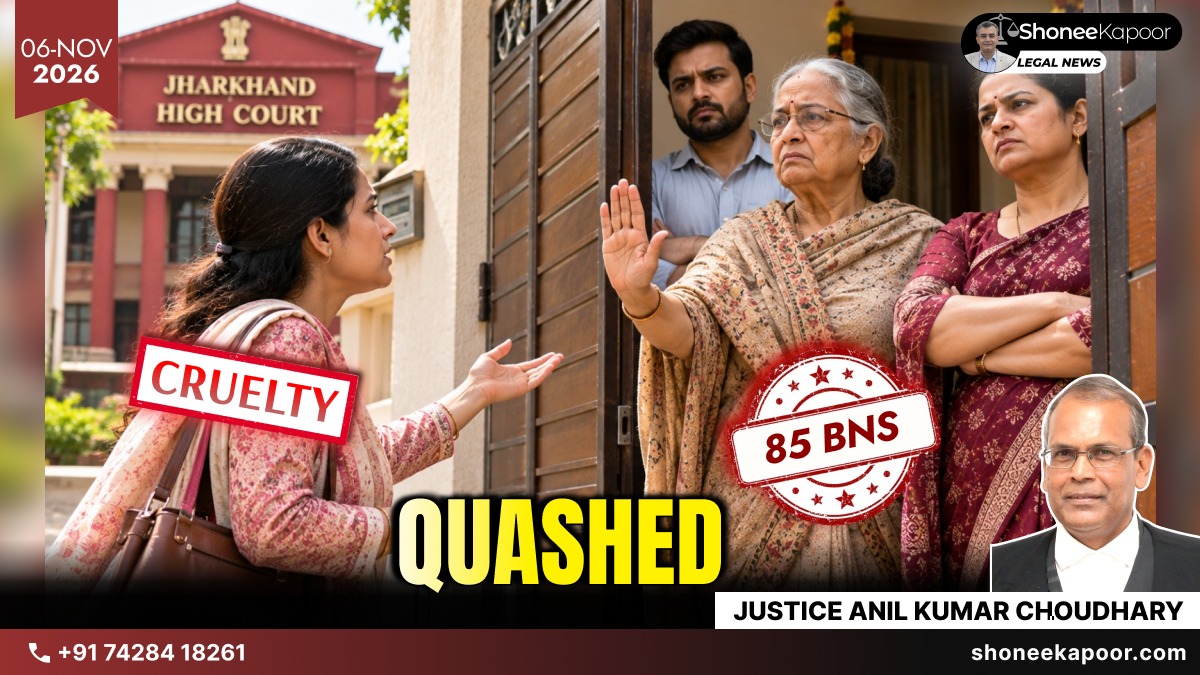
Section 85 BNS |Refusing Daughter-in-Law Entry Into Matrimonial Home And Insulting Her Is Not Cruelty: Jharkhand HC Quashes Case

Curated by NEWS DESK
Editorial DeskJHARKHAND: The Jharkhand High Court has ruled that merely refusing a daughter-in-law entry into her matrimonial home and insulting her is not sufficient to establish cruelty under Section 85 BNS. The Court quashed criminal proceedings against a 69-year-old mother-in-law and her daughter, finding that the allegations did not satisfy the essential ingredients of the offences.
Justice Anil Kumar Choudhary passed the judgment on 3 November 2026, allowing a petition filed by Ursila Toppo and Savita Soni Toppo under Section 528 BNSS to quash the criminal proceedings.
Read Also:- How To File 498A Or Section 85 BNS Quashing Petition Under Section 528 BNSS?
The case arose from a complaint filed by Rekha Ekka, who alleged that her mother-in-law and sister-in-law prevented her from entering her matrimonial home in Ranchi and insulted her.
However, the main allegations of assault and taking dowry were against her husband, Sujeet Madhukar Toppo. Another woman, Artima Xess, was accused of threatening the complainant and demanding ₹3 lakh.
Following the complaint, police registered Lohardaga Mahila P.S. Case No. 23 of 2024 and filed a chargesheet against the two women under Sections 85, 115(2), 126(2), 352 and 351(2) BNS.
The Chief Judicial Magistrate, Lohardaga, took cognisance on 21 August 2025 and framed charges on 10 August 2026.
Challenging these orders, the petitioners argued that the allegations were general and vague, with no specific acts establishing cruelty, assault, wrongful restraint, intimidation or intentional insult under the relevant criminal provisions.
The petitioners relied on Preeti Gupta v. State of Jharkhand (2010), where the Supreme Court discussed the principles for quashing criminal proceedings.
Referring to R.P. Kapur v. State of Punjab (1960), the Supreme Court had recognised that proceedings may be quashed:
“where the allegations in the first information report or complaint taken at their face value and accepted in their entirety do not constitute the offence alleged;”
The State opposed the petition, arguing that the allegations were sufficient to justify the charges.
The High Court also relied on Neelu Chopra v. Bharti (2009), where the Supreme Court stressed the importance of specific allegations against each accused.
The Supreme Court had observed:
“What is required to be brought to the notice of the court is the particulars of the offence committed by each and every accused and the role played by each and every accused in committing of that offence.”
Applying these principles, the Jharkhand High Court examined each charge separately.
Regarding Section 115(2) BNS, the Court found that the allegation of assault was only against the husband. The complainant did not allege that the mother-in-law or sister-in-law caused any hurt.
Similarly, the criminal intimidation charge under Section 351(2) BNS was not maintainable against the petitioners because the allegation of threatening the complainant was against another woman.
While examining Section 85 BNS, the Court referred to Sushil Kumar v. Union of India (2005) and explained that the alleged conduct must satisfy the legal requirements of cruelty.
The High Court held that refusing entry into the matrimonial home and insulting the daughter-in-law, without further allegations establishing the required elements of cruelty, was insufficient to constitute an offence under Section 85 BNS.
The Court also rejected the wrongful restraint charge under Section 126(2) BNS, finding no specific allegation that the petitioners had wrongfully obstructed the complainant.
Regarding Section 352 BNS, the Court clarified that mere insult is not enough unless the required intention or knowledge concerning provocation likely to cause a breach of peace or another offence is established.
The High Court concluded that even if all allegations against the petitioners were accepted as true, the essential ingredients of the charged offences were missing.
Read Also:- Police Pressuring Men To Marry In Section 69 BNS Cases — Ground Reality
The Court observed that continuing the prosecution would "amount to abuse of process of law".
Accordingly, the Jharkhand High Court quashed the entire criminal proceedings against the mother-in-law and sister-in-law, including the cognisance order dated 21 August 2025 and the charge-framing order dated 10 August 2026.
EXPLANATORY TABLE OF LAWS AND SECTIONS
| Law / Section | What It Means | Application In This Case |
|---|---|---|
| Section 85, BNS | Punishment for cruelty by a husband or his relatives. | Cruelty charge quashed against both petitioners. |
| Section 86, BNS | Defines cruelty for the purpose of Section 85. | Relevant to deciding whether the allegations amounted to cruelty. |
| Section 115(2), BNS | Punishment for voluntarily causing hurt. | The petitioners made no allegation of hurt. |
| Section 126(2), BNS | Punishment for wrongful restraint. | No specific allegation satisfying wrongful restraint. |
| Section 351(2), BNS | Punishment for criminal intimidation. | Threat allegations were against another woman. |
| Section 352, BNS | Intentional insult intended or known to be likely to provoke a breach of peace. | Mere allegation of insult was insufficient. |
| Section 528, BNSS | High Court's inherent powers to prevent abuse of legal process and secure justice. | Used to quash the criminal proceedings against the petitioners. |
CASE DETAILS
| Particular | Details |
|---|---|
| Case Title | Ursila Toppo and Another v. State of Jharkhand and Another |
| Court | Jharkhand High Court, Ranchi |
| Neutral Citation | 2026: JHHC:32186 |
| Bench | Justice Anil Kumar Choudhary |
| Judgment Date | 3 November 2026 |
| Case Number | Cr.M.P. No. 942 of 2026 |
| Interlocutory Application | I.A. No. 15684 of 2026 |
| Petitioners' Counsel | Advocates Suraj Verma and Anjani Kumar |
| State Counsel | Shailendra Kumar Tiwari, Special Public Prosecutor |
| Police Station | Lohardaga Mahila Police Station, Jharkhand |
| FIR Number | Lohardaga Mahila P.S. Case No. 23 of 2024 |
| G.R. Number | 311 of 2025 |
| Final Decision | The petition was allowed to the extent of quashing all criminal proceedings against the two petitioners. |
KEY TAKEAWAYS
- Mere Insult Is Not Cruelty: Refusing a daughter-in-law entry into her matrimonial home does not automatically constitute cruelty under Section 85 BNS.
- Vague Allegations Are Not Enough: Criminal charges against a husband's relatives require specific allegations satisfying the ingredients of an offence.
- Mother-in-Law and Sister-in-Law Get Relief: Jharkhand High Court quashed all criminal proceedings against both women.
- Misuse of Criminal Process Cannot Continue: The High Court held that continuing prosecution without the required legal ingredients would amount to abuse of process.
- Husband's Family Deserves Legal Protection: Matrimonial disputes cannot justify prosecuting relatives without specific allegations establishing their criminal liability.
Share Your Thoughts
Comments are moderated before publication.