
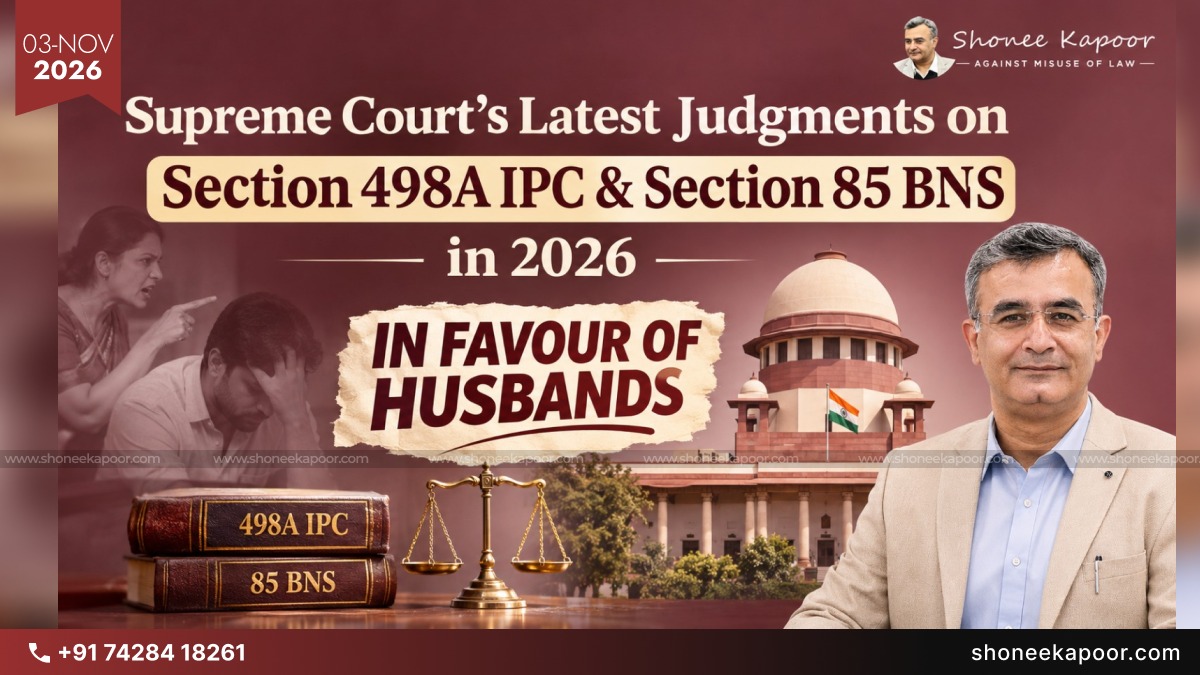
Supreme Court’s Latest Judgments on Section 498A IPC & Section 85 BNS in 2026 in Favour of Husbands

Written and analysed by Vaibhav Ojha
Head Of Legal Communications
Can a husband's life be turned upside down by a 498A case without specific evidence? Can every family member be dragged into criminal proceedings merely because a marriage has failed?
In 2026, the Supreme Court of India delivered several important judgments answering these questions. In some cases, husbands secured relief from Section 498A IPC proceedings. In others, the Court stopped prosecutions against parents and relatives whose individual roles had not been established.
The biggest development came on 2 November 2026, when the Supreme Court quashed a 498A and dowry-death case against a husband, examining allegations that he had called his wife “stupid” and “useless”.
These decisions also matter under Section 85 of the Bharatiya Nyaya Sanhita (BNS), 2023, which now governs the corresponding offence of cruelty by a husband or his relatives.
Here are six significant, verified Supreme Court decisions from 2026.
1. Calling Wife “Stupid” and “Useless” Not Enough in This Case: Supreme Court Quashes Husband’s 498A FIR
Case: Piyush S/o Deepak Narlawar v. State of Maharashtra & Others
Date: 2 November 2026
Citation: 2026 INSC 1183
Relief: FIR and consequential proceedings quashed against the husband.
The wife died by suicide in Toronto in June 2023. Her father subsequently alleged dowry demands, physical cruelty and mental harassment by the husband and his family.
Among the allegations was that the husband frequently called his wife “stupid” and “useless” because she was unable to find employment in Canada.
The defence relied on her suicide note, Canadian police findings, the coroner's report and CCTV footage. The note referred to distress about employment and studies but did not blame the husband or his family.
What happened before the Supreme Court?
The husband's counsel argued that the allegations lacked material support and had no demonstrated connection with the suicide. The State opposed quashing, relying on allegations of dowry demands and violence, while the complainant challenged the conclusions of the Canadian investigation.
After examining the record, the Supreme Court found that the alleged insults, in the circumstances of this case, did not establish the criminal offences alleged. It also found the asserted dowry demands and their connection with the death insufficiently supported.
The Court held:
“Mere general allegations of harassment, without specifics against such persons, would not suffice to continue criminal proceedings.”
The result: The Supreme Court quashed FIR No. 212/2023 and the consequential criminal proceedings against the husband.
Why it matters: The judgment does not give husbands permission to insult or abuse their wives. It makes the narrower but critical point that criminal cruelty must be established through the applicable statutory ingredients and a factual foundation.
Read the full Supreme Court judgment — Piyush v. State of Maharashtra
2. Husband’s Parents Cannot Be Prosecuted on General Dowry Allegations: Supreme Court Grants Relief
Case: Prasanta Kumar Dhar & Another v. State of West Bengal & Another
Date: 5 October 2026
Citation: 2026 INSC 1087
Relief: Criminal proceedings quashed against the father-in-law and mother-in-law.
The case involved allegations of cruelty, dowry harassment, criminal breach of trust and intimidation.
The Supreme Court examined whether the complaint and supporting material disclosed specific criminal acts by the husband's parents.
The allegations did not sufficiently establish an individual dowry demand, dishonest misappropriation of entrusted property or the necessary ingredients of criminal intimidation against them.
The Court refused to treat family relationship as a substitute for individual criminal liability.
It therefore quashed the proceedings against the two parents.
Important distinction: The husband was not the beneficiary of this quashing order. The ruling cannot be represented as his acquittal.
Why it matters: In a 498A prosecution, naming the entire family is not enough by itself. Each accused person's alleged role must be examined against the ingredients of the offences invoked.
Download the Supreme Court judgment PDF — Prasanta Kumar Dhar
3. Mere Taunts and Alleged Failure to Control Son Not Enough: Mother-in-Law Gets 498A Relief
Case: Prabha Devi v. State of Bihar & Others
Date: 8 September 2026
Case reference: Criminal Appeal arising from SLP (Criminal) No. 3845 of 2026
Relief: Proceedings quashed against the mother-in-law alone.
Prabha Devi was accused alongside her son and other family members.
The allegations against her concerned taunting, opposition to the marriage, harassment and missing jewellery. However, the investigation did not identify a specific unlawful demand or a sufficiently particularised act of criminal cruelty attributable to her.
The Court noted that six neighbourhood witnesses had not observed or heard of the alleged harassment. It also examined the absence of an injury report and recovery of jewellery.
The Supreme Court ruled that the ingredients of the charged offences were not disclosed against Prabha Devi.
It expressly clarified:
“This order shall not affect the proceedings against the husband, which shall be considered on their own merits.”
Why it matters: An allegation that a mother failed to restrain her adult son does not automatically establish that she personally committed an offence under Section 498A.
Read the case analysis on ShoneeKapoor.com — Prabha Devi
4. BSF Duty Records Help Husband Defeat 498A and Dowry-Death Prosecution
Case: Rahul v. State of Uttar Pradesh & Another
Date: 11 August 2026
Citation: 2026 INSC 825
Relief: FIR, charge-sheet and consequential proceedings quashed against the husband.
Rahul, a Border Security Force personnel, faced allegations of dowry harassment and dowry death following his wife's death in 2016.
His defence relied on official BSF records showing his duty postings away from the place of occurrence.
The Supreme Court also considered the medical and inquest evidence, the absence of corroborating call-detail records for the alleged telephonic dowry demands, and the acquittal of his parents on the same prosecution evidence.
What was the decisive point?
The Court did not hold that absence from the place of death automatically defeats a dowry-death prosecution. Cruelty or harassment can occur even when spouses are physically apart.
Instead, the combination of reliable official records and the weaknesses in the prosecution material made continuation of proceedings unjustified in this particular case.
The result: The prosecution against Rahul was quashed.
Why it matters: Objective defence evidence of exceptional reliability can sometimes be considered even at the quashing stage. A husband should preserve official duty records, travel documents, communications and other contemporaneous evidence.
Read the detailed judgment analysis on ShoneeKapoor.com — Rahul
Read the full Supreme Court judgment
5. Merely Siding With Husband Does Not Make His Relatives Criminals: Supreme Court Quashes 498A Proceedings
Case: Arti Mehta & Others v. State of Madhya Pradesh & Another
Date: 25 May 2026
Citation: 2026 INSC 533
Relief: Proceedings under Section 498A IPC, the Dowry Prohibition Act and the Domestic Violence Act quashed against four relatives.
The wife made detailed allegations concerning her husband's conduct. However, the accusations against his mother, sisters and brother-in-law were largely general.
The Supreme Court compared the FIR, domestic violence complaint and matrimonial pleadings. It found no sufficiently specific allegations establishing the individual criminal involvement of the four relatives.
The Court cautioned:
“Criminal law cannot be permitted to become an instrument for venting personal grievances or settling familial scores.”
Merely supporting the husband, advising the wife to adjust or failing to intervene in a dispute did not, without more, establish the alleged criminal liability.
Important distinction: The husband’s trial was allowed to proceed. The Court also clarified that relatives could face proceedings later if sufficient evidence emerged during trial.
Why it matters: This judgment protects relatives against unsupported collective allegations without providing blanket immunity to anyone who actually participates in cruelty or dowry harassment.
Read the case analysis on ShoneeKapoor.com — Arti Mehta
Read the original Supreme Court judgment PDF
6. Husband Not Talking to Wife for 13 Days: Supreme Court Sets Aside 498A Conviction
Case: Jayesh Kanna v. Assistant Commissioner Law and Order (West) & Others
Date: 7 May 2026
Citation: 2026 INSC 615
Relief: Husband's conviction and sentence under Section 498A IPC set aside.
The prosecution alleged that the husband did not communicate with his wife for approximately 13 days while he was abroad. This was presented as mental cruelty connected with her subsequent suicide.
But the Supreme Court found that the prosecution had not adequately proved the alleged non-communication or established criminal cruelty.
The absence of supporting call-detail records was significant. The Court also observed that the absence of WhatsApp messages did not rule out communication through ordinary phone calls.
Its conclusion was fact-specific:
“There is insufficient evidence to prove the allegation of cruelty.”
The Supreme Court set aside the conviction and sentence and also directed the return of the husband's passport if it remained seized by the Trial Court.
Why it matters: Marital silence, disagreement or temporary non-communication does not automatically satisfy Section 498A. The prosecution must prove conduct meeting the legal definition of cruelty.
Read the Supreme Court judgment PDF — Jayesh Kanna
Section 498A IPC vs Section 85 BNS: What Is the Law in 2026?
This distinction is essential.
Section 498A IPC was the earlier provision dealing with cruelty by a husband or his relatives. For the corresponding offence under the new criminal law, the applicable provisions are now:
Section 85 BNS: Punishment for subjecting a married woman to cruelty — imprisonment up to three years and a fine.
Section 86 BNS: Defines cruelty for Section 85, including specified serious wilful conduct or harassment connected with unlawful demands for property or valuable security.
The BNS came into force on 1 July 2024. Conduct predating its commencement may continue to be prosecuted under the applicable IPC provisions.
Crucially, the six Supreme Court rulings discussed above arose under Section 498A IPC, not from prosecutions decided under Section 85 BNS. Their interpretation of criminal cruelty and individual responsibility remains relevant because the substantive definitions correspond closely.
Read Sections 85 and 86 in the Bharatiya Nyaya Sanhita
Another Important 2026 Supreme Court Ruling: Arrest Is Not Automatic
Case: Satender Kumar Antil v. Central Bureau of Investigation & Another
Date: 15 January 2026
Citation: 2026 INSC 115
This is a general ruling on arrest safeguards, not a Section 498A acquittal.
The Supreme Court clarified the operation of Section 35 of the Bharatiya Nagarik Suraksha Sanhita (BNSS), 2023.
For offences punishable with imprisonment of up to seven years, a notice to appear under Section 35(3) is ordinarily the rule, while arrest must satisfy the legal requirements of necessity.
Where a person complies with the notice, subsequent arrest requires adequate reasons and compliance with statutory safeguards.
Because Section 85 BNS carries a maximum imprisonment of three years, these safeguards are highly relevant to allegations under that section.
An FIR is not an automatic arrest warrant. But these safeguards do not create immunity from lawful arrest.
Download the Supreme Court judgment PDF — Satender Kumar Antil
What These Judgments Mean for Husbands Facing 498A or BNS 85 Cases
The Supreme Court has not abolished Section 498A or weakened the legal protection available to genuine victims of matrimonial cruelty.
What these decisions establish is that the legal ingredients of an offence, the role of the accused and the available evidence cannot be ignored merely because the allegations arise from a marriage.
For husbands and their families, the practical lessons are straightforward: preserve original communications, maintain financial and travel records, document relevant events, respond appropriately to investigation notices, and assess whether the complaint discloses the offences actually alleged.
Depending on the facts and the law governing the proceedings, the appropriate remedy may involve anticipatory bail, discharge, trial defence or a petition seeking quashing before the High Court. In proceedings governed by the BNSS, Section 528 preserves the High Court's inherent powers.
A quashing judgment is not a declaration that every complainant lied. Equally, an accusation is not proof that every named family member committed a crime.
My View
I have consistently maintained one simple position: A law meant to protect victims must never become a weapon against innocent people.
In 2026, the Supreme Court has again shown why criminal proceedings must be tested against facts, evidence and the actual ingredients of an offence.
A failed marriage is not proof of cruelty. Being someone's husband is not proof of guilt. Being his parent, brother or sister is not proof of conspiracy.
Protect genuine victims. Prosecute genuine offenders. But stop punishing men and entire families merely on the strength of unsupported allegations.
That is not a demand for special treatment for men. It is a demand for equal justice.
FAQ'S
1. Is Section 498A IPC still applicable in 2026?
Yes, to relevant earlier conduct and proceedings. For the corresponding offence under the new law, Sections 85 and 86 BNS apply from 1 July 2024.
2. Can police immediately arrest a husband under Section 85 BNS?
Arrest is not automatic. Police must follow Section 35 BNSS and the Supreme Court's arrest-safeguard directions.
3. Is refusing to talk to a wife criminal cruelty under 498A?
Not automatically. The Supreme Court's 2026 Jayesh Kanna ruling requires proof of conduct meeting the statutory threshold.
4. Can parents and siblings of a husband be prosecuted under 498A?
Yes, if the applicable offence is disclosed against them. Mere relationship or unsupported collective allegations are not enough.
5. Can a false Section 85 BNS FIR be quashed?
Yes, in appropriate cases through the High Court's inherent jurisdiction under Section 528 BNSS. Quashing depends on the facts and recognised legal grounds.
Legal note: This article discusses selected Supreme Court rulings verified up to 3 November 2026. Relief in one case does not guarantee the same outcome in another. This article is for general legal awareness and is not a substitute for case-specific legal advice.
Related Articles
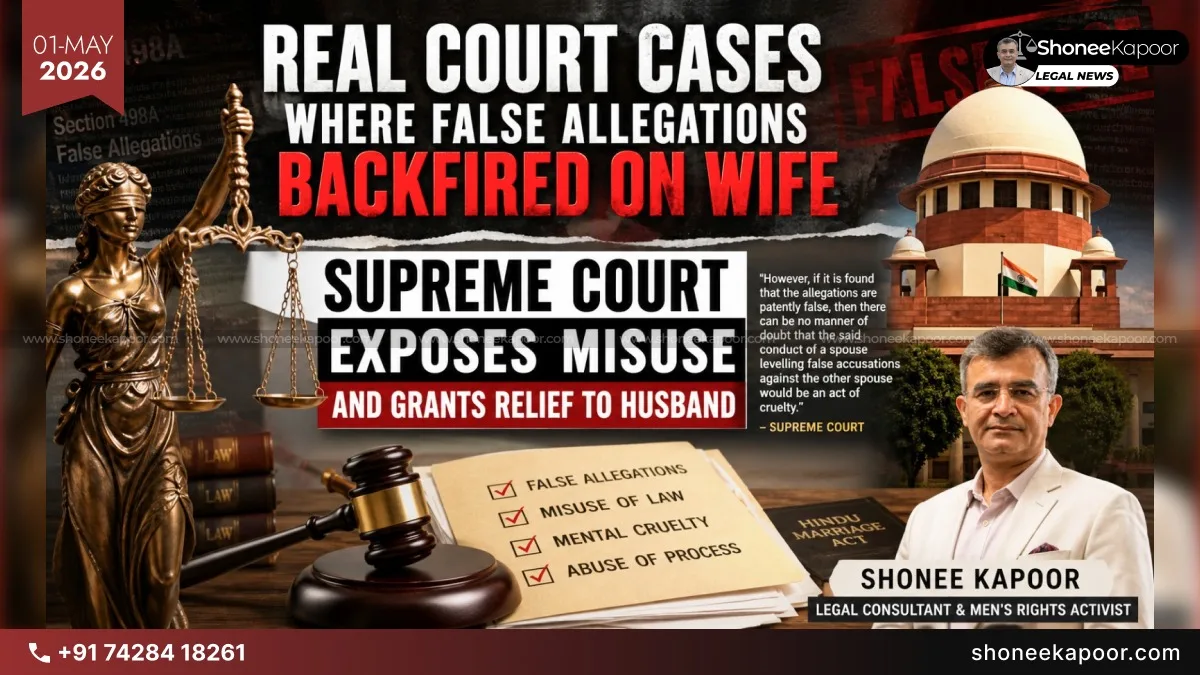
Real Court Cases Where False Allegations Backfired On Wife
Real Indian court cases where false 498A, dowry, cruelty and defamatory allegations against husbands backfired, leadi...





Share Your Thoughts
Comments are moderated before publication.