
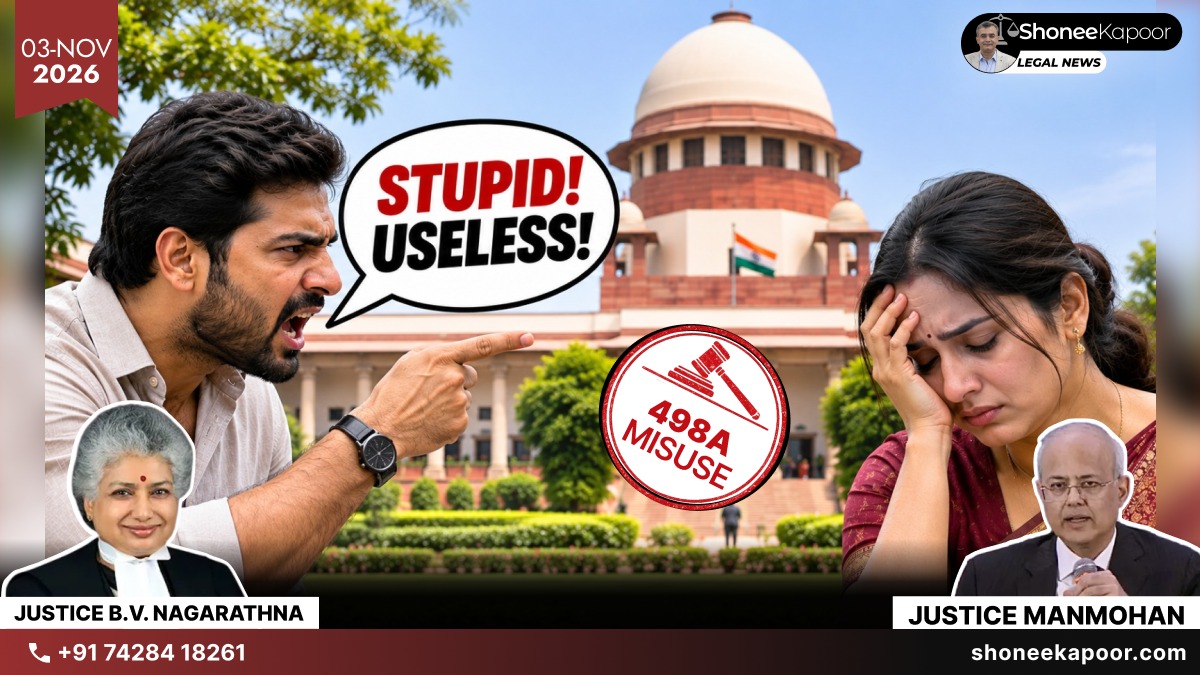
Husband Calling Wife ‘Stupid, Useless’ Is Not Cruelty: Supreme Court Quashes 498A IPC And Dowry Death Case

Curated by NEWS DESK
Editorial DeskNEW DELHI: The Supreme Court of India has quashed a dowry death and cruelty FIR against a husband, holding that allegations of calling his wife "stupid" and "useless" were insufficient to establish criminal cruelty or intimidation without supporting evidence.
A Bench of Justice B.V. Nagarathna and Justice Manmohan set aside the Bombay High Court's order refusing to quash the criminal case against the husband. The Court found no specific evidence linking the alleged dowry demands or matrimonial cruelty to the wife's suicide.
The couple married on January 3, 2021, and moved to Toronto, Canada, in February 2022. On June 11, 2023, the wife died by suicide after jumping from the 22nd floor of their apartment building.
Police recovered a handwritten suicide note in which the wife mentioned her struggle to find employment and feelings of failure. Importantly, the suicide note did not blame her husband or his family.
Following her death, the wife's father lodged an FIR on June 30, 2023, alleging dowry demands, physical harassment and mental cruelty under Sections 304B, 323, 498A, 504 and 34 IPC, along with Sections 3 and 4 of the Dowry Prohibition Act.
The complaint alleged demands for 15 tolas of gold, Diwali jewellery and ₹1 lakh from the wife's brother. It also claimed that the husband frequently insulted his wife and had slapped her during a family wedding.
However, the Canadian coroner's report confirmed that the death resulted from injuries sustained in the fall. The Toronto Police closed their investigation after verifying the suicide note, finding no signs of struggle and examining CCTV footage showing that the husband was absent when the incident occurred.
Earlier, the Bombay High Court had quashed the FIR against the husband's parents and sister, but refused similar relief to the husband. Subsequently, a chargesheet was filed, and non-bailable warrants were issued against him in February 2025.
While hearing the appeal, the Supreme Court observed that no dowry-related complaint had been made during the marriage before the wife's death. The Court also found no evidence establishing a connection between the alleged dowry demands and her suicide.
The Bench examined allegations concerning gold jewellery and Diwali gifts, observing that customary wedding and festival presents could not automatically be treated as dowry without evidence of an unlawful demand.
Regarding the ₹1 lakh bank transfer, the Court noted that the transaction occurred around the time the husband booked his wife's flight from Canada to India. It held that an isolated financial transaction, without examining its circumstances, could not establish a dowry demand.
The Court also considered allegations that the husband called his wife "stupid" and "useless". It found that such remarks, even if accepted as alleged, were insufficient in the circumstances to establish the required ingredients of criminal cruelty or intentional insult.
The Supreme Court emphasised that general allegations of matrimonial harassment cannot replace specific evidence. It found insufficient material to establish dowry-related cruelty, criminal intimidation or any connection between the husband's alleged conduct and the wife's death.
Relying on State of Haryana v. Bhajan Lal, the Court held that continuing the criminal proceedings would amount to an abuse of the legal process.
Accordingly, the Supreme Court allowed the husband's appeal, set aside the Bombay High Court's January 8, 2025 order, and quashed the dowry death FIR and all consequential criminal proceedings against the husband.
EXPLANATORY TABLE OF LAWS AND SECTIONS
| Law / Section | What It Means | Application in This Case |
|---|---|---|
| Section 304B IPC | Dowry death within seven years of marriage, linked to dowry-related cruelty soon before death. | Court found no sufficient evidence connecting alleged dowry demands with the suicide. |
| Section 498A IPC | Punishes legally defined cruelty by a husband or his relatives. | General allegations without specific supporting material were insufficient. |
| Section 323 IPC | Punishment for voluntarily causing hurt. | Allegations of physical violence lacked sufficient supporting material. |
| Section 321 IPC | Defines voluntarily causing hurt. | Considered while examining the alleged physical assault. |
| Section 504 IPC | Punishes intentional insult intended or likely to provoke a breach of peace. | Alleged verbal insults did not satisfy the required ingredients. |
| Section 503 IPC | Defines criminal intimidation. | Discussed by the Court, although Section 504 concerns intentional insult rather than criminal intimidation. |
| Section 34 IPC | Joint criminal liability for acts committed with common intention. | Invoked against the husband and family members in the FIR. |
| Section 3, Dowry Prohibition Act | Punishes giving, taking or abetting dowry, subject to statutory exceptions. | Wedding and festival gifts were not established as unlawful dowry. |
| Section 4, Dowry Prohibition Act | Punishes demanding dowry. | Alleged demands for jewellery and money lacked sufficient supporting evidence. |
| Section 2, Dowry Prohibition Act | Defines dowry. | Relevant to distinguishing customary gifts from dowry. |
| Section 482 CrPC | High Court's inherent powers to prevent abuse of legal process and secure justice. | Husband initially sought quashing before the Bombay High Court. |
| Section 161 CrPC | Police examination of witnesses during investigation. | Father's statement concerning the wedding gold was examined. |
| Section 113B, Indian Evidence Act | Presumption concerning dowry death once foundational requirements are established. | Required foundational facts were not established. |
| Article 226, Constitution | High Court's writ jurisdiction. | Discussed through the Bhajan Lal precedent on quashing proceedings. |
| Sections 154, 155(2), 156(1) CrPC | Provisions relating to FIRs and investigation of cognizable and non-cognizable offences. | Sections 155(2) and 156(1) appeared in the cited Bhajan Lal principles; Section 154 was not separately invoked in the operative ruling. |
CASE DETAILS
| Particular | Details |
|---|---|
| Case Title | Piyush S/o Deepak Narlawar v. State of Maharashtra & Others |
| Court | Supreme Court of India |
| Neutral Citation | 2026 INSC 1183 |
| Judgment Date | November 2, 2026 |
| Bench | Justice B.V. Nagarathna and Justice Manmohan |
| Case Number | Criminal Appeal arising out of SLP (Crl.) No. 12158 of 2025 |
| Appellant | Piyush S/o Deepak Narlawar |
| Respondents | State of Maharashtra & Others |
| High Court | Bombay High Court, Aurangabad Bench |
| High Court Case | Criminal Application No. 725 of 2024 |
| Impugned Order | January 8, 2025 |
| FIR | FIR No. 212/2023, dated June 30, 2023 |
| Police Station | Satara Police Station, Aurangabad Town, Maharashtra |
| Interim Supreme Court Order | August 11, 2025 — protection against coercive steps, subject to cooperation |
| Final Decision | Appeal allowed; High Court order set aside; FIR and consequential proceedings quashed |
KEY TAKEAWAYS
- Dowry Death FIR Quashed: Supreme Court quashed the criminal case against the husband due to insufficient evidence.
- Calling Wife "Stupid" or "Useless" Not Automatically Cruelty: Verbal insults alone did not establish criminal cruelty in this case.
- Suicide Note Did Not Blame Husband: Canadian police findings and CCTV evidence supported the husband's defence.
- Dowry Allegations Need Evidence: Wedding gifts, money transfers and general allegations cannot automatically prove dowry demands.
- Husbands Deserve Protection From Unsupported Cases: The Supreme Court reinforced that criminal prosecution must rest on evidence, not mere allegations.
Share Your Thoughts
Comments are moderated before publication.