
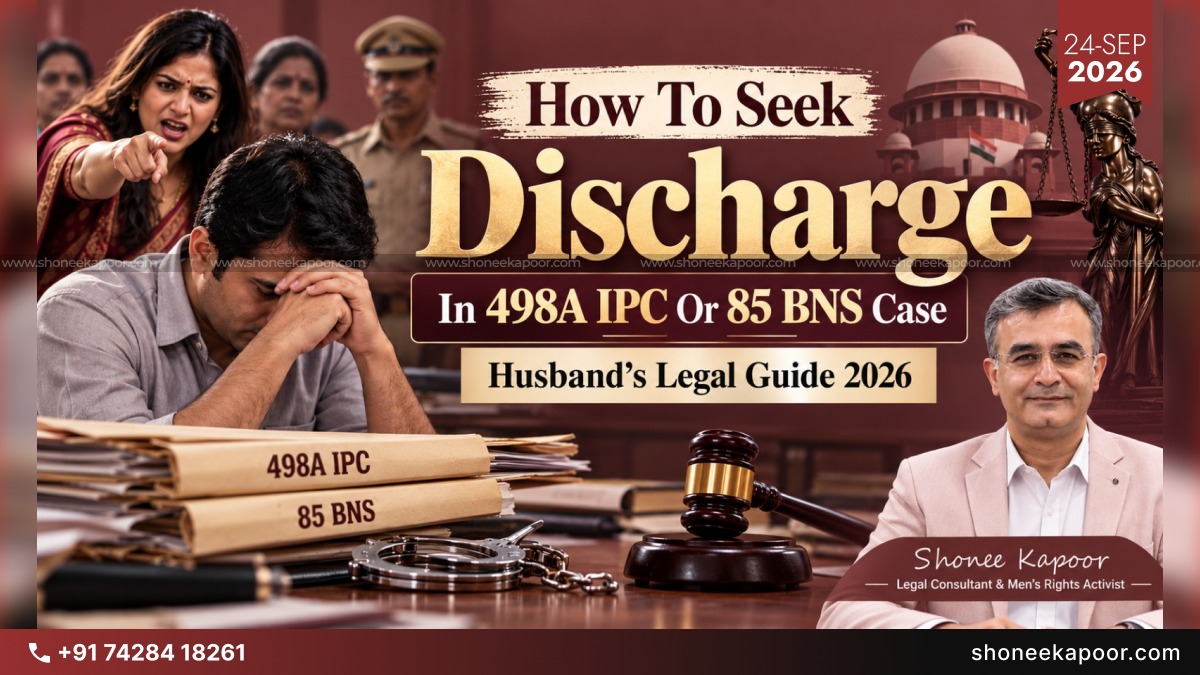
How To Seek Discharge In 498A IPC Or 85 BNS Case: Husband's Legal Guide 2026

Written and analysed by Vaibhav Ojha
Head Of Legal Communications
NEW DELHI: A chargesheet in a 498A IPC or Section 85 BNS case does not automatically mean that the husband must face a full criminal trial.
If the prosecution material itself fails to disclose the legal ingredients of cruelty, the husband can ask the court to discharge him before charges are framed.
But discharge is not a second trial. And one of the biggest mistakes husbands make is trying to prove their entire defence at the discharge stage.
First Know The Law: 498A IPC Or Section 85 BNS?
Section 498A IPC applied under the old Indian Penal Code. From 1 July 2024, cruelty by a husband or his relatives is dealt with under Sections 85 and 86 of the Bharatiya Nyaya Sanhita, 2023.
Section 85 provides punishment of up to three years and fine. Section 86 defines the cruelty required for Section 85. The definition substantially carries forward the two limbs of old Section 498A:
- Wilful conduct of the specified gravity, including conduct likely to drive the woman to suicide or cause grave injury or danger to life, limb or mental or physical health.
- Harassment connected with coercing an unlawful demand for property or valuable security, or failure to meet that demand.
Every marital quarrel, allegation of bad behaviour or unhappy marriage does not automatically satisfy these statutory ingredients.
The Supreme Court has repeatedly cautioned courts against mechanically permitting criminal prosecution on vague and omnibus matrimonial allegations.
Which Discharge Section Applies In 2026?
| Situation | Relevant Provision |
|---|---|
| Police-report warrant case continuing under old CrPC | Section 239 CrPC |
| Police-report warrant case governed by BNSS | Section 262 BNSS |
| Sessions case governed by old CrPC | Section 227 CrPC |
| Sessions case governed by BNSS | Section 250 BNSS |
Most standalone 498A or BNS 85 prosecutions are triable by a Magistrate. Under Section 262 BNSS, the accused may prefer an application for discharge within 60 days from the date on which copies of documents are supplied under Section 230 BNSS. The Magistrate then examines the police report and documents and, after hearing both sides, must discharge the accused if the charge is found to be groundless.
Do Not Blindly Apply BNSS To Every Old 498A Case
The transition is important.
Section 531 BNSS saves certain investigations, inquiries, trials, appeals and applications that were already pending when BNSS came into force. In Parvinder Singh v. Directorate of Enforcement, 2026 INSC 519, the Supreme Court explained that the object of the savings provision is to prevent piecemeal application of CrPC and BNSS to proceedings already initiated under the old Code.
So before drafting discharge, check:
When were the alleged acts committed? When was the proceeding initiated? Was an investigation, inquiry or trial already pending on 1 July 2024?
Do not decide the applicable procedural section merely from the date printed on the chargesheet.
When Can A Husband Seek Discharge?
A strong discharge application attacks the prosecution case itself, ingredient by ingredient.
1. The Allegations Do Not Constitute Legal “Cruelty”
Ask a simple question:
Even if every prosecution allegation is taken at face value, does it satisfy Section 498A IPC or Sections 85 and 86 BNS?
Ordinary marital differences, broad allegations of misbehaviour, medical issues or general accusations are not automatically criminal cruelty.
In a Delhi case decided on 9 July 2026, the court discharged a husband from Sections 498A and 323 IPC. It held, among other things, that allegations concerning impotence or medical conditions did not by themselves constitute Section 498A cruelty and that the complaint contained no specific dowry demand.
The court specifically observed:
“Mere non-disclosure of a medical condition... cannot, by itself, constitute an offence under Section 498A IPC.”
That is the correct way to analyse discharge: allegation versus statutory ingredient.
2. Allegations Are Vague And Omnibus
“Everyone harassed me.”
“They all demanded dowry.”
“My husband and his family tortured me.”
These sentences may sound serious. But criminal liability must ultimately attach to legally relevant acts and the role attributed to the particular accused.
In Kahkashan Kausar @ Sonam v. State of Bihar, 2022 INSC 163, the Supreme Court dealt with general and omnibus allegations against matrimonial relatives and cautioned against permitting prosecutions without specific allegations.
In Dara Lakshmi Narayana v. State of Telangana, 2024 INSC 953, the Supreme Court again interfered where matrimonial allegations were vague and omnibus and lacked sufficient particulars.
And in Sivaraman Nair v. State of Kerala, 2026 INSC 412, the Supreme Court quashed proceedings against the husband’s relatives where the accusations did not disclose specific overt acts or active participation attributable to them.
These are principally quashing authorities, not Section 239 discharge orders. But their analysis of what is required to disclose a 498A offence remains important when testing whether prosecution material contains the essential ingredients.
3. Dowry Harassment Is Alleged, But No Unlawful Demand Is Shown
For the dowry-demand limb of cruelty, merely saying that money, jewellery or articles were given at marriage is not the same as showing harassment with a view to coercing an unlawful demand.
The prosecution material should be examined for:
Who demanded what? From whom? What harassment was allegedly connected with that demand? What material in the chargesheet supports it?
If that chain is missing, point it out precisely.
4. The Chargesheet Does Not Cure The Defects In The Complaint
Never read only the FIR.
Read the:
FIR, complaint, Section 161 CrPC or corresponding BNSS statements, supplementary statements, seizure documents, medical material, police report and every document relied upon in the chargesheet.
Sometimes the FIR is vague but later statements provide particulars. Sometimes repeated statements still do not disclose the basic ingredient of the offence.
Your discharge application should deal with the complete prosecution record, not merely attack one paragraph of the FIR.
Delhi Court Example: Husband Discharged From 498A And 406
In State v. Himanshu Chhabra, FIR No. 452/2024, PS Burari, the JMFC, Mahila Court-03, Central District, Delhi discharged the husband from Sections 498A and 406 IPC on 16 May 2026.
The defence argued that the accusations lacked specific incidents, dates, times and places and failed to disclose the ingredients of either offence.
After examining the complaint, investigation statements and other prosecution material, the court found no specific allegations establishing the required cruelty or dowry-linked harassment. For Section 406 IPC, the necessary particulars of entrustment and dishonest misappropriation were also missing.
The court concluded:
“No prima facie offence under Section 498A/406 IPC is made out against the accused...”
This is a trial-court discharge order, not a binding Supreme Court precedent. But it is an excellent practical illustration of how an ingredient-based discharge argument actually works.
The Biggest Mistake: Turning Discharge Into A Mini-Trial
A husband may have WhatsApp chats, recordings, photographs, bank statements, travel records or other material which he believes proves that the allegations are false.
That does not mean all of it can simply be introduced and adjudicated at discharge.
In State of Orissa v. Debendra Nath Padhi, (2005) 1 SCC 568, the Supreme Court settled that at the charge stage the accused ordinarily cannot rely upon outside defence material merely to establish his innocence.
The Supreme Court reaffirmed this position in November 2024, stating that a trial court cannot consider documents outside the chargesheet while deciding discharge merely because the accused wishes to rely on them.
There is a narrow but important qualification.
In Nitya Dharmananda @ K. Lenin v. Gopal Sheelum Reddy, the Supreme Court held that although an accused ordinarily cannot invoke Section 91 merely to bring defence material at the charge stage, the court is not powerless where material of sterling quality, already available with the investigator but withheld from the chargesheet, has a crucial bearing on framing of charge.
Translation for husbands: Do not dump your entire defence file into a discharge application. First destroy the prosecution case from its own record.
What Is The Test At The Discharge Stage?
The court is not deciding whether you are finally guilty or innocent.
In Union of India v. Prafulla Kumar Samal, (1979) 3 SCC 4, the Supreme Court held that the court may sift the material for the limited purpose of deciding whether a prima facie case exists. Where the material creates some suspicion but not grave suspicion, discharge may follow. The court cannot conduct a full trial at this stage.
Similarly, in State of Tamil Nadu v. N. Suresh Rajan, (2014) 11 SCC 709, the Supreme Court made clear that discharge proceedings cannot become a mini-trial. The issue is whether there is ground to presume commission of the offence, not whether conviction is ultimately certain.
That distinction is critical.
Discharge succeeds because the prosecution material fails the charge-stage test, not merely because the husband has a better version of events.
How I Would Structure A 498A / BNS 85 Discharge Application
Keep it surgical.
First: Identify the exact offence and applicable procedural law.
Second: Reproduce only the necessary ingredients of Section 498A IPC or Sections 85 and 86 BNS.
Third: Make an allegation-to-ingredient chart.
Fourth: Show what is missing from the prosecution record.
Fifth: Separate each accused. A husband’s case and his parents’ case may stand on completely different allegations.
Sixth: Use Supreme Court precedents for the charge-stage test and matrimonial-law principles.
Seventh: Ask for discharge because the charge is legally groundless, not because you want the Magistrate to conduct the entire defence trial before charge.
Under BNSS, also watch the 60-day period under Section 262(1) from supply of Section 230 documents.
Discharge, Quashing And Acquittal Are Not The Same
Discharge: The court stops the case against the accused before trial because the material does not justify framing the relevant charge.
Quashing: The High Court or Supreme Court terminates proceedings using its higher or inherent jurisdiction where the applicable legal test is met.
Acquittal: Comes after trial when the prosecution fails to prove guilt to the required standard.
And one point must remain legally clear:
Discharge does not automatically prove that the complainant filed a false case or lied. It means the prosecution material did not meet the legal threshold required to put the accused on trial for the relevant charge.
That distinction makes a legal article stronger, not weaker.
Final Word
For a husband facing 498A IPC or Section 85 BNS, a chargesheet is not a conviction and it is not always a ticket to years of trial.
But discharge is also not a magic petition.
Read the prosecution record. Break the offence into ingredients. Identify what is legally missing. Use the correct CrPC or BNSS provision. And do not waste the discharge stage trying to prove every defence fact that belongs to trial.
In criminal law, allegations start a case. Ingredients sustain it. If the ingredients are missing, that is where the discharge argument begins.
FAQ'S
1. Can a husband seek discharge after a 498A chargesheet is filed?
Yes. In an applicable police-report warrant case, discharge can be sought before charge under Section 239 CrPC or Section 262 BNSS, depending on the procedural regime governing the proceeding.
2. What is the time limit for discharge under Section 262 BNSS?
The accused may prefer the discharge application within 60 days from supply of documents under Section 230 BNSS.
3. Are vague allegations enough to frame a 498A or BNS 85 charge?
Not automatically. The prosecution material must disclose the statutory ingredients and satisfy the charge-stage threshold. Courts have repeatedly scrutinised vague and omnibus matrimonial allegations.
4. Can a husband produce WhatsApp chats and private documents at discharge?
Ordinarily not merely to prove his defence. The charge court normally considers the prosecution record. The limited principle recognised in Nitya Dharmananda applies to crucial material of sterling quality available with the investigator but withheld.
5. Does discharge mean the wife’s case was proved false?
No. Discharge means the material failed the legal threshold for framing the relevant charge. A finding that a complaint was deliberately false requires its own factual and legal basis.



Share Your Thoughts
Comments are moderated before publication.