
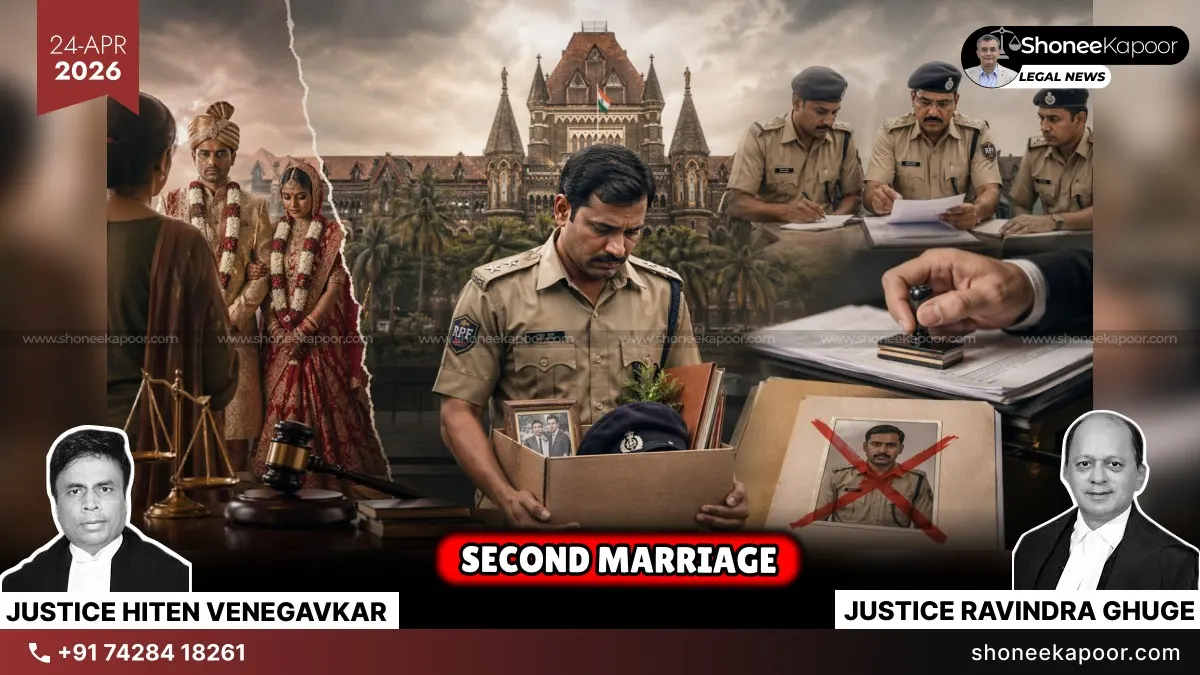
Can punishment truly be called justice if it leaves a man unable to feed himself?
Bombay High Court held that punishment must be proportionate and should not push an employee into poverty and helplessness.
Mumbai: The Bombay High Court, in an important judgment by Justice Ravindra Ghuge and Justice Hiten Venegavkar, gave major relief to a Railway Protection Force employee whose dismissal from service had been ordered for Second Marriage while his first marriage was still legally continuing.
The case was filed by Santosh Motiram Chavan against the Union of India. Chavan had joined as a Police Constable in the Railway Police Force and was later working as a junior clerk at Kalyan in Thane district.
As per the case records, Chavan got married on April 21, 2008. Later, disputes started between him and his first wife, and both got involved in legal cases. During this period, before getting legal divorce, Chavan married again in 2016.
Because of this, the Railways started disciplinary proceedings against him under the Railways Service (Conduct) Rules, 1968. An enquiry officer examined witnesses, recorded Chavan’s statement, and then the punishment of stoppage of one increment was imposed in February 2021.
Later, the Revisional Authority of RPF took suo motu action, ordered a fresh enquiry, and appointed another enquiry officer. This time, a major punishment was considered, and Chavan was dismissed from service in March 2025.
Chavan challenged the dismissal. After no relief from the Central Administrative Tribunal, he approached the Bombay High Court through his counsil.
Before the High Court, his lawyer admitted that Chavan committed a mistake by marrying again before divorce. However, he argued that dismissal from service was far too harsh. He submitted:
“Dismissing from service is nothing but a civil death…”
The High Court considered the financial condition of the employee and noted that he may also have to pay maintenance to his first wife in future.
Justice Ghuge observed:
“He should not have entered into a relationship with a person with whom he has got married by performing the Hindu rites, when his earlier marriage was still subsisting. Be that as it may, on one hand he stands a serious risk of paying maintenance to the first wife as and when an order is passed by the court. On the other hand, he has to feed himself and the woman whom he calls his wife. The second marriage in Hindu religion is impermissible. By the order of dismissal from service, he has lost his source of income and is virtually starving with the second wife, whom he has married as per the Hindu rites and cannot now desert. So also, when such an act is committed by him it cannot be termed as such a grave and serious act which can be termed as an act deserving to be met with an order of dismissal.”
The Court said Chavan clearly made a mistake, but punishment must match the misconduct. The judges stated:
“There is no reason to not believe that the petitioner has committed a blunder. He could have waited till a divorce was granted and then could have entered into a second marriage…What has happened has happened and we now have to assess whether dismissal was commensurate with his act…Dismissal of service is a shocking punishment in the facts and circumstances of this case.”
The Court also noted that Chavan agreed to accept stoppage of increments for at least three years and did not ask for back wages from the date of dismissal.
The Bench further said:
“We are of the view that this could be a commensurate punishment because if he is dismissed from service he would be in grave difficulty in view of maintaining the first wife and supporting himself and the second wife, whom he now cannot desert. He needs to earn a salary which would resolve all his financial problems. He would be rendered to penury if removed from his service.”
The Court also found fault with the second enquiry. It held that the earlier enquiry was already a full enquiry, though called preliminary. The judges said the revision authority had no power to order a completely fresh enquiry and had misread the rules.
With these observations, the Bombay High Court partly allowed the petition and directed reinstatement of the petitioner from May 2. This judgment highlights that while misconduct can be punished, punishment must be fair, balanced, and proportionate under law.
Explanatory Table: Laws And Provisions Involved
| Law / Provision | Purpose | How Applied in This Case |
| Hindu Marriage Law (Monogamy Principle) | Under Hindu law, a second marriage during lifetime of first spouse without valid divorce is not legally permissible. | Court accepted that second marriage during first subsisting marriage was wrong. |
| Railways Service (Conduct) Rules, 1968 | Rules governing conduct and discipline of Railway employees. | Department charged employee for second marriage violating service conduct rules. |
| Departmental Enquiry Rules | Procedure for internal disciplinary action against government employees. | First enquiry imposed minor punishment; second enquiry led to dismissal. |
| Revisional Powers under Service Rules | Higher authority may review punishment orders as per rules. | Court held revision authority misread powers and wrongly ordered fresh enquiry. |
| Doctrine of Proportionality | Punishment must match seriousness of misconduct. | Main basis for Court saying dismissal was too harsh. |
| Principles of Natural Justice | Fair hearing, fair procedure, unbiased decision. | Court noted first enquiry was already full-fledged and second process was improper. |
| Maintenance Liability (Family Law Principle) | Husband may be required to maintain legally wedded wife depending on court orders. | Court considered future maintenance burden on employee. |
| Judicial Review under Article 226 of Constitution | High Court can examine illegal or unfair government actions. | Petition filed in Bombay High Court challenging dismissal order. |
Case Details
- Case Title: Santosh Motiram Chavan vs Union of India
- Case Number: Writ Petition No. 540 of 2025
- Court: Bombay High Court
- Date of Order: 23 April 2026
- Bench:
- Justice Ravindra Ghuge
- Justice Hiten Venegavkar
- Counsels:
- For Petitioner: Advocate Abhinav Chandrachud
- For Respondent: Advocate T.J. Pandian
Key Takeaways
- Punishment must be proportionate—destroying a man’s livelihood for a personal mistake is not justice, it is overreach.
- Law should not ignore ground reality—financial survival and maintenance responsibilities cannot be brushed aside.
- Systemic bias often punishes men first and examines facts later—this approach needs urgent correction.
- Departmental authorities cannot misuse power by repeatedly targeting an individual until a harsher punishment is achieved.
- Accountability in personal life should not automatically translate into extreme professional consequences without a balanced legal assessment.
This Could Change Your Case-Get FREE Legal Advice-Click Here!
Disclaimer: The views and opinions expressed in this article are those of the Indian courts and do not necessarily reflect the official policy or position of “ShoneeKapoor.com” or its affiliates. This article is intended for informational and educational purposes only. The content provided is not legal advice, and viewers should not act upon this information without seeking professional counsel. Viewer discretion is advised.
