
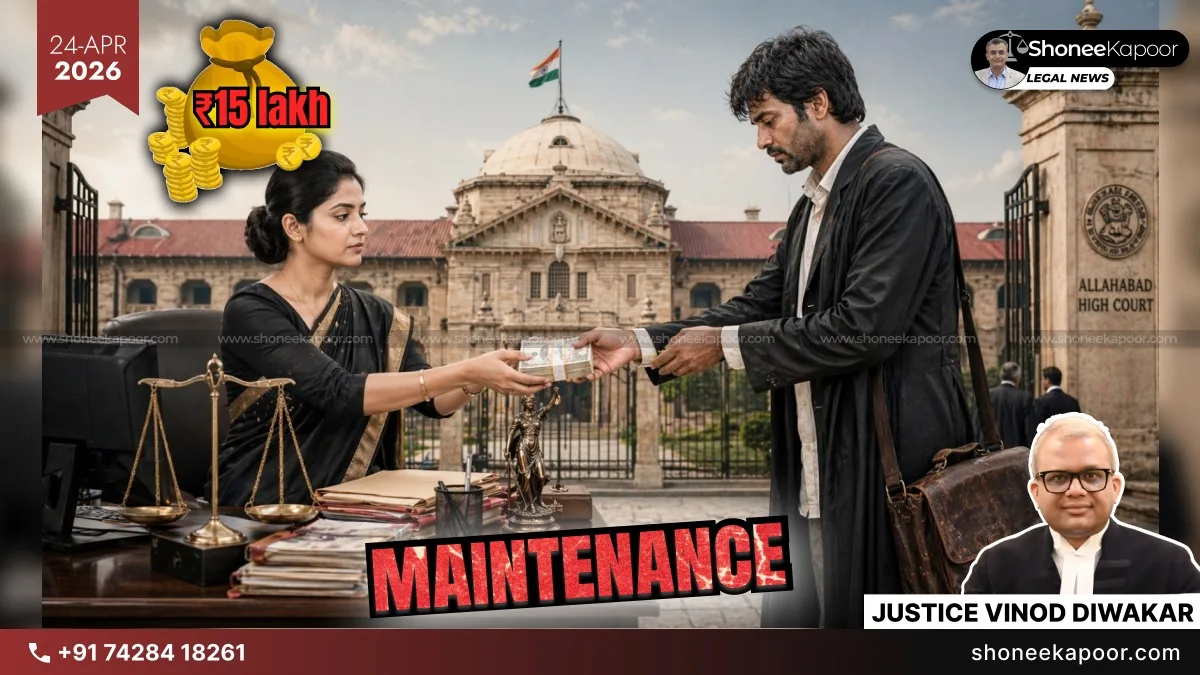
The Allahabad High Court not only dismissed the husband’s petition but also imposed heavy costs of ₹15 lakh.
Would a financially dependent wife have received the same treatment as the husband in this matter?
PRAYGRAJ: The Allahabad High Court, through Justice Vinod Diwakar, passed an order that courts must carefully examine facts and should not grant relief where there is concealment, false claims, or misuse of legal process by any party in a matrimonial dispute.
The Court dismissed the husband’s petition filed under Article 227 of the Constitution and imposed ₹15 lakh as compensatory cost payable to the wife.
The husband had approached the High Court seeking speedy disposal of his maintenance case under Section 144 BNSS pending before the Family Court at Etawah. He claimed that he was unemployed, had no stable income, and was financially dependent on his wife, who is working as an Additional Private Secretary in the High Court.
He alleged that after securing a government job, the wife started insulting him, humiliating him, and filing false criminal complaints against him. According to him, he was surviving only through loans taken from friends and relatives.
The wife strongly opposed the petition and presented a different picture. She argued that the husband belonged to a financially strong family, was a practicing advocate, and had hidden his real sources of income.
She also alleged that personal loans were taken from her salary account on his request in the name of buying land, but the money was later transferred to his own accounts and misused. She informed the Court that she is still paying an EMI of ₹26,020 every month.
After examining bank records, earlier court proceedings, affidavits, and income details, the High Court found that the husband had already received an earlier order under Section 24 of the Hindu Marriage Act granting him ₹5,000 monthly maintenance and ₹10,000 towards litigation expenses. However, this important fact was not properly disclosed in the present petition.
The Court also noted that the maintenance proceedings at Etawah had already been stayed in another transfer case. Therefore, seeking urgent disposal of a stayed matter had no legal basis. In this background, the Court remarked:
“The High Court is not a window shopping forum.”
Justice Diwakar further took serious note of suppression of facts and repeated litigation tactics. The Court observed:
“The conduct of the petitioner in suppressing material facts and pursuing parallel remedies, while seeking equitable relief, disentitles him from any indulgence by this Court.”
While discussing the legal position on maintenance claims under criminal law provisions, the Court referred to earlier judgments and quoted:
“The legislature would not have intended to clothe the husband with the right to claim maintenance from his wife under this Chapter.”
It also cited another ruling stating:
“A husband is not entitled to file application under Section 125 Cr.PC claiming maintenance from the wife.”
After considering the entire matter, the Court held that the petition lacked bona fide intention and dismissed it with ₹15 lakh cost, payable within six weeks. If the amount is not paid, it can be recovered as arrears of land revenue.
The Family Court at Prayagraj was also directed to expedite the pending matrimonial proceedings between the parties.
Explanatory Table: Laws And Section Involved
| Law / Section | Purpose | How Applied in This Case |
| Article 227, Constitution of India | Gives High Court supervisory powers over subordinate courts | Husband filed petition seeking direction for speedy hearing |
| Section 144 BNSS, 2023 | Maintenance remedy for wife, children and parents | Husband filed maintenance proceedings before Family Court Etawah |
| Section 24, Hindu Marriage Act | Interim maintenance and litigation expenses during pending matrimonial cases | Husband had already received ₹5,000 monthly and ₹10,000 expenses |
| Section 13, Hindu Marriage Act | Divorce provision | Wife had filed divorce case |
| Section 9, Hindu Marriage Act | Restitution of Conjugal Rights | Husband filed separate matrimonial case |
| Section 21-B, Hindu Marriage Act | Speedy disposal of matrimonial matters | High Court directed Family Court to expedite pending matters |
| Section 11, Family Courts Act | Allows in-camera/private hearing in family disputes | Court directed evidence may be recorded privately |
| Section 498A IPC | Cruelty by husband or relatives | FIR filed by wife |
| Section 323 IPC | Punishment for causing hurt | Included in wife’s FIR |
| Section 504 IPC | Intentional insult provoking breach of peace | Included in wife’s FIR |
| Section 506 IPC | Criminal intimidation | Included in FIRs |
| Section 406 IPC | Criminal breach of trust | FIR relating to car/property allegations |
| Section 3/4 Dowry Prohibition Act | Punishes dowry demand/taking | Included in wife’s FIR |
| Arrears of Land Revenue | Recovery process through state machinery | Ordered if ₹15 lakh cost is not paid |
Case Details
- Case Title: Ranjeet Singh vs Neetu Singh
- Court: High Court of Judicature at Allahabad
- Case Type: Matters Under Article 227
- Case Number: No. 12198 of 2025
- Bench: Hon’ble Justice Vinod Diwakar
- Neutral Citation: 2026:AHC:90307
- Date of Judgment: 23 April 2026
- Counsels:
- For Petitioner: Anurag Shukla, Arun Kumar Soni, Kumar Anubhav, Ms. Amrita Rai Mishra
- For Respondent: Gyan Chandra, Mahendra Bahadur Singh, Vijeta Singh
Key Takeaways
- The Court placed strong emphasis on the husband’s conduct and non-disclosure, while the wife’s stable government income and financial position were not treated as a determining factor in granting or denying relief.
- Despite the wife being the earning spouse, the legal framework applied did not recognize a reciprocal right of maintenance for the husband under the criminal law provisions.
- The Court relied on precedents which clearly exclude husbands from claiming maintenance under Section 125 CrPC / Section 144 BNSS, reinforcing a gender-specific interpretation.
- Financial transactions and alleged misuse of the wife’s earnings were examined, but the broader question of financial dependency of a non-earning husband was not accepted as a valid ground.
- The final outcome reflects that even where the wife is financially stronger, the legal position remains unchanged, and the husband’s claim gets rejected primarily on conduct and maintainability grounds.
This Could Change Your Case-Get FREE Legal Advice-Click Here!
Disclaimer: The views and opinions expressed in this article are those of the Indian courts and do not necessarily reflect the official policy or position of “ShoneeKapoor.com” or its affiliates. This article is intended for informational and educational purposes only. The content provided is not legal advice, and viewers should not act upon this information without seeking professional counsel. Viewer discretion is advised.
