
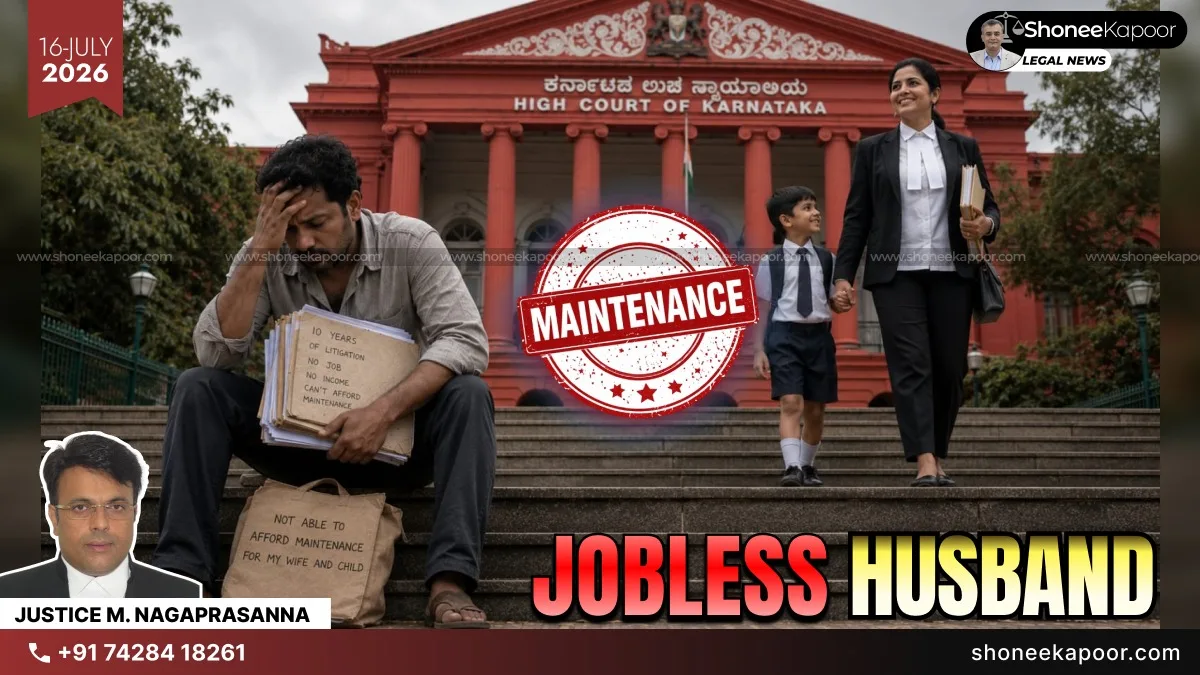
Can a man struggling with unemployment or a meagre salary be excused from maintenance? The Karnataka High Court says no, holding that an able-bodied husband is expected to find work or seek better-paying employment to support his wife and child.
BENGALURU: The Karnataka High Court has held that a husband cannot escape his maintenance merely by claiming to be unemployed or underpaid, ruling that it is on him to find employment, or better-paying employment, no matter how difficult that may actually be.
Justice M. Nagaprasanna dismissed a petition filed by a man seeking to overturn orders of the Magistrate and the Revisional Court directing him to pay Rs 8,000 per month each to his wife and lurch child as maintenance under Section 125 CrPC/ 144 BNSS, totalling Rs 16,000 a month. The High Court found no illegality in the orders, holding that an able-bodied husband cannot be excused from his duty simply by pointing to his current lack of income.
The Court held that a wife and child cannot be left in the lurch merely because a husband says he has no job or an inadequate one — leaving little space for the possibility that his claim of unemployment might simply be true.
The husband told the High Court that he was presently unemployed to comply with the order. He also submitted that his wife, an enrolled advocate, earned more than he did — a claim the Court did not weigh against her in assessing her own need for maintenance.
The wife, appearing in person, stated that ill health had prevented her from practising even for a single day, and argued that the maintenance award should not be interfered with. Her claim was accepted without the same scrutiny applied to her husband’s claim of joblessness.
It also emerged during the hearing that the husband had not complied with the original maintenance order passed in February 2022, and that arrears had accumulated to around Rs 21 lakh — a sum treated by the Court chiefly as evidence of his non-compliance, rather than as a signal that the order itself may no longer be realistic for him to meet.
Justice Nagaprasanna framed the issue as whether to accept the husband’s submission that he presently has no source of income, and therefore has been unable to comply with an order passed four years ago. The Court declined to accept this.
The Bench observed:
“If the husband has no job, it is for him to search for a job. He has a job that pays less salary, it is for him to search for a job that pays higher salary and take care of the wife and the child. The child and the wife cannot be left in the lurch.”
The Court further held that the husband’s submission regarding his son’s age would have deserved consideration only if he had first complied with the maintenance order — meaning his inability to pay, itself flowing from his unemployment, was used to foreclose every other argument he sought to raise.
The husband had also argued that the courts below failed to follow the Supreme Court’s detailed means-and-needs framework in Rajnesh v. Neha. The High Court rejected this, holding that the Revisional Court had in fact undertaken an even more elaborate scrutiny than Rajnesh contemplated, and that his conduct in any event did not warrant interference.
Finding no legal infirmity in the concurrent findings of the courts below, the High Court dismissed the petition and upheld the maintenance awarded to the wife and minor chid— leaving an unemployed husband liable for Rs 16,000 a month going forward, on top of Rs 21 lakh in arrears, with no assessment of whether either sum is realistically within his means.
CASE LAWS & SECTIONS MENTIONED IN THE CASE
| LAW / PROVISION | PURPOSE | HOW IT WAS APPLIED IN THIS CASE |
| Section 125, Code of Criminal Procedure, 1973 (Maintenance of Wives, Children & Parents) | Casts a statutory duty on a husband with sufficient means or the ability to earn to maintain a wife and child unable to maintain themselves. | The Magistrate’s original order and the Revisional Court’s confirmation of Rs 8,000 per month each to wife and child were passed under this provision; the husband’s plea that unemployment excused him from paying was rejected. |
| Anju Garg v. Deepak Kumar Garg (2022 SCC Online SC 1314) | Holds that an able-bodied husband must actively search for work, or better-paying employment, rather than rely on unemployment as a defence. | The High Court relied on this precedent to reject the husband’s claim that his present joblessness justified non-compliance with the maintenance order. |
| Rajnesh v. Neha (2021) 2 SCC 324 | Lays down a detailed procedure for assessing maintenance based on the means, needs, and standard of living of both parties. | The husband argued this framework was not followed; the High Court held the Revisional Court had in fact gone further than Rajnesh required, and declined to interfere. |
CASE DETAILS
- Case Title: Sri Harish R. v. Smt. Sowmya & Anr.
- Court: High Court of Karnataka
- Neutral Citation: 2026: KHC:34049
- Date of Order: 7 July 2026
- Coram: Justice M. Nagaprasanna
- Order Appealed Against: Concurrent orders of the Magistrate and the Revisional Court awarding maintenance of Rs 8,000 per month each to wife and child
- Original Maintenance Order: February 2022 (Rs 16,000 per month, combined)
COUNSELS APPEARED
- For the Petitioner (Husband): Sri Sudhindra S.A., Advocate
- For the Respondent 1 (Wife): Appeared in person
- For the Respondent 2 (Minor son): Sri Surya Dev R., Advocate
KEY TAKEAWAYS
- An unemployed husband gets no benefit of the doubt, while a wife’s claim of being unable to work is accepted without similar scrutiny.
- Four-year-old maintenance orders are treated as fixed and untouchable, even when a husband’s circumstances have visibly changed since.
- Courts keep repeating that a husband must simply ‘find a job,’ without asking whether that is realistically possible for him.
- A maintenance figure fixed in 2022 was upheld unchanged in 2026, even as arrears reached Rs 21 lakh — the order was not revisited despite the husband’s changed circumstances.
- The Court’s reliance on Anju Garg effectively converts a maintenance order into a floor that never moves, regardless of how long it takes a husband to find comparable work again.
This Could Change Your Case-Get FREE Legal Advice-Click Here!
Disclaimer: The views and opinions expressed in this article are those of the Indian courts and do not necessarily reflect the official policy or position of “ShoneeKapoor.com” or its affiliates. This article is intended for informational and educational purposes only. The content provided is not legal advice, and viewers should not act upon this information without seeking professional counsel. Viewer discretion is advised.
