
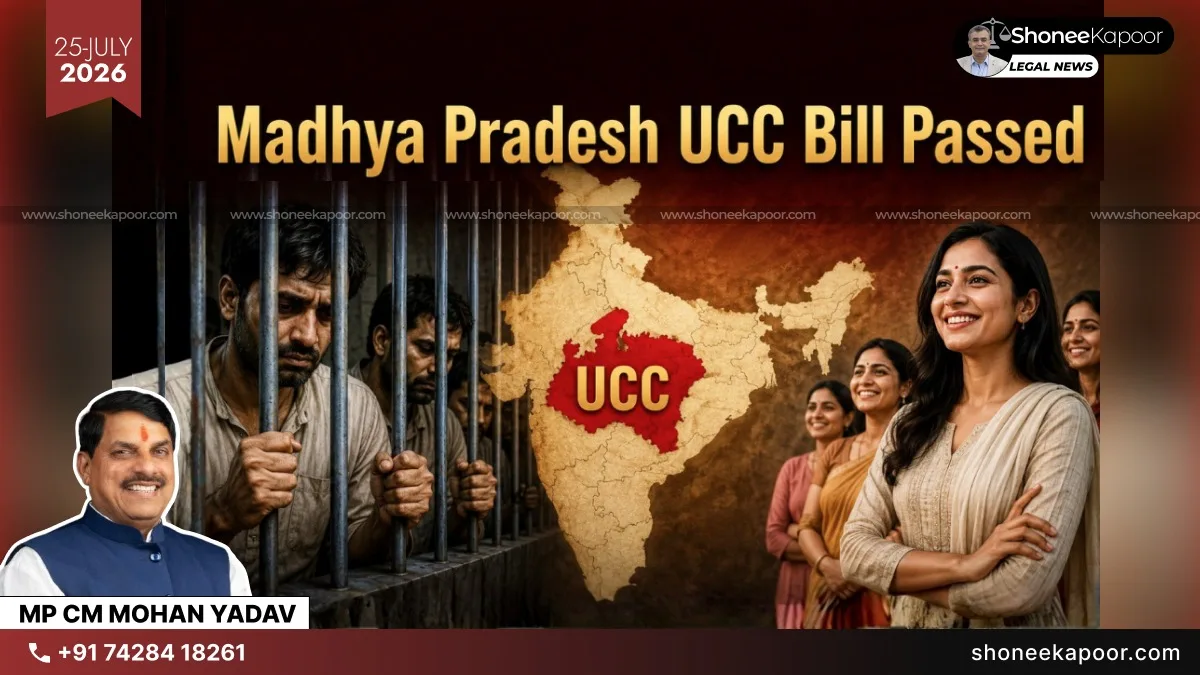
Will compulsory registration and court-controlled divorce bring equality, or will the gender-specific punishment expose married men to another one-sided criminal provision?
BHOPAL: The Madhya Pradesh Assembly passed the Uniform Civil Code Bill, 2026, on July 21 by a voice vote amid opposition protests. The Bill covers marriage, divorce, inheritance and live-in relationships, but it will not become law until it receives the required assent.
Chief Minister Mohan Yadav told the Assembly that the proposed law rests on “four pillars”– marriage, divorce, succession, and live-in relationships.
He said the UCC would not interfere with religious ceremonies, customs, rituals or traditions. People would remain free to perform marriages according to their religious and social practices, but their legal rights and duties would be governed by common rules.
Under the Bill, the minimum marriage age will remain 21 years for men and 18 years for women. Polygamy will be completely prohibited, irrespective of religion.
Registration of every marriage will become compulsory. Failure to register a marriage may invite a monetary penalty. Divorce will also be permitted only through a legal court process.
“No one will be able to enter into arbitrary marriages and divorces outside the jurisdiction of the court,” the Chief Minister said.
Live-in relationships will also have to be registered with the government. Earlier reports on the draft stated that couples would be required to complete registration within one month.
One of the most significant and controversial provisions concerns married men. According to the Chief Minister’s statement, a married man who deceives his wife and enters a live-in relationship may face imprisonment of up to five years.
While the provision is presented as protection for wives, its gender-specific wording may require close legal examination. A criminal punishment directed only at married men could create unequal consequences where both adults knowingly enter the relationship. Clear safeguards, proper investigation and strong proof standards will be necessary to prevent personal disputes or unverified accusations from turning into serious criminal prosecution.
The Bill also proposes equal inheritance rights for sons and daughters in ancestral property.
“Daughters and sons will have equal rights in the ancestral property. Legally, the women’s property will also be transferred in the same manner as that of men. This is a right to equality for mothers and sisters.”
Scheduled Tribes and certain communities whose customary practices receive legal protection have been kept outside the Bill’s scope.
The state government said that it received more than 1,164 suggestions during the consultation process and claimed that 93% of the people who participated supported the proposed law.
Congress MLA Arif Masood opposed the Bill and demanded that it be sent to a Select Committee for further examination.
The draft was prepared by a seven-member committee headed by former Supreme Court judge Justice Ranjana Prakash Desai. Until the Bill receives assent and is formally notified, its provisions—including compulsory registration and the five-year punishment—remain proposals and cannot be enforced as law.
LEGAL PROVISIONS EXPLAINED
| LAW OR PROVISION MENTIONED | WHAT IT MEANS | PROPOSED LEGAL EFFECT | KEY CONCERN |
| Madhya Pradesh Uniform Civil Code Bill, 2026 | A proposed common framework for marriage, divorce, succession and live-in relationships, regardless of religion | The Assembly passed it by voice vote on July 21, 2026 | It is a legislative Bill, not a court judgment |
| Compulsory marriage registration | Every marriage must be officially registered | Failure to register may attract a fine | The exact deadline, fine and section number require the official Bill |
| Minimum marriage age | Men must be at least 21 and women at least 18 | A marriage below the prescribed age may violate the proposed Code and existing child-marriage law | Different minimum ages for men and women continue |
| Ban on polygamy | A person cannot have more than one legally subsisting spouse | A second marriage during the first valid marriage may be prohibited | Exact punishment must be verified from the Bill |
| Judicial divorce | Marriage cannot be dissolved merely through an informal or private declaration | Divorce must take place through legally recognised court proceedings | Religious ceremonies may continue, but legal dissolution will require judicial procedure |
| Live-in relationship registration | Couples in a live-in relationship must inform or register with the prescribed government authority | Non-registration or concealment may lead to legal consequences | Registration conditions and privacy safeguards require examination |
| Five-year punishment involving married men | A married man who allegedly deceives his wife and enters a live-in relationship may face imprisonment | Punishment may extend to five years, according to the reported provision | A provision aimed only at men raises questions about equal criminal liability and misuse through unverified allegations |
| Equal ancestral-property rights | Sons and daughters will receive equal rights in ancestral property | Gender cannot be the basis for denying inheritance | Similar equality already exists under several succession laws, but the UCC seeks uniform application |
| Transfer of women’s property | Property legally belonging to a woman will devolve according to the prescribed succession rules | Women’s estates will receive formal succession protection | Exact heirs and order of succession depend on the Bill’s text |
| Scheduled Tribe exemption | Certain Scheduled Tribes and protected customary communities may remain outside the Code | Their recognised customary practices may continue | The precise exempted groups must be identified from the final law |
| Governor’s assent | A Bill passed by the State Assembly ordinarily requires assent before becoming enforceable | The provisions cannot be treated as operational merely because the Assembly passed the Bill | Gazette notification and commencement date must be checked |
| Article 44 of the Constitution | A Directive Principle asking the State to endeavour to secure a Uniform Civil Code | It provides constitutional policy support for pursuing a UCC | Article 44 is not directly enforceable like a Fundamental Right |
| Article 14 of the Constitution | Guarantees equality before law and equal protection of laws | Gender-based classifications must satisfy constitutional equality standards | A punishment applying only to married men may invite scrutiny if similarly placed women are treated differently |
| Article 15 of the Constitution | Prohibits discrimination on specified grounds, including sex, subject to constitutional exceptions | Laws cannot ordinarily impose arbitrary disadvantages solely because of sex | Gender-specific penal consequences may require a clear and constitutionally valid justification |
| Article 21 of the Constitution | Protects life and personal liberty, including dignity and privacy | Live-in registration rules must follow fair procedure and respect privacy | Compulsory disclosure of intimate relationships may face proportionality and privacy questions |
KEY TAKEAWAYS
- A Uniform Civil Code should create equal rights and equal liabilities. Any criminal provision targeting only married men raises serious questions about gender neutrality.
- The proposed five-year jail provision must have strong safeguards against false complaints, as criminal law should punish proven misconduct, not mere allegations.
- Making marriage and live-in registration compulsory can improve legal certainty, but privacy rights and due process must be protected.
- Court-supervised divorce can reduce arbitrary separations, provided the process remains fair, time-bound and equally accessible to both spouses.
- Equal inheritance rights and a ban on polygamy promote uniformity, but true equality under a UCC also requires gender-neutral criminal provisions.
This Could Change Your Case-Get FREE Legal Advice-Click Here!
Disclaimer: The views and opinions expressed in this article are those of the Indian courts and do not necessarily reflect the official policy or position of “ShoneeKapoor.com” or its affiliates. This article is intended for informational and educational purposes only. The content provided is not legal advice, and viewers should not act upon this information without seeking professional counsel. Viewer discretion is advised.
