
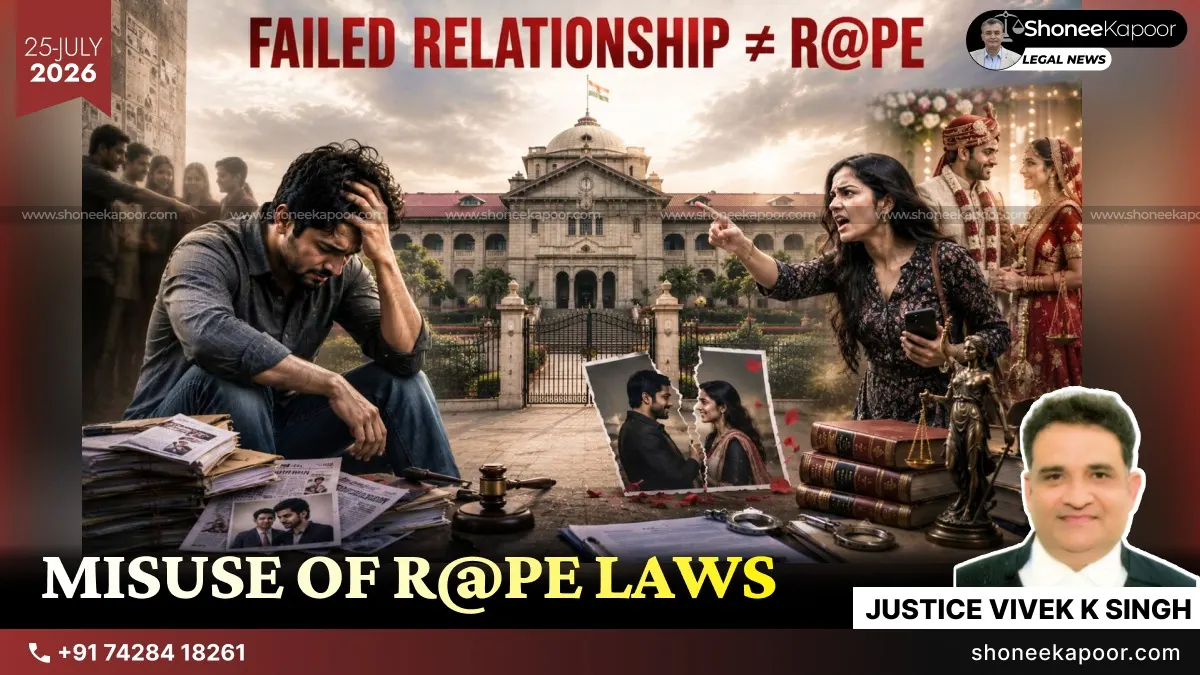
Can a long consensual relationship be treated as rape merely because the man later refuses to marry?The Allahabad High Court looked beyond the allegations to examine what really happened.
UTTAR PRADESH:The Allahabad High Court recently quashed a rape case arising from a failed consensual relationship, observing that the FIR appeared to have been filed to take revenge after the man decided to end the relationship and marry another woman.
Justice Vivek Kumar Singh examined the statements of both parties and the material placed before the Court. The Court found that the man and the woman had remained in a consensual relationship for a considerable period.
According to the Court, the woman’s conduct and her own statements did not support the allegation that the physical relationship was established against her will or without her consent.
The High Court allowed the application filed under Section 528 of the BNSS, and quashed the charge sheet, the cognizance order and the complete criminal proceedings under Sections 376, 504 and 506 of the Indian Penal Code.
The Court observed:
“no offence of rape is made out against the applicant and the instant first information report was lodged by the prosecutrix as she was annoyed by the behaviour of the applicant and was unwilling to leave him. It appears from the conduct of the victim that the first information report was lodged by her to take revenge from the applicant”,
The Court further added:
“It appears from the conduct of the victim that the first information report was lodged by her to take revenge from the applicant,”
The woman stated that she came into contact with the accused through Facebook. Over time, they developed a romantic relationship.
She alleged that the accused established physical relations with her after promising marriage. She claimed that he later refused to marry her after his marriage was fixed with another woman.
However, after examining the evidence and the statements recorded during the investigation, the High Court found that their relationship had continued consensually for around one-and-a-half years.
The Court also noted that the woman was an adult and educated. In her statement recorded under Section 164 of the Code of Criminal Procedure, she stated that she had physical relations with the accused around 30 to 40 times during the relationship.
The High Court found no material showing that the accused had made a false promise of marriage from the very beginning only to obtain her consent for a physical relationship.
Instead, the evidence indicated that the relationship was genuine at the initial stage but later broke down due to differences between the parties.
The bench noted that the accused eventually withdrew from the relationship. The woman was reportedly unable or unwilling to accept his decision.
The FIR was then lodged against him, possibly after his ‘Tilak’ ceremony had taken place for his proposed marriage with another woman.
Justice Singh described the case as “an example of a failed relationship” and clarified that criminal law cannot automatically be used when a consensual relationship does not result in marriage.
The Court rejected the woman’s argument that she had consented to the physical relationship under the misconception that the accused would certainly marry her.
The bench noted that she had not alleged that the accused had no intention to marry her from the very beginning of their relationship.
For an allegation of rape based on a false promise of marriage, it must normally be shown that the promise was false from the start and was made only to obtain the woman’s consent.
A later refusal to marry, change of circumstances or breakdown of a relationship cannot by itself prove that the original promise was fraudulent.
The Court therefore held that the essential ingredients required to establish the offence of rape were not present in the case.
The High Court further observed:
“…when a woman of competent age, having sufficient understanding of the physical activities in which she is involved on the basis of a promise of marriage, understands the risks associated with such a physical relationship as there is a significant difference between marriage and a mere promise of marriage…This Court finds that by no stretch of imagination the prosecutrix could have given her consent for sexual relationship under misconception of marriage”.
The Court stated that an educated and independent adult who voluntarily enters a romantic relationship after making a free and conscious choice must understand that every relationship carries certain uncertainties.
A promise or expectation of marriage cannot always be treated as a legally guaranteed outcome.
The Court also acknowledged that the end of a relationship can cause emotional pain, disappointment and anger. Some people may find it difficult to accept the breakdown of a relationship in a mature manner.
However, emotional distress or resentment cannot be allowed to convert a consensual relationship into a serious criminal prosecution unless the legal ingredients of the alleged offence are clearly established.
The bench cautioned:
“In such situations, allegations may sometimes arise which are rooted more in personal grievance than in the commission of a criminal offence. Courts are therefore required to exercise caution and discernment while examining such allegations, particularly where the material on record reflects a consensual relationship between adults”
The Court remarked that it had noticed in a “large number of cases” a “growing trend” in which long-term consensual relationships were sought to be criminalised after the relationship turned bitter.
The judgment highlights the need to carefully distinguish between an actual case of sexual exploitation based on deception and a voluntary adult relationship that later fails.
Serious criminal provisions can cause major damage to the liberty, reputation, career and family life of an accused person. Therefore, such provisions cannot be continued merely to settle personal scores after a romantic dispute.
At the same time, the Court’s ruling does not mean that every allegation involving a promise of marriage must be rejected. Each case must be decided on its own facts, including the intention of the accused at the beginning of the relationship and the circumstances in which consent was given.
In the present case, the High Court found that continuing the prosecution would amount to a “gross abuse of the process of law”.
The Court relied upon the principles laid down by the Supreme Court in State of Haryana v. Bhajan Lal.
It held that the matter fell within the first, fifth and seventh categories identified in the Bhajan Lal judgment, under which criminal proceedings can be quashed where the allegations do not disclose an offence, appear inherently improbable or have been initiated with a malicious intention.
The High Court concluded that the proceedings appeared to have been started with an ulterior motive to take vengeance after a personal relationship failed.
Accordingly, the Court quashed the charge sheet, cognizance order and the entire criminal proceedings against the accused.
EXPLANATORY TABLE OF LAWS AND SECTION
| LAW/SECTION | WHAT IT MEANS | RELEVANCE IN THIS CASE |
| Section 528, BNSS | Gives the High Court inherent power to stop abuse of the legal process and secure justice. It corresponds broadly with Section 482 CrPC. | The applicant used this provision to seek quashing of the charge-sheet, cognizance order and entire criminal case. |
| Section 482, CrPC | Former provision recognising the High Court’s inherent power to quash criminal proceedings in exceptional cases. | The Court discussed earlier judgments explaining when such inherent powers can be exercised. |
| Section 375, IPC | Defines the offence of rape and explains circumstances where consent is absent or legally invalid. | The Court examined whether the woman’s consent was obtained through a false promise of marriage. |
| Section 376, IPC | Provides punishment for rape. | This was the principal criminal charge against the applicant. The Court held that its basic ingredients were not made out. |
| Section 376(2)(n), IPC | Deals with repeatedly committing rape upon the same woman. | Supreme Court precedents concerning prolonged relationships and repeated intimacy were discussed to distinguish rape from a consensual relationship. |
| Section 504, IPC | Punishes intentional insult intended to provoke a breach of peace. | The Court found that the allegation of abuse was not supported by material particulars. |
| Section 506, IPC | Punishes criminal intimidation or threats. | The Court found no adequate material particulars supporting the allegation of threats. |
| Section 90, IPC | States that consent given under fear or misconception of fact may not be legally valid. | The Court examined whether consent was based on a genuine misconception created by a deliberately false promise of marriage. |
| Section 161, CrPC | Allows the police to record statements of persons during investigation. | The woman’s police statement was compared with the FIR and her statement before the Magistrate. |
| Section 164, CrPC | Allows a Magistrate to formally record a statement or confession. | In this statement, the woman reportedly said that physical relations occurred around 30–40 times. |
| Section 156(1), CrPC | Gives police power to investigate cognizable offences without a Magistrate’s prior order. | Mentioned while reproducing the Supreme Court’s Bhajan Lal guidelines on quashing FIRs. |
| Section 155(2), CrPC | Requires a Magistrate’s order before police investigate a non-cognizable offence. | Also mentioned in the Bhajan Lal guidelines reproduced by the High Court. |
CASE DETAILS
| Particular | Details |
| Case Title | Lokendra Singh v. State of U.P. and Another |
| Neutral Citation | 2026:AHC:127911 |
| Case Number | Application U/S 528 BNSS No. 16851 of 2025 |
| Court | High Court of Judicature at Allahabad |
| Bench | Hon’ble Justice Vivek Kumar Singh |
| Decision Date | 18 June 2026 |
| Applicant | Lokendra Singh |
| Opposite Parties | State of Uttar Pradesh and Another |
| Counsel for Applicant | Sri Mahendra Pratap Singh |
| Counsel for Informant/Victim | Sri Raj Kumar Shukla |
| Counsel for State | Sri O.N. Mishra, Additional Government Advocate |
KEY TAKEAWAYS
- A consensual relationship does not become rape merely because the man later refuses to marry.
- A failed relationship cannot be criminalised without proof of a false promise from the very beginning.
- Revenge or emotional distress cannot justify invoking rape laws against a man.
- Courts must carefully scrutinise consent and evidence before allowing a rape prosecution to continue.
- Serious criminal laws should protect genuine victims, not become tools to settle personal relationship disputes.
This Could Change Your Case-Get FREE Legal Advice-Click Here!
Disclaimer: The views and opinions expressed in this article are those of the Indian courts and do not necessarily reflect the official policy or position of “ShoneeKapoor.com” or its affiliates. This article is intended for informational and educational purposes only. The content provided is not legal advice, and viewers should not act upon this information without seeking professional counsel. Viewer discretion is advised.
