
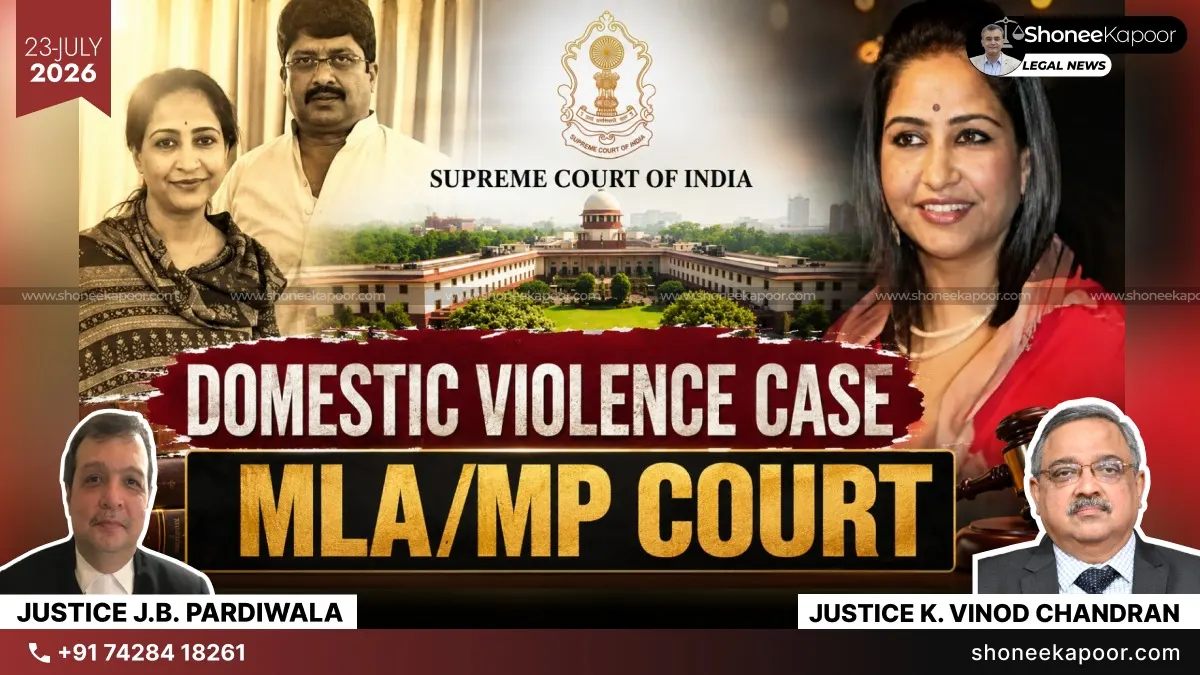
Can a private matrimonial dispute be treated like a criminal case against a politician merely because one spouse is a legislator? The Supreme Court has raised this important question while transferring the case back to the Mahila Court where it was originally filed.
NEW DELHI: The Supreme Court has expressed a prima facie view that special MP/MLA courts, which were created to speed up criminal cases against elected representatives, may not have jurisdiction to hear matrimonial disputes merely because one of the parties is a legislator.
A Bench of Justice J.B. Pardiwala and Justice K. Vinod Chandran made the observation while hearing a petition filed by MLA Raghuraj Pratap Singh, popularly known as Raja Bhaiya.
The case arose from proceedings initiated by his wife under the Protection of Women from Domestic Violence Act, 2005. A Rouse Avenue MP/MLA Court had issued summons to Singh, and the Delhi High Court had earlier upheld that order.
The Supreme Court observed:
“We are not convinced that a matrimonial dispute can be agitated before such a special Court merely for reason of one of the parties being a legislator.”
The Delhi High Court had held that an MP/MLA Court continues to function as a Magistrate Court exercising powers under the Code of Criminal Procedure or the Bharatiya Nagarik Suraksha Sanhita. Therefore, according to the High Court, proceedings under Section 12 of the PWDV Act could legally continue before such a court.
Singh, an MLA from the Kunda constituency, challenged the High Court decision before the Supreme Court. He argued that the special MP/MLA Court had no jurisdiction to hear a case filed under the Domestic Violence Act.
The question before the Supreme Court was:
“Whether the proceedings taken before the special designated MP/MLA Court at Rouse Avenue, would be maintainable for lack of jurisdiction especially considering the statutory mandate under territorial jurisdiction under Section 27 of the PWDV Act.”
Senior Advocate Kirti Uppal, appearing for Singh, informed the Court that the wife had originally filed the case before the Metropolitan Magistrate Court, also known as the Mahila Court. However, that case was later withdrawn and filed before the Special MP/MLA Court for faster disposal.
The Supreme Court accepted the need to examine whether such a transfer was legally permissible. Referring to Ashwini Kumar Upadhyay v. Union of India and Another (2021), the Court observed:
“The Special Courts for MP/MLA were sought to be designated to try criminal cases against MPs/MLAs in offences under the Indian Penal Code (IPC) and the special legislations.”
The Court further explained the purpose behind creating such special courts:
“Large pendency and delay occasioned, prompted this Court to pass orders directing designations of special Courts to ensure public accountability, promote vigilance and prevention of corruption.”
The Supreme Court noted that MP/MLA courts were created mainly to ensure speedy disposal of criminal cases involving legislators and to maintain public accountability. They were not necessarily meant to become an alternative forum for private matrimonial proceedings.
The observation is significant because allowing a matrimonial case to be moved to a special court solely because the husband is a legislator could place one party at a procedural disadvantage and create a special legal route that may not be available in ordinary matrimonial disputes.
However, the Supreme Court clearly stated that its observations were only prima facie. It did not finally decide the legal question regarding whether MP/MLA courts can hear proceedings under the Domestic Violence Act and kept the issue open for consideration in an appropriate case.
During the hearing, both parties agreed that the matter could be transferred back to the court where it was originally filed.
Accordingly, the Supreme Court transferred the case to Metropolitan Magistrate-02, Mahila Court, South District, Saket Courts, New Delhi.
The Court directed the Magistrate to explore the possibility of deciding the case within one year. It also directed both parties to cooperate with the proceedings and disposed of the petition.
EXPLANATORY TABLE OF ALL LAWS, SECTIONS AND CASES MENTIONED
| LAW, PROVISION OR PRECEDENT | WHAT IT MEANS | RELEVANCE IN THIS CASE |
| Protection of Women from Domestic Violence Act, 2005 | A law providing civil and protective remedies to women alleging domestic violence, including protection, residence, monetary relief, custody and compensation orders. | The respondent-wife’s proceedings against the petitioner arose under this Act. The dispute concerned which Magistrate Court had jurisdiction to hear the matter. |
| Section 27, Protection of Women from Domestic Violence Act, 2005 | Determines territorial jurisdiction. A competent Magistrate may hear the case where the aggrieved person resides temporarily or permanently, where the respondent resides, or where the alleged cause of action arose. | The Supreme Court identified territorial jurisdiction under Section 27 as a central issue while examining whether proceedings before the Rouse Avenue MP/MLA Court were maintainable. |
| Indian Penal Code, 1860 | The principal criminal code applicable before the Bharatiya Nyaya Sanhita came into force. It defined general criminal offences and punishments. | The Court noted that MP/MLA Special Courts were designated mainly to try criminal cases against legislators involving offences under the IPC and special criminal laws. |
| Special Legislations | Laws outside the general penal code that create specific criminal offences or procedures, such as anti-corruption or other special criminal statutes. | The Supreme Court explained that MP/MLA courts were created to expedite criminal cases against legislators under the IPC and special legislations, not necessarily private matrimonial disputes. |
| Article 136 of the Constitution of India — implicit through SLP jurisdiction | Gives the Supreme Court discretionary power to grant special leave to appeal against judgments or orders passed by courts and tribunals. | Raghuraj Pratap Singh approached the Supreme Court through a Special Leave Petition against the Delhi High Court’s order. Article 136 is not expressly quoted in the order but forms the jurisdictional basis of an SLP. |
| Ashwini Kumar Upadhyay v. Union of India and Another | A series of Supreme Court proceedings concerning the speedy trial of criminal cases pending against MPs and MLAs. | The Court relied on this precedent to explain why special MP/MLA courts were designated—public accountability, vigilance, prevention of corruption and faster disposal of criminal cases against legislators. |
| W.P.(C) No. 699 of 2016 | The writ petition number of Ashwini Kumar Upadhyay v. Union of India and Another. | Mentioned in the footnote as the proceeding in which directions concerning MP/MLA Special Courts were issued. |
| (2021) 20 SCC 613 | Supreme Court Cases reporter citation for one of the reported orders or decisions in the Ashwini Kumar Upadhyay proceedings. | The Bench examined this reported decision before observing that MP/MLA courts were intended to try criminal cases against legislators. |
| Criminal Procedure Code / Special Magistrate Jurisdiction | The procedural framework under which criminal courts and Magistrates exercise their powers. | Although the uploaded Supreme Court order does not expressly discuss any CrPC section, the jurisdictional controversy arose from the status and powers of the Special MP/MLA Magistrate Court. |
| Bharatiya Nagarik Suraksha Sanhita, 2023 | India’s current criminal procedure law, which replaced the Code of Criminal Procedure, 1973. | It was referred to in the Delhi High Court reasoning described in the legal report, but it is not expressly named in the uploaded Supreme Court order. |
CASE DETAILS
| PARTICULAR | DETAILS |
| Case Title | Raghuraj Pratap Singh v. Bhanvi Kumari Singh |
| Case Number | Special Leave Petition (Criminal) No. 11962 of 2026 |
| Court | Supreme Court of India |
| Jurisdiction | Extraordinary Appellate Jurisdiction |
| Nature of Order | Non-Reportable Order |
| Petitioner | Raghuraj Pratap Singh |
| Respondent | Bhanvi Kumari Singh |
| Bench | Justice J.B. Pardiwala and Justice K. Vinod Chandran |
| Order Date | July 15, 2026 |
| Court Number | Court No. 6 |
| Item Number | Item No. 15 |
| Section Classification | Section II-D |
| Impugned High Court Case | CRL.M.C. No. 7205 of 2024 |
| Impugned Judgment Date | May 30, 2026 |
| Impugned Court | High Court of Delhi at New Delhi |
| Underlying DV Case | CT Case No. 12 of 2024 |
| Underlying Case Title | Ms. Bhanvi Kumari Singh v. Sh. Raghuraj Pratap Singh |
| Court From Which Case Was Transferred | Chief Metropolitan Magistrate, Rouse Avenue Courts, New Delhi |
| Court to Which Case Was Transferred | Metropolitan Magistrate-02, Mahila Court, South District, Saket Courts, New Delhi |
| Connected Application | IA No. 187629 of 2026 — Exemption from filing certified copy of the impugned judgment |
COUNSELS
FOR THE PETITIONER
| NAME | DESIGNATION |
| Ms. Kirti Uppal | Senior Advocate |
| Mr. Gaurav Choudhary | Advocate-on-Record |
| Mr. Dhruv Gupta | Advocate |
| Mr. Anubhav Garg | Advocate |
FOR THE RESPONDENT
| NAME | DESIGNATION |
| Mr. Mohd Bilal | Advocate |
| Mr. Vishal Maurya | Advocate |
| Ms. Tanya Agarwal | Advocate-on-Record |
| Mr. Arvind Kumar Shukla | Advocate |
| Ms. Neena Shukla | Advocate |
| Ms. Surbhi Khanna | Advocate |
KEY TAKEAWAYS
- The husband was made to face proceedings before a special MP/MLA Court merely because he was a legislator.
- A private matrimonial dispute should not be converted into a high-pressure political trial against the husband.
- The Supreme Court rightly questioned why the husband was denied the ordinary court process available in normal matrimonial cases.
- Special courts cannot be used as an extra weapon to shame, pressure or corner a husband in a marital dispute.
- Had the legislator been a woman, the system would have protected her dignity and questioned the forum immediately. Men also deserve equal procedure, equal dignity and equal protection of law.
This Could Change Your Case-Get FREE Legal Advice-Click Here!
Disclaimer: The views and opinions expressed in this article are those of the Indian courts and do not necessarily reflect the official policy or position of “ShoneeKapoor.com” or its affiliates. This article is intended for informational and educational purposes only. The content provided is not legal advice, and viewers should not act upon this information without seeking professional counsel. Viewer discretion is advised.
