Legal Reading Room

English Articles

Practical legal writing on 498A, matrimonial disputes, criminal allegations, maintenance, custody and Indian court procedure.

Recent Articles

All Articles

Page 9 of 165 · 1483 articles

Husband Didn’t Take Wife To Dubai For Anniversary, So She Killed Him? Bombay High Court Grants Bail On Grounds Of Severe Spinal Problems
High Court Sep 16, 2026 0

Husband Didn’t Take Wife To Dubai For Anniversary, So She Killed Him? Bombay High Court Grants Bail On Grounds Of Severe Spinal Problems

The Bombay High Court granted bail to Renuka Khanna, accused in the 2023 death of her husband Nikhil Khanna, primarily considering her serious spinal condition and more than two years and ten months of pre-trial incarceration. Police alleged that the couple had quarrelled over several issues, including the husband not taking her to Dubai for her birthday and not giving an expected anniversary gift. The Court noted that a physical altercation preceded the death and that the husband died after being pushed and falling on a heavy, sharp object. The bail order does not determine her guilt; the High Court expressly stated that its observations were prima facie and would not affect the trial.

NEWS DESK Read
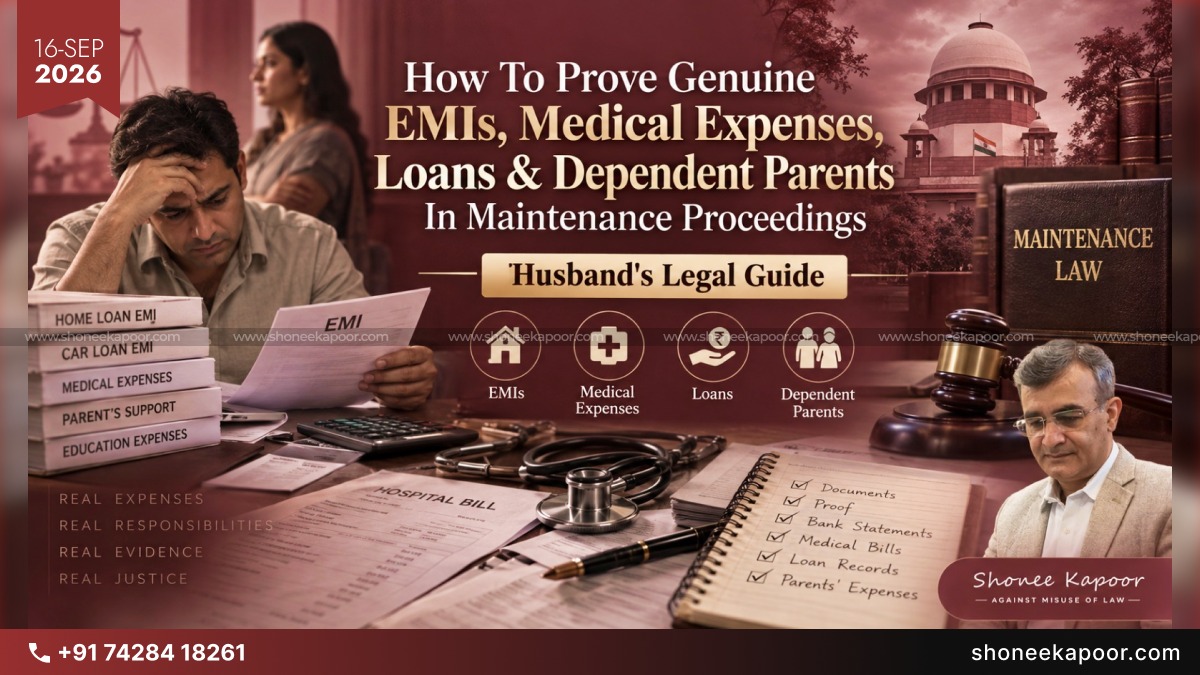
How To Prove Genuine EMIs, Medical Expenses, Loans & Dependent Parents In Maintenance Proceedings: Husband's Legal Guide
Blog Sep 16, 2026 0

How To Prove Genuine EMIs, Medical Expenses, Loans & Dependent Parents In Maintenance Proceedings: Husband's Legal Guide

In maintenance proceedings, a husband can place genuine financial liabilities before the court, but merely listing EMIs, loans or family expenses is generally insufficient. Courts examine documentary proof and the nature of each liability while assessing actual income, reasonable expenses, dependants and overall financial capacity. The Supreme Court’s Rajnesh v. Neha framework requires detailed disclosure of assets, liabilities, loans, EMIs, medical expenditure and dependent family members when maintenance is determined.

Vaibhav Ojha Read
Father Got Interim Child Custody After Family Court Criticised Mother For Failing “Pious Duties” As Wife; Bombay HC Sets It Aside, Calls Remarks “Regressive”
High Court Sep 15, 2026 0

Father Got Interim Child Custody After Family Court Criticised Mother For Failing “Pious Duties” As Wife; Bombay HC Sets It Aside, Calls Remarks “Regressive”

The Bombay High Court set aside a Family Court order granting interim custody of a minor child to the father after finding that the decision was influenced by observations about the mother allegedly failing her “pious duties” as a wife. The High Court described such remarks as regressive and stressed that child-custody decisions must focus on the welfare and best interests of the child rather than stereotypical expectations about a woman’s matrimonial role. The matter was directed to be reconsidered on legally relevant custody factors.

NEWS DESK Read
“Single Grave Act” Can Constitute 498A Cruelty, But Vague Allegations Cannot Drag Husband’s Relatives Into Trial: Kerala High Court
High Court Sep 15, 2026 0

“Single Grave Act” Can Constitute 498A Cruelty, But Vague Allegations Cannot Drag Husband’s Relatives Into Trial: Kerala High Court

The Kerala High Court held that a series of incidents is not always necessary to establish cruelty under Section 498A IPC; even a single act may be sufficient if it is grave enough to satisfy the statutory definition. However, ordinary marital disagreements or ill-treatment do not automatically constitute criminal cruelty. In Firoz Kunnumal v. State of Kerala, the Court quashed proceedings against six relatives of the husband because the allegations against them were vague and omnibus, with no specific overt acts attributed to them. The case against the husband was allowed to continue because the allegations against him were specific and prima facie disclosed the alleged offences.

NEWS DESK Read
Wife Sought Maintenance From Husband After 40 Years Of Separation: Delhi High Court Says Long Separation Does Not End His Liability
High Court Sep 15, 2026 0

Wife Sought Maintenance From Husband After 40 Years Of Separation: Delhi High Court Says Long Separation Does Not End His Liability

The Delhi High Court held that merely living separately for a long period does not, by itself, extinguish a husband’s obligation to maintain his wife. The entitlement to maintenance depends on statutory conditions, including the wife’s financial position, the circumstances behind the separation and the husband’s means—not simply on how many years the spouses have lived apart. Courts have consistently treated separate residence as a factor to examine rather than an automatic bar to maintenance.

NEWS DESK Read
₹2 Crore Alimony To Earning Wife Because Husband Earned More? Karnataka HC Cuts It To ₹50 Lakh: “Alimony Not Intended To Equalise Wealth”
High Court Sep 15, 2026 0

₹2 Crore Alimony To Earning Wife Because Husband Earned More? Karnataka HC Cuts It To ₹50 Lakh: “Alimony Not Intended To Equalise Wealth”

The Karnataka High Court reduced permanent alimony awarded to an earning wife from ₹2 crore to ₹50 lakh, observing that alimony is intended to provide reasonable financial security rather than equalise the assets or wealth of spouses. The Court considered that the wife was a qualified medical professional earning about ₹1.22 lakh net per month and had her own financial assets. Although the husband earned approximately ₹70 lakh annually, his higher income alone could not justify a disproportionate award. The Court also considered his liabilities, expenses and responsibilities toward the children and aged parents.

NEWS DESK Read
Wife Deserted Husband “Without Any Reasonable Cause” In 1992: Gujarat High Court Grants Divorce To 67-Year-Old Husband After 3 Decades
High Court Sep 14, 2026 0

Wife Deserted Husband “Without Any Reasonable Cause” In 1992: Gujarat High Court Grants Divorce To 67-Year-Old Husband After 3 Decades

The Gujarat High Court granted divorce to a 67-year-old husband after finding that his wife had been living separately from him since 1992 without reasonable cause. The couple married in 1989 and had two sons, but the wife left the matrimonial home in August 1992 and did not return. The Court set aside the Family Court’s finding on desertion and dissolved the marriage under the Hindu Marriage Act. It also increased the wife’s permanent alimony from ₹12,000 to ₹20,000 per month, considering that she had no independent source of income.

NEWS DESK Read
Entering a Woman’s House At Night, Lifting Her Clothes Without “Specific Overt Act” Is Not Rape: Jharkhand HC Cuts Man’s Conviction After 26 Years
High Court Sep 14, 2026 0

Entering a Woman’s House At Night, Lifting Her Clothes Without “Specific Overt Act” Is Not Rape: Jharkhand HC Cuts Man’s Conviction After 26 Years

The Jharkhand High Court modified a man’s conviction for attempted rape in a case arising from a 1999 incident. The Court held that entering the woman’s house at night, catching hold of her and lifting her clothes, without proof of a specific overt act sufficiently proximate to committing rape, did not meet the legal threshold for attempt to rape. However, the conduct remained criminal: the conviction was altered to Section 354 IPC for assault or criminal force intending to outrage a woman’s modesty, while the house-trespass conviction was upheld. Considering that more than 26 years had passed and the appellant had already spent about eight months in custody, the sentence was reduced to the period already undergone.

NEWS DESK Read
Wife Subjected Husband To Mental Cruelty, His Evidence Went Unchallenged: Pune Court Grants Divorce, Says “Mere Denial Cannot Defeat Evidence”
Legal Update Sep 14, 2026 0

Wife Subjected Husband To Mental Cruelty, His Evidence Went Unchallenged: Pune Court Grants Divorce, Says “Mere Denial Cannot Defeat Evidence”

A Pune district court granted divorce to a husband after concluding that he had proved mental cruelty by his wife. The husband alleged frequent quarrels, harassment, pressure to live separately from his family and denial of physical intimacy. The court noted that material parts of his evidence remained unchallenged and held that a mere denial by the wife was insufficient to displace evidence that had not been effectively rebutted. The divorce was granted under Section 10(x) of the Indian Divorce Act, applicable to the Christian couple.

NEWS DESK Read

Need legal clarity on your situation?

Every case is different. Book a consultation with Shonee Kapoor for specific, practical guidance.