
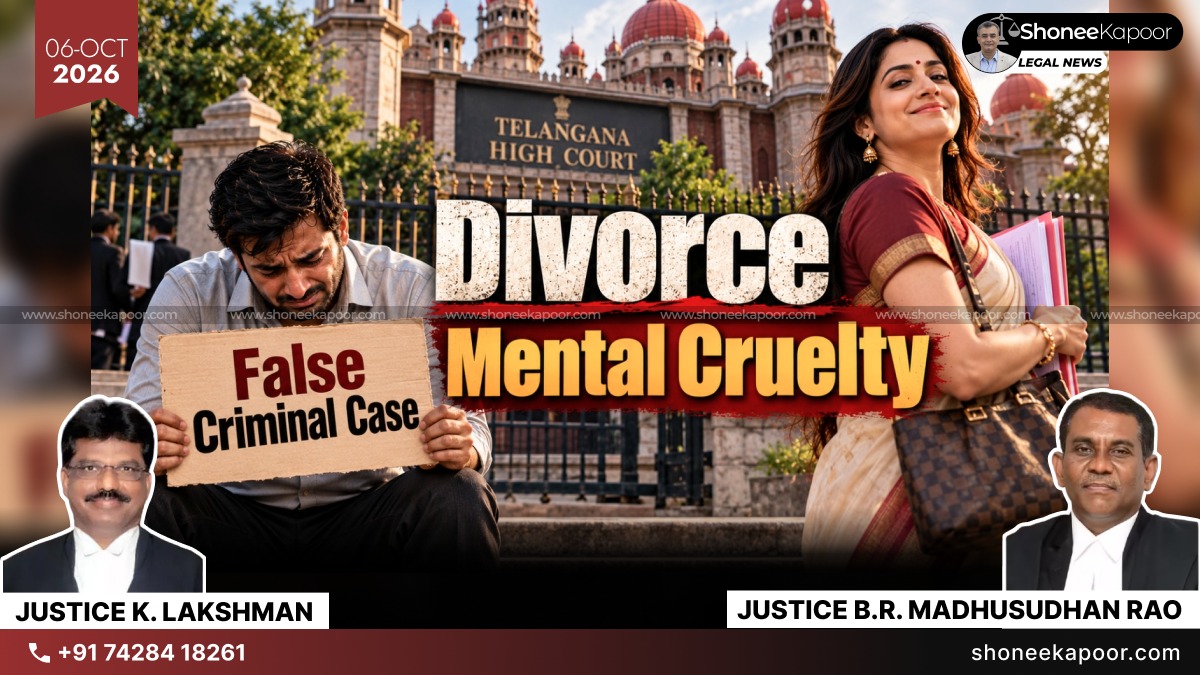
Wife Filing A False Criminal Case Against Husband Amounts To Mental Cruelty: Telangana High Court Grants Divorce After 16 Years

Written and analysed by Vaibhav Ojha
Head Of Legal CommunicationsHYDERABAD: The Telangana High Court has granted divorce to a husband who had been living separately from his wife for nearly 16 years. The Court held that the criminal complaint lodged against the husband and his family, which ultimately ended in acquittal, along with the long separation between the couple, amounted to mental cruelty.
A Division Bench of Justice K Lakshman and Justice B R Madhusudhan Rao set aside the Family Court order that had earlier dismissed the husband’s divorce petition.
The Court observed that the conduct of both parties showed that there was practically no intention to continue their matrimonial relationship.
“It is apt to note that when the petition was filed, the appellant was 33 years old and the respondent was 27 years old. At present, they are 49 years old and 42 years old, respectively. They have been living separately for approximately 16 years. The appellant has categorically stated that he is not willing to resume cohabitation or take her back into his society,” the Court stated in its September 18 order.
The Bench noted that the husband and wife had remained separated for around 16 years and no genuine attempt had been made to restore their marital relationship. It held that forcing such a marriage to continue would serve no meaningful purpose and could cause further mental cruelty to the parties.
The couple married in 2007. According to the husband, problems started within three to four months of the marriage. He alleged that his wife harassed and tortured him and wanted him to become a “puppet husband”. He also alleged that she stopped performing her “matrimonial obligations”.
The husband further claimed that when he refused to accept her demands, she physically assaulted him. According to him, her parents initially took her away for around 10 days after assuring him that they would counsel her. However, he alleged that the harassment and abusive behaviour resumed after she returned.
The couple allegedly started living in separate rooms in the same house from 2008. The husband claimed that in 2009, the wife left the matrimonial home and began living with her parents.
The wife denied these allegations. She accused the husband and his family of harassment and physical abuse and alleged interference by his family members in their matrimonial life. She also alleged that her mother-in-law and other relatives harassed her and that her husband physically assaulted her.
Read Also:- Punjab and Haryana HC Defines what is Mental Cruelty
The matrimonial dispute became a criminal case in 2010 after the wife and her father approached the women’s protection cell. A complaint was subsequently registered against the husband and his family alleging cruelty and offences under the Dowry Prohibition Act.
The husband thereafter filed for divorce in 2010 on the ground of cruelty.
The Family Court dismissed his divorce petition in 2017, holding that he had failed to establish cruelty through clear evidence. The husband then approached the Telangana High Court against that decision.
Meanwhile, the criminal proceedings continued. The husband and his family were acquitted in 2020, and the acquittal was upheld in 2025.
While examining the matrimonial dispute, the High Court explained that cruelty has no fixed statutory definition and must be determined according to the facts and circumstances of each case. The social and economic background of the parties, their conduct and the overall circumstances of the marriage must be considered.
Read Also:- High Court Upholds Divorce for Husband, Recognizes Mental Cruelty by Wife
The Court stressed that matrimonial cruelty cannot always be decided by looking at individual incidents separately. Courts must consider the cumulative effect of the parties’ conduct. Persistent quarrels, humiliation, abusive behaviour, mental harassment, unilateral desertion and false allegations may amount to cruelty, although normal matrimonial disagreements and minor quarrels by themselves may not.
Significantly, the High Court examined the allegations made against the husband and his family and found the wife's claims relating to dowry harassment and possession of jewellery to be “vague or unsupported”.
According to the Court, the dowry allegation surfaced for the first time during cross-examination and no specific details of an alleged dowry demand were given. Her allegation concerning jewellery was also found inconsistent with her own statement regarding possession of the keys to her almirah.
The High Court further held that the criminal case filed against the husband and his family, which ultimately resulted in acquittal, could be considered as subsequent evidence while deciding whether the husband had suffered matrimonial cruelty.
“It is a well-settled legal position that when a criminal case ends in acquittal, it can be considered as a ground for cruelty,” the Court concluded.
The ruling is significant because the High Court considered not only the circumstances existing when the divorce case was originally filed, but also subsequent developments in the parties’ dispute.
Although the husband's testimony by itself was not considered sufficient to establish cruelty, the later acquittal in the criminal proceedings, the wife's contradictory statements and nearly 16 years of separation strengthened his case.
Read Also:- Dowry Prohibition Act Judgements
The High Court consequently set aside the Family Court's dismissal and granted divorce, bringing an end to a matrimonial dispute in which the husband had spent years facing both matrimonial and criminal proceedings before ultimately securing relief.
EXPLANATORY TABLE - LAWS & SECTIONS
| LAW / PROVISION | WHAT IT MEANS | RELEVANCE TO CASE |
|---|---|---|
| Hindu Marriage Act, 1955 — Section 13(1)(ia) | Divorce on the ground that one spouse has treated the other with cruelty | The husband sought divorce alleging cruelty. The High Court ultimately found sufficient circumstances to grant divorce. |
| IPC Section 498A | Punished cruelty by husband or his relatives against a married woman | The reported criminal proceedings concerned allegations of matrimonial cruelty against the husband and his family. |
| Dowry Prohibition Act, 1961 | Prohibits giving, taking and demanding dowry | The wife had made allegations concerning dowry demands; the High Court found her dowry allegations “vague or unsupported”. |
| Mental Cruelty — Matrimonial Law Principle | Cruelty is assessed from the overall conduct and circumstances rather than isolated incidents alone | The Court considered the criminal proceedings, contradictory statements and prolonged separation while deciding cruelty. |
CASE DETAILS
| PARTICULAR | DETAILS |
|---|---|
| Court | Telangana High Court |
| Decision/Order Date | 18 September 2026 |
| Bench | Justice K Lakshman and Justice B R Madhusudhan Rao |
| Marriage | 2007 |
| Criminal complaint | 2010 |
| Divorce petition | 2010 |
| Family Court decision | Divorce petition dismissed in 2017 |
| Criminal case result | Husband and family acquitted in 2020 |
| Acquittal challenged | Acquittal upheld in 2025 |
| Period of separation | Approximately 16 years |
| High Court result | Family Court order set aside; divorce granted |
| Principal ground | Mental cruelty, including subsequent acquittal in the criminal proceedings and prolonged separation |
KEY TAKEAWAYS
- 16 Years of His Life Gone: The couple remained separated for nearly 16 years before the husband finally secured divorce.
- Husband & Family Faced Criminal Case: The wife initiated criminal proceedings involving cruelty and dowry allegations; they ultimately ended in acquittal.
- Dowry Claims Found Weak: The High Court described the wife's dowry/jewellery allegations as “vague or unsupported”.
- Acquittal Became Relevant to Cruelty: The Court said, “It is a well-settled legal position that when a criminal case ends in acquittal, it can be considered as a ground for cruelty.”
- Acquittal Does Not Return Lost Years: The husband eventually obtained divorce, but only after years of matrimonial and criminal litigation. Justice delayed can consume the very life a man went to court to reclaim.
Share Your Thoughts
Comments are moderated before publication.