
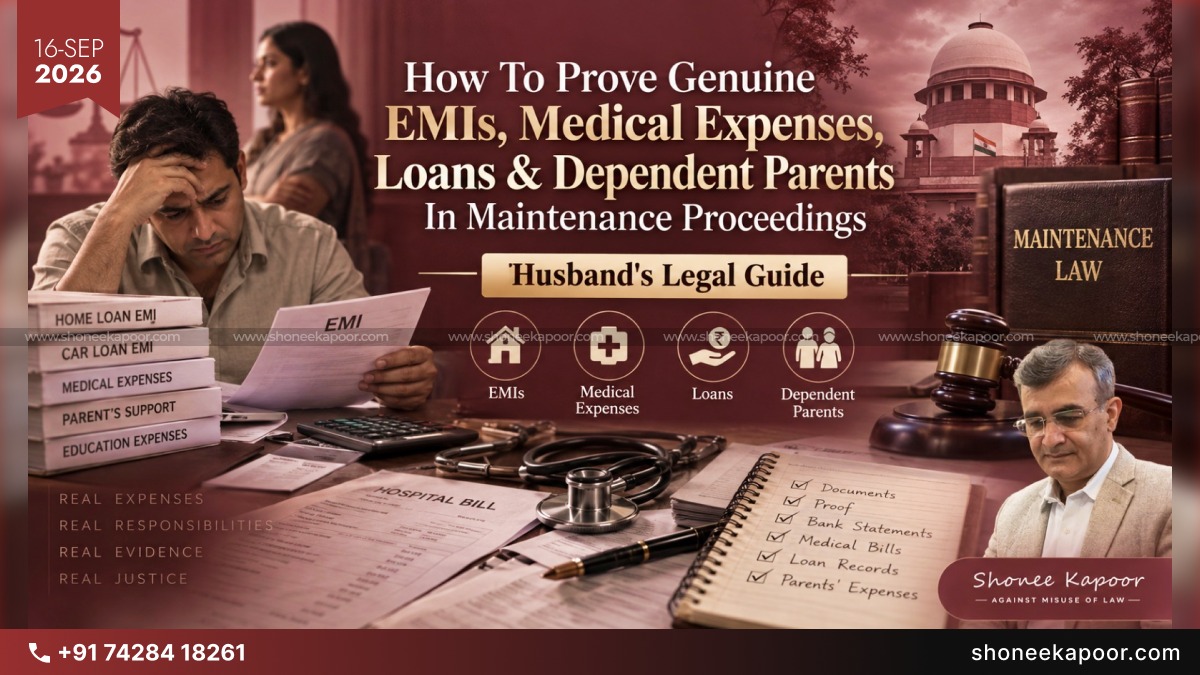
How To Prove Genuine EMIs, Medical Expenses, Loans & Dependent Parents In Maintenance Proceedings: Husband's Legal Guide

Written and analysed by Vaibhav Ojha
Head Of Legal CommunicationsFacing a maintenance case? Learn how Indian courts assess genuine EMIs, loans, parents’ medical expenses and dependency, and which documents husbands must file.
NEW DELHI: A common mistake men make in maintenance proceedings is simple:
“I have a ₹40,000 EMI. My parents depend on me. I spend ₹20,000 on their medicines.”
That statement proves almost nothing.
Courts decide financial liabilities on evidence, not family narratives.
And there is an equally important warning after the Supreme Court’s 2026 judgment in Deepa Joshi v. Gaurav Joshi: even a genuine loan does not automatically become a permissible deduction from your income for maintenance. Asset-creating loan repayments cannot be allowed to substantially dilute the legal obligation of maintenance.
THE SUPREME COURT RULE: YOUR LIABILITIES AND DEPENDANTS DO MATTER
In Rajnesh v. Neha, (2021) 2 SCC 324, the Supreme Court laid down comprehensive guidelines for maintenance proceedings across India.
While assessing the paying spouse’s financial capacity, courts have to consider his actual income, reasonable personal expenses, dependent family members whom he is legally obliged to maintain, and genuine liabilities. The Supreme Court also mandated affidavits disclosing assets and liabilities in maintenance proceedings.
The controlling principle is:
“A careful and just balance must be drawn between all relevant factors.”
That is the law. But “considered” does not mean “automatically deducted.”
1. HOME LOAN EMI: PROVE IT, BUT DO NOT TREAT IT AS A MAGIC DEDUCTION
A housing loan should be proved through a clean financial trail.
| CLAIM | STRONG EVIDENCE | WEAK CASE |
|---|---|---|
| Home Loan EMI | Sanction letter, loan agreement, complete loan statement, repayment schedule, bank debits, property documents | Merely mentioning EMI in affidavit |
| Personal Loan | Loan agreement, disbursement record, purpose, outstanding statement, bank repayments | Unexplained loan or cash liability |
| Parents’ Expenses | Parents’ income/pension records, bank statements, bills and your payments | Merely saying “parents are dependent” |
| Medical Expenses | Diagnosis, prescriptions, hospital/pharmacy bills, bank payments, insurance reimbursement details | Round monthly estimate without bills |
A Documented EMI Can Matter
In Ankush Kumar Parashar v. Sapna @ Mona, 2025:DHC:7489, the Delhi High Court found from the husband’s bank statement that he was paying approximately ₹11,000 per month as home-loan EMI. The Court also took his expenses and responsibilities towards his parents into account and reduced the total maintenance from ₹25,000 to ₹17,500 per month in the circumstances of that case.
The Court recorded:
“The maintenance amount must be determined in a balanced manner...”
But Supreme Court 2026: Asset-Building Emis Cannot Come First
In Deepa Joshi v. Gaurav Joshi, 2026 INSC 370, decided on 16 April 2026, the Supreme Court specifically dealt with loan deductions.
The Court held:
“The liability to maintain a spouse is a primary obligation...”
It explained that loan repayments which create or acquire assets are in the nature of capital investment and cannot be placed on the same footing as essential or unavoidable expenditure. The wife’s maintenance was enhanced to ₹25,000 per month.
Therefore: prove your EMI, but never argue as if ₹1 lakh salary minus ₹40,000 EMI automatically means your maintenance income is ₹60,000. That is not the law.
2. AN UNPROVED LOAN MAY BE TREATED AS NO LOAN AT ALL
The latest example is Shri Manav Tandon v. Sidhi Luthra & Anr., decided by the Delhi High Court on 1 September 2026.
The husband claimed a housing-loan liability. But the High Court noted:
“no document was produced before the Family Court in respect of such liability.”
Result: the claimed housing loan did not assist him at that stage.
Yet the Family Court had separately accounted for ₹50,000 per month being paid by him towards maintenance of his parents, and the High Court specifically noted that this parental obligation had been considered.
That single case explains the entire subject:
Loan claimed but not documented: no benefit.
Parental payment visible and considered: relevant.
3. DEPENDENT PARENTS: PROVE DEPENDENCY, NOT MERELY THEIR AGE
Parents being elderly does not by itself establish the amount you claim to spend on them.
The financial picture should disclose whether they receive pension, salary, rent, interest or other income; what assets they hold; what their actual recurring expenses are; what medical expenditure they incur; and what amount you actually pay.
This is legally relevant. Section 144 BNSS expressly includes a father or mother unable to maintain himself or herself, and for Hindus, Section 20 of the Hindu Adoptions and Maintenance Act places an obligation to maintain aged or infirm parents who cannot maintain themselves from their earnings or property.
In Anurag Manohar Kankarwal v. Soham Rani, 2026:DHC:2821, the Delhi High Court considered that the husband had two children as well as a father and mother both aged over 80. While rejecting voluntary loans, LIC premiums and health-insurance premiums as deductions overriding maintenance, the Court nevertheless treated the aged parents as members relevant to the apportionment of income.
That distinction matters: parents may be genuine dependants even when your voluntary financial products are not deductible.
4. PARENTS’ MEDICAL EXPENSES: BUILD A MEDICAL PAPER TRAIL
Do not write simply:
“Parents’ medical expenses: ₹25,000 per month.”
Prove the expenditure.
The Rajnesh v. Neha disclosure framework itself requires disclosure concerning serious ailments, medical records, disabilities requiring continuing expenditure and approximate medical costs.
For recurring medical expenditure, the strongest record is a continuous chain:
Diagnosis/prescription → hospital or pharmacy bill → payment from bank/card/UPI → insurance or CGHS/ECHS reimbursement, if any → actual out-of-pocket expenditure.
If a ₹20,000 bill was reimbursed by insurance, do not present ₹20,000 as your final monthly burden. Show the net expense actually borne by you.
Credibility matters more than inflated arithmetic.
5. PERSONAL LOANS, LIC AND INSURANCE PREMIUMS: DO NOT MIX THEM WITH NECESSITIES
This is where husbands frequently damage their own case.
In Anurag Manohar Kankarwal, the Delhi High Court held that voluntary expenses including loan repayment, LIC premiums and health-insurance premiums cannot override the statutory maintenance obligation. It reiterated that ordinarily only statutory deductions from salary are taken into account while determining interim maintenance.
Similarly, Delhi High Court decisions including Sodan Singh Rawat v. Vipinta, 2025:DHC:1218, have reiterated that loan EMI repayments cannot simply be deducted like compulsory statutory deductions when computing income for maintenance purposes.
Therefore, never club every outgoing under one heading called “liabilities.”
Income tax is not the same as a personal loan. A hospital bill is not the same as LIC. An aged parent’s recurring treatment is not the same as an asset-building home loan.
Your affidavit should make those distinctions clear.
What I Would Tell A Husband Before Filing His Maintenance Affidavit
Do not plead poverty. Prove your financial reality.
If your parents genuinely depend on you, prove their lack of sufficient independent income and prove what you spend.
If there is genuine medical expenditure, file the prescriptions, bills and payment trail.
If you have a loan, disclose its date, purpose, amount, outstanding liability and repayment history.
And if your EMI is building an asset for you, do not pretend that the Supreme Court has permitted you to place that investment ahead of maintenance. It has said the opposite.
A maintenance court should see the complete balance sheet of the family, not an artificially inflated income on one side or conveniently inflated liabilities on the other.
For men, the practical lesson is brutal but simple: what you cannot document, do not expect the court to believe. What you can document still has to survive the legal test of relevance and priority.
FAQ’s
Can home-loan EMI reduce maintenance in India?
It can be considered as part of the overall financial picture in an appropriate case, but it is not an automatic deduction. The Supreme Court has held that asset-generating loan repayments cannot substantially dilute maintenance liability.
Are dependent parents considered while deciding a husband’s maintenance liability?
Yes. Rajnesh v. Neha expressly recognises dependent family members whom the husband is legally obliged to maintain as a relevant factor. Dependency should be proved with financial records.
How do I prove that my parents are financially dependent on me?
File evidence of their pension or other income, bank statements, medical records, recurring expenses and your actual transfers or direct payments on their behalf.
Will parents’ medical expenses reduce maintenance?
Genuine and necessary medical expenditure can form part of the financial assessment, but it should be supported by medical records, bills and proof of actual out-of-pocket payment. It is not enough merely to quote a monthly figure.
Can I take a personal loan after matrimonial litigation starts and claim a lower maintenance amount?
Do not assume that it will reduce maintenance. Courts scrutinise voluntary financial commitments, and recent Supreme Court and Delhi High Court rulings make clear that such liabilities cannot be used to override the primary maintenance obligation.
LEGAL DISCLAIMER
This article provides general legal information. Maintenance depends upon the governing statute, pleadings, evidence, financial circumstances and facts of the individual case.





Share Your Thoughts
Comments are moderated before publication.