
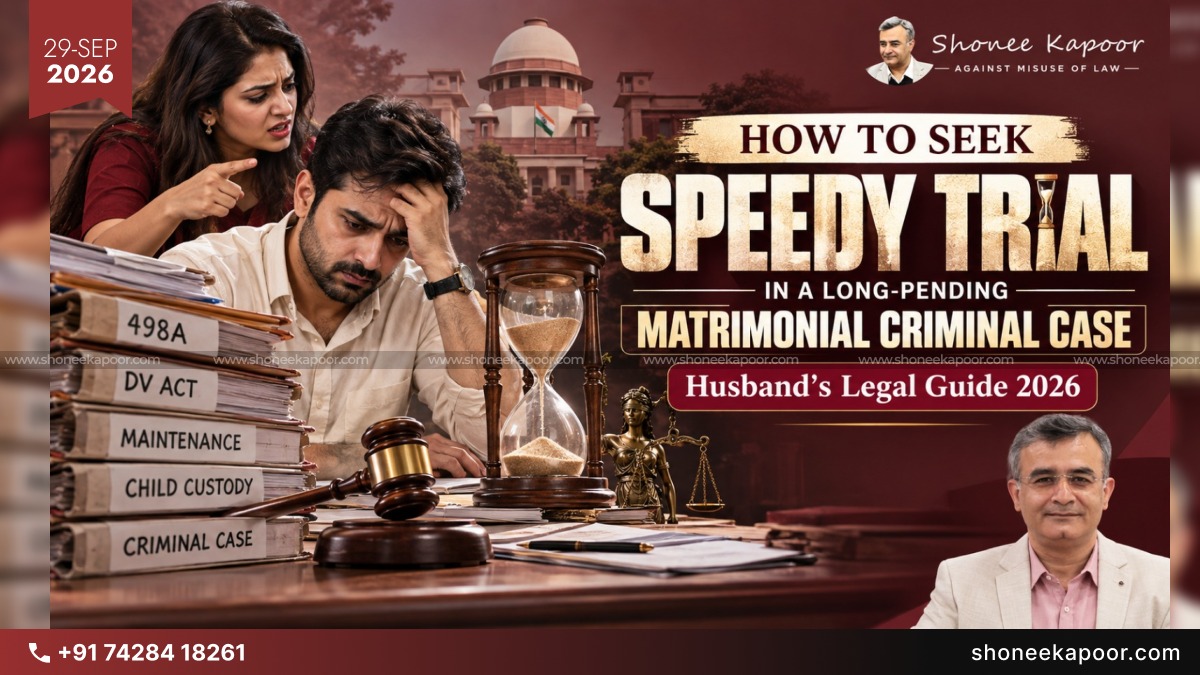
How To Seek Speedy Trial In A Long-Pending Matrimonial Criminal Case: Husband's Legal Guide 2026

Written and analysed by Vaibhav Ojha
Head Of Legal CommunicationsNEW DELHI: A husband gets bail. He attends court. His lawyer remains ready. Years pass.
Witnesses do not appear. Evidence does not start. Dates keep changing.
The law does not say that an accused must silently spend years waiting for his criminal trial to move.
The Supreme Court has consistently recognised that the right to a reasonably speedy investigation and trial forms part of Article 21 of the Constitution. That right extends beyond the actual trial and can cover investigation, inquiry, appeal, revision and retrial.
But there is an equally important warning.
A case does not automatically disappear merely because it has become old.
There is no universal rule that a 498A, Section 85 BNS or other matrimonial criminal case must be quashed after three, five, seven or ten years. The court examines why the delay occurred and who caused it.
First Check: CrPC Or BNSS?
This matters enormously in a long-pending case.
BNSS came into force on 1 July 2024. Section 531 contains the repeal-and-savings provision. Where an investigation, inquiry, trial, application or appeal was already pending immediately before BNSS commenced, the provision generally preserves continuation under the old CrPC.
In Parvinder Singh v. Directorate of Enforcement, 2026 INSC 519, the Supreme Court explained that Section 531 is intended to prevent piecemeal application of CrPC and BNSS to proceedings initiated under the old procedural regime.
So do not blindly write Section 346 BNSS in an old 498A case.
First identify which procedural law actually governs your proceeding.
Read Also:- Chargesheet Filed In 498A Or 85 BNS Case: What Should The Husband Do Next?
|
LEGAL PROVISION |
WHY IT MATTERS FOR SPEEDY TRIAL |
|
Article 21, Constitution |
Constitutional foundation of the right to a reasonably speedy trial |
|
Section 309 CrPC |
Governs adjournments and continuous examination in cases continuing under CrPC |
|
Section 346 BNSS |
Current provision requiring expeditious proceedings and restricting adjournments |
|
Section 482 CrPC / Section 528 BNSS |
Inherent jurisdiction of the High Court, depending on the applicable procedural regime |
|
Article 227 |
High Court's constitutional supervisory jurisdiction over subordinate courts |
|
Determines whether an older pending proceeding continues under CrPC |
Section 346 BNSS Makes Routine Adjournments Harder
For cases governed by BNSS, Section 346 is important.
Once witnesses are attending, the statute contemplates proceedings continuing on a day-to-day basis unless adjournment beyond the following day is necessary for reasons recorded by the court.
More importantly, where adjournment is sought by a party, it can ordinarily be granted only where circumstances are beyond that party's control. In those circumstances, the provision says not more than two adjournments may be granted, after hearing the other side and recording reasons.
It also expressly states that an advocate being engaged in another court is not by itself a ground for adjournment.
That does not mean every criminal trial must finish in two dates.
It means repeated adjournments should not become the normal method of conducting a criminal trial.
Supreme Court's 2025 Warning On Endless Criminal Trials
A major 2025 Supreme Court order deserves attention.
In Central Bureau of Investigation v. Mir Usman @ Ara @ Mir Usman Ali, 2025 INSC 1155, the Court examined a criminal trial where examination of a witness had been deferred for months. It reiterated the mandate behind Section 309 CrPC and its successor, Section 346 BNSS.
Read Also:-Wife Filed False IPC 498A / BNS 85? What To Do Immediately Before Police Action Starts
The Court recorded:
“The proceedings in every inquiry or trial shall be held expeditiously.”
It also stressed continuous examination of witnesses, written reasons for exceptional adjournments and advance scheduling of witness evidence. The order was directed to be forwarded to all High Courts.
The message is simple.
A criminal trial should be conducted as a trial, not as an endless series of dates.
How I Would Seek Speedy Trial In A Husband’s Case
Do not start by filing a dramatic petition saying, “My case is seven years old, quash it.”
Build the record first.
- Prepare a date-wise delay chart. Obtain the order sheets and show when charges were framed, how many prosecution witnesses exist, how many have been examined, which dates were lost and why. Separately identify adjournments caused by prosecution, complainant, witnesses, court administration and the accused.
- File a focused application before the Trial Court. Invoke Section 309 CrPC or Section 346 BNSS, as applicable. Seek short dates, continuous evidence and recording of reasons whenever witnesses are present but the matter is adjourned.
- Show your own readiness. State that the accused will cooperate, remain available and will not seek unnecessary adjournments. This matters because Supreme Court law specifically requires examination of who was responsible for the delay.
- Ask for a workable schedule, not fantasy relief. For example, prosecution witnesses can be grouped on consecutive or closely spaced dates. A practical prayer is often stronger than demanding that a five-year-old case be completed in fifteen days.
- Approach the High Court where delay becomes serious and unexplained. Depending on the case and procedural regime, relief may be sought through the High Court's supervisory or inherent jurisdiction under Article 227, Section 482 CrPC or Section 528 BNSS. Section 528 preserves the High Court's inherent power to prevent abuse of court process and secure the ends of justice.
Can The High Court Order Trial To Finish Within A Fixed Time?
Sometimes. But do not sell this remedy as automatic.
In High Court Bar Association, Allahabad v. State of U.P., 2024 INSC 150, a Constitution Bench cautioned that constitutional courts should not ordinarily impose fixed timelines upon trial courts because courts have different workloads and competing priority cases.
Such an outer deadline should ordinarily be imposed only in exceptional circumstances or extraordinary situations.
This judgment changes the drafting strategy.
Do not merely pray:
“Direct the Magistrate to finish my case within three months.”
First demonstrate why your case requires intervention: age of proceedings, number of ineffective hearings, absence of accused-created delay, repeated failure to produce witnesses, professional or personal prejudice and the procedural stage already reached.
What If The Trial Is Stuck Because Of A High Court Stay?
There is another important 2026 point.
The old understanding that a stay of trial would automatically expire after six months under Asian Resurfacing is no longer good law in that form.
The Constitution Bench in High Court Bar Association, Allahabad held that High Court stays do not automatically vacate merely because six months have passed.
If an old stay is paralysing the matrimonial criminal case, the affected party can seek vacation or modification of that stay. The Supreme Court said applications concerning prolonged interim relief should receive appropriate priority.
Can Years Of Delay Get The Criminal Case Quashed?
Yes, in an exceptional case.
No, merely counting years is not enough.
In Vakil Prasad Singh v. State of Bihar, (2009) 3 SCC 355, criminal proceedings were ultimately quashed after an extraordinary and substantially unexplained delay extending over decades, which was not attributable to the accused.
The Supreme Court memorably stated:
“The prosecution should not be allowed to become a persecution.”
But P. Ramachandra Rao v. State of Karnataka, (2002) 4 SCC 578 makes the other side equally clear: courts cannot create a rigid universal limitation period after which every criminal trial automatically ends. The Article 21 test remains fact-specific.
So the correct legal position is:
Long delay can become a constitutional issue. Long delay by itself is not an automatic acquittal or quashing order.
The Most Important Document Is Often Not Your FIR
It is your order-sheet chronology.
When a husband tells me, “My 498A case has been pending for eight years,” my first question would not be how old the FIR is.
My question would be:
What happened on those eight years of hearing dates?
That answer decides whether the delay argument has substance.
If fifty dates were taken by the accused, the argument weakens.
If witnesses were repeatedly absent, prosecution sought adjournments, evidence remained stalled despite the husband's presence and the accused consistently cooperated, the record tells a very different story.
Courts decide from records, not frustration.
Final Word
A long-pending matrimonial criminal case should not become a punishment before guilt is decided.
But anger at delay is not legal strategy.
Document the delay. Identify who caused it. Invoke the correct CrPC or BNSS provision. Ask the Trial Court for continuous proceedings. If the record shows serious and unjustified stagnation, place that record before the High Court.
A husband who wants a speedy trial must first create a record showing that he was ready for the trial while the trial itself was not moving.
That is a much stronger Article 21 argument than simply saying: “My case is old.”
FAQ'S
1. Can a husband seek speedy trial in a pending 498A case?
Yes. Speedy trial forms part of Article 21. The applicable procedural route will depend on whether the case continues under CrPC or is governed by BNSS.
2. Which section should be used for repeated adjournments?
For applicable older proceedings, Section 309 CrPC is relevant. For cases governed by BNSS, the corresponding provision is Section 346 BNSS.
3. Can a seven-year-old 498A case automatically be quashed?
No. There is no fixed number of years after which a criminal case automatically ends. Courts examine the cause of delay, prejudice and responsibility for it.
4. Can the High Court order the Magistrate to finish the trial in three months?
It can in an appropriate exceptional case, but the Supreme Court has said fixed outer deadlines should not ordinarily be imposed mechanically.
5. What should a husband collect before filing a speedy trial petition?
Complete order sheets and a date-wise delay chart. Clearly show prosecution delays, witness non-appearance, stays, adjournments and whether any delay was attributable to the accused.





Share Your Thoughts
Comments are moderated before publication.