
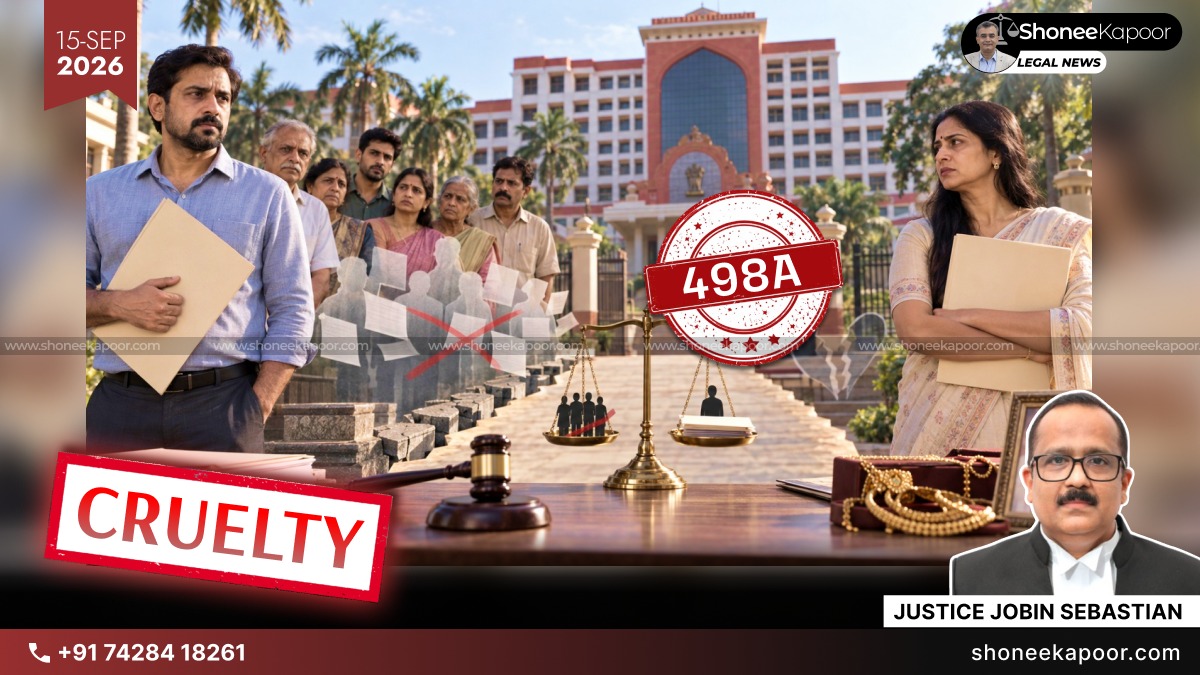
“Single Grave Act” Can Constitute 498A Cruelty, But Vague Allegations Cannot Drag Husband’s Relatives Into Trial: Kerala High Court

Curated by NEWS DESK
Editorial DeskCan one serious incident itself amount to cruelty under Section 498A IPC? The Kerala High Court says yes, but also made it clear that vague, omnibus allegations are not enough to prosecute the husband’s relatives.
KERALA: The Kerala High Court has held that a single grave act can amount to cruelty under Section 498A IPC if it satisfies the statutory definition, and repeated or continuous acts are not always necessary. At the same time, the Court quashed criminal proceedings against six relatives of the husband because the allegations against them were general, vague and omnibus, without any specific overt act.
Justice Jobin Sebastian passed the order in a petition filed by the husband and six of his relatives seeking quashing of criminal proceedings arising from Crime No. 1124 of 2024 of Tellicherry Police Station, Kannur.
The husband and wife were married on September 3, 2007. According to the prosecution, after marriage, the husband and his relatives allegedly subjected the wife to mental and physical cruelty. It was also alleged that the husband misappropriated her gold ornaments.
The case was registered under Sections 406 and 498A read with Section 34 IPC.
The accused approached the High Court under Section 528 of the Bharatiya Nagarik Suraksha Sanhita, 2023, seeking quashing of the proceedings. They argued that the allegations were vague and omnibus and did not attribute specific acts to them. They also pointed out that the complaint was lodged nearly 17 years after the marriage.
While examining the scope of Section 498A IPC, the High Court made it clear that every matrimonial disagreement or allegation of ill-treatment cannot automatically be treated as criminal cruelty.
The Court observed:
“Not every instance of harassment, disagreement, or ill-treatment between spouses would, by itself, constitute ‘cruelty’ within the meaning of Section 498A of the IPC.”
However, the Court clarified that cruelty under Section 498A does not always require repeated incidents. One sufficiently serious act can also attract the provision.
The Court said:
“A single act, if sufficiently grave and of the nature contemplated by the statutory definition, may also constitute cruelty.”
The High Court then examined the allegations against the husband’s relatives. It found that the allegations against petitioner Nos. 2 to 7 were general and omnibus, with no specific act of cruelty or harassment attributed to any of them.
There was also no specific allegation that the wife’s gold ornaments had been entrusted to or misappropriated by these relatives.
The Court held that continuing criminal proceedings against family members on such vague allegations would amount to an abuse of the process of law.
Accordingly, the High Court quashed the criminal proceedings against all six of the husband's relatives.
The husband's position, however, was different. The Court found that the allegations against him were specific and prima facie disclosed the ingredients of the alleged offences.
Whether those allegations were true or false, and what evidentiary value to give to the material collected during investigation, were matters for the trial court.
The High Court made it clear that at the quashing stage, it could not “conduct a mini-trial.”
Therefore, while the husband’s six relatives were discharged from the criminal proceedings, the 498A and Section 406 proceedings against the husband were allowed to continue and the allegations against him will have to be tested during trial.
EXPLANATORY TABLE OF LAWS AND SECTIONS
| Law / Section | What It Means | Application In This Case |
|---|---|---|
| Section 498A IPC | Punishes a husband or his relative for subjecting a married woman to cruelty as defined by the provision. | The Court held that even one sufficiently grave act may constitute cruelty, but vague allegations against relatives were insufficient. |
| Section 406 IPC | Punishment for criminal breach of trust, requiring the necessary ingredients including entrustment and dishonest misappropriation/conversion. | The husband allegedly misappropriated the wife's gold ornaments. The Court found no specific allegation of entrustment or misappropriation against petitioner Nos. 2 to 7. |
| Section 34 IPC | Applies where a criminal act is done by several persons in furtherance of their common intention. | Section 34 was invoked along with Sections 406 and 498A against the accused. |
| Section 528 BNSS, 2023 | Preserves the High Court’s inherent power to make orders necessary to prevent abuse of court process or secure the ends of justice. | The husband and his relatives invoked this provision to seek quashing. Relief was granted only to petitioner Nos. 2 to 7. |
| Section 482 Cr.P.C. | Earlier provision recognising the High Court’s inherent powers to prevent abuse of process and secure justice. | The Court referred to the principles governing quashing under Section 482 Cr.P.C. while explaining the corresponding jurisdiction under Section 528 BNSS. |
CASE DETAILS
| Particular | Details |
|---|---|
| Case Title | Firoz Kunnumal and Others v. State of Kerala and Another |
| Case Number | Crl. M.C. No. 228 of 2026 |
| CNR Number | KLHC010021902026 |
| Neutral Citation | 2026:KER:68282 |
| Court | High Court of Kerala at Ernakulam |
| Decision Date | September 9, 2026 |
| Bench | Justice Jobin Sebastian |
| Petitioners' Counsel | Aadithyan S. Mannali, Abdurahiman Vayalil Peedikayil, Neeraj Rehman |
| De Facto Complainant's Counsel | Sreeshma B. Chandran, T.P. Sajid, K.P. Mohamed Shafi, Shifa Latheef, Muhammed Haroon A.N., Mohemed Favas, Hasharurahiman U., Muhammed Bilal K. |
| State | Navas V. A., Senior Public Prosecutor |
KEY TAKEAWAYS
- One Grave Act Can Trigger 498A
A series of incidents is not necessary if even one alleged act is sufficiently grave. - Every Matrimonial Fight Is Not Cruelty
Ordinary harassment, disagreement or ill-treatment does not automatically satisfy Section 498A IPC. - Vague Allegations Cannot Drag The Entire Family To Trial
The High Court quashed proceedings against six relatives of the husband because no specific acts were attributed to them. - 17 Years After Marriage, Family Still Faced Criminal Proceedings
Despite the huge gap, the husband and his relatives had to approach the High Court, where six family members finally obtained relief. - Husband Still Has To Face Trial
The allegations against him were considered specific enough to continue prosecution. The trial court will now have to test his guilt or innocence.
Share Your Thoughts
Comments are moderated before publication.