
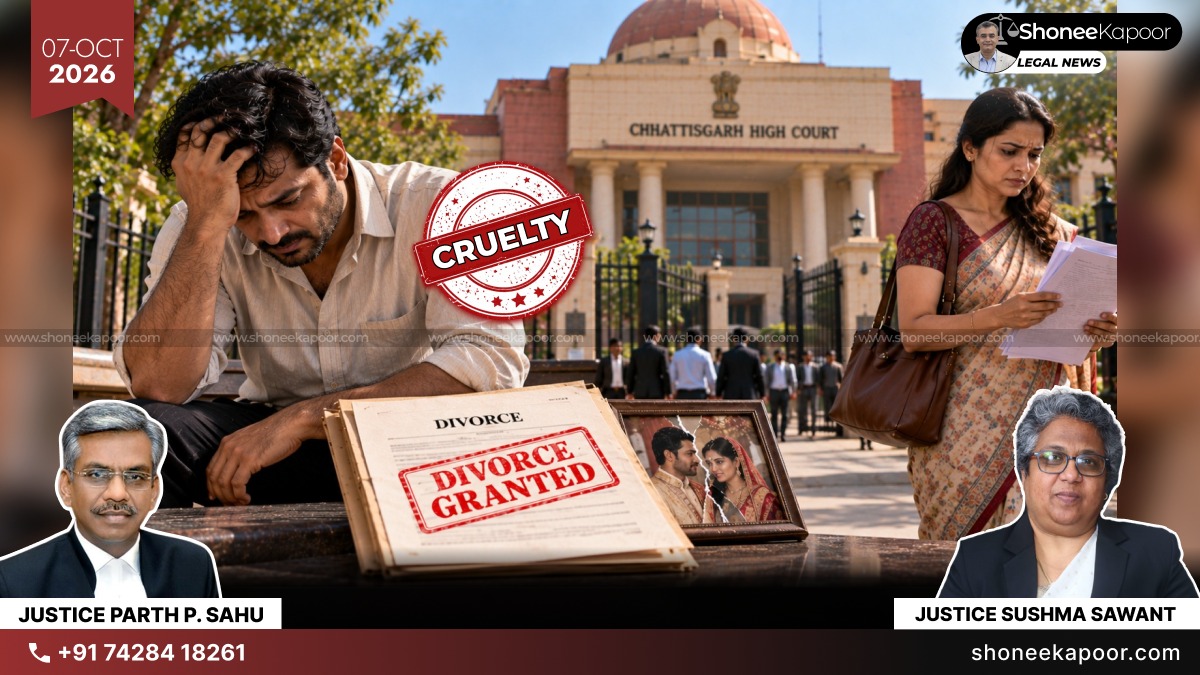
Wife’s Continued Litigation Against Husband Even After Acquittal Amounts To Mental Cruelty: Chhattisgarh High Court Grants Divorce

Curated by NEWS DESK
Editorial DeskCHHATTISGARH: The Chhattisgarh High Court has granted divorce to a husband after holding that his wife’s continued pursuit of criminal and Domestic Violence Act proceedings against him and his family, even after acquittal and dismissal of her complaint, caused him mental agony, harassment and distress.
A Division Bench of Justice Parth Prateem Sahu and Justice Sushma Sawant allowed the husband’s appeal and set aside the Family Court’s 2019 judgment which had dismissed his divorce petition.
The husband had sought divorce alleging cruelty and also claimed that his wife was suffering from a mental disorder which had allegedly been concealed before marriage. According to him, she misbehaved with him and his family, used abusive language, created disturbances at home and had even slapped him on one occasion.
Read Also: घरेलू हिंसा के मुकदमे में शामिल होने वाले कदम/ अनुसरण की जाने वाली प्रक्रिया ।
The wife denied these allegations. She accused the husband and his family of subjecting her to physical and mental cruelty and demanding Rs 5 lakh. She also alleged that incorrect information had been given about the husband’s employment and salary.
The Family Court rejected the husband’s divorce petition after finding that he had failed to prove cruelty or establish that his wife suffered from an incurable mental illness. The husband then approached the High Court.
Before the High Court, counsel for the husband argued that the wife had initiated criminal proceedings against him and his family on allegations of dowry demand and cruelty, but they were subsequently acquitted. It was also pointed out that she continued challenging the acquittal.
Significantly, no one appeared before the High Court on behalf of the wife.
The High Court did not accept the husband’s allegation regarding the wife’s mental illness. It held that such a serious allegation required strict proof and found insufficient evidence to establish that she was suffering from a mental disease before marriage.
However, the Court took a different view of her continued litigation against the husband and his family.
The Court observed:
“…appeals preferred by the respondent wife challenging the said judgment of acquittal, which demonstrates continued efforts of respondent/wife to prosecute appellant and his family even after their acquittal. In the facts and circumstances of the case, the continuation of such proceedings caused considerable mental agony, harassment and distress to the appellant,”
The High Court also noted that the wife’s complaint under the Protection of Women from Domestic Violence Act, 2005 had been dismissed by the Magistrate, but she challenged that order in appeal.
The Court said:
“…act and the conduct of respondent to challenge the order of acquittal of appellant and his family is put to challenge in criminal appeal, and further that order passed by Magistrate under the Act of 2005 rejecting the application was further challenged in appeal under Section 29 of the Act of 2005, in the considered opinion of this Court, it is the act of cruelty by respondent upon appellant,”
Considering her conduct as a whole and the background of the matrimonial dispute, the High Court held that the husband had suffered mental cruelty.
The High Court ultimately set aside the Family Court judgment and dissolved the marriage by a decree of divorce.
EXPLANATORY TABLE OF LAWS AND SECTIONS
| Law / Section | What It Means | Relevance In This Case |
|---|---|---|
| Hindu Marriage Act, 1955 – Cruelty | Permits divorce where one spouse treats the other with legally recognised cruelty. | The husband relied on cruelty to seek dissolution of marriage. The High Court ultimately found mental cruelty established. |
| Hindu Marriage Act – Mental Disorder Ground | In specified circumstances, serious mental disorder may constitute a statutory ground for divorce. | The husband alleged a pre-existing mental disorder, but the High Court found insufficient evidence to prove it. |
| Protection of Women from Domestic Violence Act, 2005 | Provides remedies to women alleging domestic violence in a domestic relationship. | The wife had initiated DV proceedings, but her application was dismissed by the Magistrate. |
| Section 29, Domestic Violence Act, 2005 | Provides an appeal against specified orders passed by a Magistrate under the DV Act. | The wife challenged the dismissal of her DV application through an appeal under this provision. |
CASE DETAILS
| Particular | Details |
|---|---|
| Case Title | Husband v. Wife |
| Court | High Court of Chhattisgarh at Bilaspur |
| Bench | Justice Parth Prateem Sahu and Justice Sushma Sawant |
| Decision | 18 September 2026 |
| Appellant | Husband |
| Respondent | Wife |
| Family Court Result | Husband’s divorce petition had been dismissed |
| High Court Result | Husband’s appeal allowed; Family Court judgment set aside; marriage dissolved on the ground of cruelty |
KEY TAKEAWAYS
- Acquittal did not end the husband’s ordeal — the wife continued challenging the orders and pursuing litigation against him and his family.
- The Chhattisgarh High Court treated the continued legal battle as mental cruelty in the overall facts of the marriage.
- The husband and his family had already faced criminal proceedings and a Domestic Violence case, yet the litigation continued even after adverse orders against the wife.
- Winning a false or failed case does not return a man’s lost years, peace, reputation or money. The process itself can become the punishment.
- Men deserve protection from weaponised matrimonial litigation too. Legal remedies cannot become tools for endless harassment after allegations fail in court.
Share Your Thoughts
Comments are moderated before publication.