
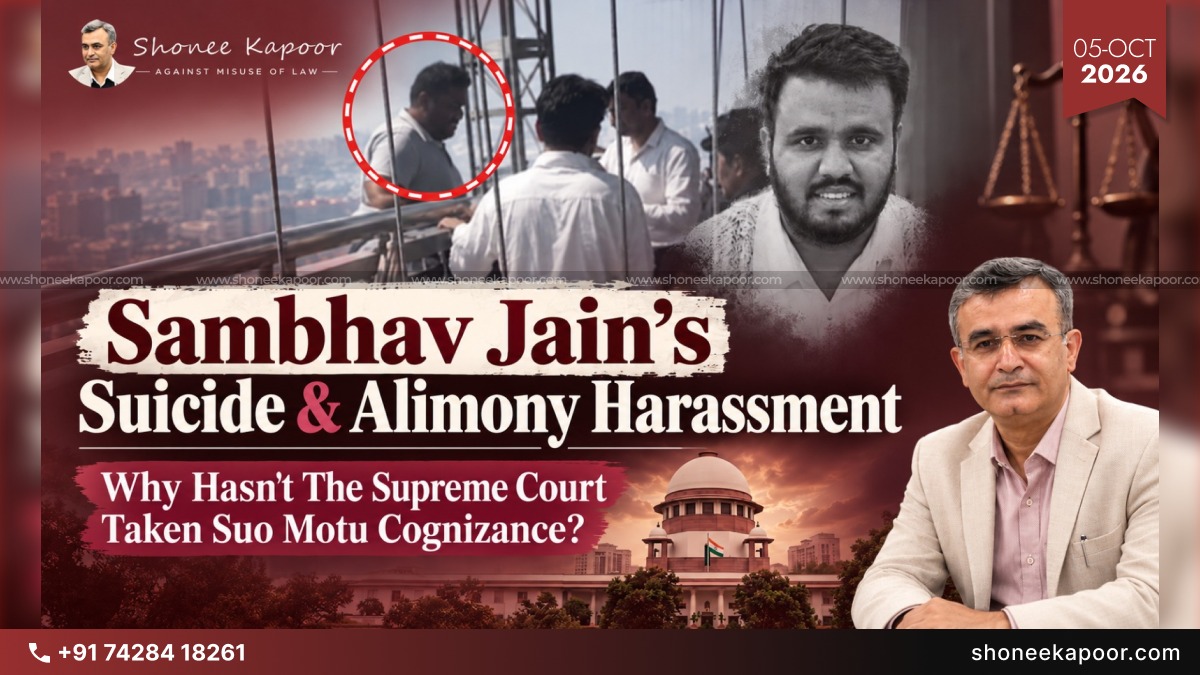
Sambhav Jain's Suicide & Alimony Harassment: Why Hasn't The Supreme Court Taken Suo Motu Cognizance?

Written and analysed by Shonee Kapoor
Legal Consultant, Author & Men's Rights ActivistNEW DELHI: Let me begin by correcting something being circulated by my own side.
Sambhav Jain was not facing ₹3 crore alimony, according to the police.
That viral figure is wrong.
Police say the initial demand communicated to them was around ₹1 crore, while the divorce settlement was ultimately finalised at approximately ₹15 lakh. Sambhav and his family had already paid around ₹7 lakh to ₹7.5 lakh and approximately ₹7.5 lakh remained.
Men's-rights advocacy does not need a false ₹3 crore figure.
The truth is disturbing enough.
Sambhav Jain was a 28-year-old software engineer. His premature son's treatment had already cost his family approximately ₹40 lakh, according to information his family gave police. He was dealing with other debts. His marriage had broken down. His wife had filed for divorce. A settlement liability remained. In the days before his death, his messages reflected serious psychological distress and concerns about debt.
And that should make us ask a question much bigger than one viral alimony figure:
How much financial, matrimonial and emotional pressure is a husband expected to carry before the system recognises that he, too, may need protection?
Highlights
- Sambhav Jain was a 28-year-old software engineer from Manesar, Gurugram.
- His prematurely born son's medical treatment had cost approximately ₹40 lakh, according to his family.
- Police say his wife initially sought about ₹1 crore, but the divorce settlement was around ₹15 lakh.
- Around half of that settlement had already been paid.
- Police specifically rejected the viral ₹3 crore alimony claim.
- Sambhav was also carrying other debts and had discussed depression and suicidal thoughts with his father.
- Police now say his final video focused on his debt and distress and that he did not blame anyone.
- No court has found his wife guilty of harassment or abetment.
- BNS Section 108 on abetment of suicide is gender-neutral.
- But Section 117 of the Bharatiya Sakshya Adhiniyam creates a special evidentiary presumption concerning the suicide of a married woman, with no mirror provision for a married man.
- The Supreme Court refused to entertain a 2023 PIL seeking a National Commission for Men and guidelines concerning suicide among married men.
- A National Commission for Men Bill, 2025 was subsequently introduced in the Rajya Sabha and remains a proposal, not law.
What Happened To Sambhav Jain?
Sambhav was married in 2024. A son was born in 2025, prematurely in the seventh month of pregnancy, and required prolonged medical treatment.
According to the family account recorded by police, approximately ₹40 lakh had already been spent on the child's treatment, with further expenses continuing.
Differences subsequently developed between Sambhav and his wife, and she approached the court for divorce.
Police say that although approximately ₹1 crore was initially sought, the dispute was ultimately settled for approximately ₹15 lakh.
Approximately ₹7 lakh to ₹7.5 lakh had already been paid. A further instalment of around ₹7.5 lakh remained outstanding.
And that was not Sambhav's only financial liability.
Police also found evidence of other debts.
Shortly before his death, AC repair workers saw Sambhav in distress and tried to intervene. According to the account given to the police and reported by the Times of India, he told them:
Read Also:- Atul Subhash vs Judge Aman vs Twisha Sharma: Is Justice Different For Men And Women?
"I'm depressed."
His chats with his father also showed anxiety over debt. His father repeatedly asked him to return home and told him the family would deal with his problems.
Police recovered his phone, video, chats and call records.
And this is the part anyone writing responsibly about the case must not hide:
According to the latest police account, Sambhav spoke about debt in his video, held himself responsible for his decision and did not blame anybody.
The investigation is continuing.
First, Kill The ₹3 Crore Lie
I am a men's-rights activist. That does not mean I will circulate misinformation because misinformation happens to help my side.
If a movement needs a fake number to make its case, it damages the genuine cases it is trying to highlight.
Police have specifically contradicted social-media claims suggesting a ₹3 crore alimony liability.
The figure presently supported by the police account is approximately ₹15 lakh as the final divorce settlement.
There is also an important legal distinction between:
an amount demanded during negotiations, an agreed matrimonial settlement, interim maintenance, permanent alimony and an amount judicially awarded after adjudication.
They are not interchangeable terms.
The available reporting says approximately ₹1 crore was initially sought and the parties later settled for approximately ₹15 lakh. It does not establish that a court ordered Sambhav to pay ₹1 crore or ₹3 crore.
That distinction must remain in this article.
Because facts first. Advocacy afterwards.
Was Sambhav Jain A Victim Of "Alimony Harassment"?
Legally, that conclusion has not been established.
As of 5 October 2026:
There is no judicial finding that his wife harassed him.
There is no finding that she abetted his suicide.
Police say Sambhav did not blame anybody in his video.
Therefore, simply calling the wife responsible would be legally and factually reckless.
When I use the expression "alimony harassment" in this discussion, I am addressing the broader men's-rights issue of excessive or coercive matrimonial financial pressure. I am not declaring Sambhav's wife criminally liable without evidence.
A ₹15 lakh settlement itself is not a criminal offence.
A demand for money during matrimonial negotiations itself does not establish abetment.
A divorce petition itself does not establish cruelty.
But none of those propositions answers the larger question:
When matrimonial money demands collide with enormous medical expenditure, debt, loss of family life and serious mental distress, what mechanism in our family-justice system identifies the husband who is collapsing?
That is the issue Sambhav Jain's death puts before us.
Indian Maintenance Law Is Supposed To Examine Financial Reality
Maintenance law is not legally supposed to work on the principle:
Husband earns, therefore husband pays whatever is demanded.
The Supreme Court's landmark decision in Rajnesh v. Neha, (2021) 2 SCC 324, established detailed financial disclosure requirements in maintenance proceedings. Courts consider income, assets, liabilities, dependants, the parties' status and other relevant financial circumstances. There is no universal mathematical percentage applicable to every marriage.
Sections 24 and 25 of the Hindu Marriage Act, 1955 are themselves gender-neutral in their text. Either a wife or husband meeting the statutory requirements may seek maintenance pendente lite or permanent alimony under those provisions.
Yet other matrimonial protections remain explicitly gender-specific.
Under Section 2(a) of the Protection of Women from Domestic Violence Act, 2005, an “aggrieved person” is defined as a woman in a domestic relationship alleging domestic violence. A husband therefore cannot simply reverse the roles and seek the same statutory DV Act remedies as an aggrieved male spouse.
That distinction matters when we discuss institutional support for abused or distressed husbands.
The Legal Asymmetry That Nobody Should Ignore
Here is perhaps the most important legal comparison in this debate.
Section 117 of the Bharatiya Sakshya Adhiniyam, 2023 provides that where a married woman dies by suicide within seven years of marriage and specified cruelty is shown, a court may presume, having regard to the circumstances, that the suicide was abetted by her husband or his relative.
Read Also:- Nikita Singhania & Others And State Of Karnataka & Anr
There is no corresponding statutory provision saying that where a husband dies by suicide after cruelty by his wife, the court may raise the same specialised matrimonial presumption against her.
Let me be equally precise.
That does not mean a wife enjoys immunity if she actually abets her husband's suicide.
She does not.
Section 108 of the Bharatiya Nyaya Sanhita, 2023 applies where any person abets another person's suicide and provides punishment extending to ten years' imprisonment and fine.
The substantive abetment offence is gender-neutral.
The specialised matrimonial evidentiary presumption is not.
That is a legitimate subject for legislative debate.
But A Suicide Note Or Marital Dispute Does Not Automatically Prove Abetment
This principle must apply irrespective of gender.
The Supreme Court has repeatedly held that abetment of suicide requires far more than simply proving that a relationship was unhappy or that somebody had been harassed.
The jurisprudence under the earlier Section 306 IPC requires instigation, intentional aid, a sufficiently proximate positive act and the necessary mens rea. The transition to BNS Section 108 does not erase those established principles concerning what constitutes abetment.
In Naresh Kumar v. State of Haryana, (2024) 3 SCC 573, the Supreme Court reiterated that mere harassment is insufficient and emphasised an active or direct act with the required mental element.
Similarly, Kumar @ Shiva Kumar v. State of Karnataka stressed the need for a direct or indirect act of incitement sufficiently proximate to the suicide.
Therefore:
If tomorrow evidence establishes deliberate, proximate instigation or intentional aid in Sambhav's case, the criminal law can operate.
But if the evidence merely establishes an unhappy marriage, financial settlement, debt and personal distress, we cannot manufacture criminal culpability merely because a tragedy occurred.
Men deserve equality before law.
Not reverse presumption of guilt.
Then Why Should The Supreme Court Even Look At Sambhav Jain's Case?
This is where I distinguish an individual criminal case from a systemic constitutional and institutional question.
I am not asking the Supreme Court to summon Sambhav's wife and pronounce her guilty on newspaper reports.
That would itself violate due process.
The bigger question is:
Should India's highest court examine why repeated deaths of men amid matrimonial litigation, debt, family breakdown and allegations of harassment are producing no dedicated institutional response?
India already has the data.
According to NCRB's Accidental Deaths & Suicides in India 2024, India recorded 1,70,746 suicides in 2024.
The male-to-female ratio among suicide victims was approximately 73.5:26.5.
Nearly 69% of male suicide victims were married.
Family problems constituted approximately 33.5% of recorded suicide causes. Marriage-related issues accounted for around 5%, while bankruptcy or indebtedness accounted for approximately 4.4%.
One warning is necessary here.
NCRB categories reflect recorded circumstances and police data. They do not prove that wives, matrimonial laws or maintenance orders caused those deaths.
But when nearly three out of every four recorded suicide victims are male, dismissing male distress as an anecdotal men's-rights talking point is equally untenable.
This is a public-policy problem.
The Supreme Court Was Asked About Married Men's Suicides Before
And this is where the debate becomes uncomfortable.
In Mahesh Kumar Tiwari v. Union of India, W.P.(C) Diary No. 10740/2023, a PIL reached the Supreme Court seeking guidelines concerning suicide among married men allegedly subjected to domestic violence and asking for the constitution of a National Commission for Men.
The Bench comprised Justice Surya Kant and Justice Dipankar Datta.
The Court declined to entertain the PIL.
During the hearing, one reported oral observation was:
"You just want to portray a one-sided picture."
The Court also emphasised that individual suicide cases depend upon their facts and that existing criminal law provides remedies where an offence is actually committed. The petition was not converted into a nationwide institutional inquiry.
Those were reported oral observations, not a declaration that husbands can never be victims of domestic abuse or abetment.
But three years later, the institutional question has not disappeared.
It has become louder.
The Karnataka High Court Asked A Very Different Question In Atul Subhash's Case
The death of Bengaluru techie Atul Subhash became one of India's most prominent men's-rights cases after he left extensive material accusing his estranged wife and her relatives of matrimonial harassment.
During proceedings in March 2026 concerning the abetment case, the Karnataka High Court orally asked:
"If husband feels harassed by wife and kills himself, isn't that abetment of suicide?"
That was a courtroom question, not a final judicial finding that the accused were guilty.
But compare the two judicial moments.
In 2023, the Supreme Court cautioned against presenting a one-sided picture of married men's suicides.
In 2026, a High Court was confronted with a specific case and expressly asked what the law should do when the alleged victim of matrimonial harassment is the husband.
The answer cannot be predetermined by gender.
It must come from evidence.
Atul Subhash And Sambhav Jain Are Not The Same Case
This distinction is crucial.
Atul Subhash left material expressly blaming named individuals and making detailed allegations.
Current police reporting says Sambhav Jain did not blame anybody in his video.
These cases therefore cannot be lazily merged into one narrative that says, “wife demanded money, husband died, therefore wife abetted suicide.”
That is not how criminal law works.
But both cases raise another question:
Why do we discuss a man's financial and emotional collapse only after his body becomes evidence?
That is the part the law has not answered.
Puneet Khurana: Another Husband's Death During Divorce Proceedings
Delhi businessman Puneet Khurana died by suicide around the end of December 2024 while divorce proceedings were underway.
A purported 59-minute video surfaced in which Khurana accused his estranged wife and her family of mental harassment and referred to an alleged demand for ₹10 lakh. His family also made allegations.
The wife's side disputed the narrative and made counter-allegations.
Again, an allegation in a video is evidence to investigate. It is not by itself a conviction.
The lesson is not “automatically arrest the wife.”
The lesson is:
Investigate a husband's allegation with the same seriousness with which the law expects allegations of domestic abuse from any victim to be investigated.
Then Look At Recent Cases Where The Husband's Victimhood Was Actually Proved In Court
The conversation about men as victims cannot be restricted to suicide.
Recent Indian courts have convicted wives in cases involving the murder of their husbands.
Saurabh Rajput: Meerut Blue Drum Murder
On 30 September 2026, a Meerut court convicted Muskan Rastogi and Sahil Shukla for the murder of Muskan's husband Saurabh Rajput, along with offences relating to conspiracy and destruction of evidence.
The case went through 126 hearings and testimony from more than 22 witnesses before the conviction. Sentencing was fixed for 14 October 2026.
That is not an allegation anymore.
That is a conviction.
Bengaluru Husband Murder: Wife And Lover Get Life
In another 2026 judgment, Bengaluru's 66th Additional City Civil and Sessions Court convicted Kalpana and Javed in the 2017 murder of Kalpana's husband, a 38-year-old cab driver.
Both received life imprisonment after circumstantial and call-record evidence connected them to the crime.
Ekam Singh Dhillon Murder: Wife Sentenced To Life
In July 2026, a Mohali court sentenced Seerat Kaur to life imprisonment for the murder of her husband Ekam Singh Dhillon.
The court relied upon CCTV footage, forensic evidence, their son's testimony and surrounding circumstances to complete the evidentiary chain.
Why mention these murder cases in an article about Sambhav?
Because one stereotype needs to die:
A husband is not incapable of being a victim simply because he is male.
Sometimes the allegation fails.
Sometimes abetment cannot be proved.
Sometimes the husband is murdered and the evidence proves it beyond reasonable doubt.
The law's duty is to follow evidence in all three situations.
Why Hasn't The Supreme Court Taken Suo Motu Cognizance Of Sambhav Jain's Death?
The legally accurate answer is:
Because suo motu cognizance is discretionary. It is not automatically triggered whenever a disturbing death receives national attention.
Nor is there presently a judicially established criminal or constitutional failure in Sambhav's individual case requiring the Supreme Court to supervise the investigation.
His phone is being examined. CCTV is being checked. Police are analysing his video, chats and financial circumstances. Current information says he blamed nobody.
Therefore, there is presently a legitimate argument that ordinary investigation should first run its course.
But that does not dispose of the systemic question.
The Supreme Court Has Used Suo Motu Jurisdiction When A Death Revealed A Wider Institutional Issue
The comparison frequently raised in public debate is the R.G. Kar Medical College case.
Following the rape and murder of a trainee doctor in Kolkata in 2024, the Supreme Court instituted Suo Motu Writ Petition (Criminal) No. 2 of 2024 under Article 32.
The Court did not restrict itself to the prosecution of the individual crime. It addressed the broader safety and well-being of medical professionals at workplaces, describing the issue as one of high national priority.
That case does not establish a legal rule that every nationally discussed death must receive identical treatment.
But it does demonstrate the constitutional distinction I am making.
The Supreme Court can look beyond one crime when an individual event exposes an institutional problem of national significance.
So my question is not:
Why hasn't the Supreme Court personally investigated Sambhav's wife?
My question is:
How many deaths, how much NCRB data and how many families must be affected before male suicide amid family and matrimonial distress becomes an institutional question worthy of national examination?
That is the legitimate men's-rights question.
Parliament Has Now Been Asked To Create A National Commission For Men
There has also been an important development since the Supreme Court declined the 2023 PIL.
On 5 December 2025, Rajya Sabha MP Dr Ashok Kumar Mittal introduced the National Commission for Men Bill, 2025.
The official Rajya Sabha record says the proposed body would safeguard men's rights and welfare, inquire into grievances, review laws and policies affecting men and promote legal aid, counselling, research and preventive outreach concerning men's physical, mental and social well-being.
As of the latest available parliamentary tracking, the Bill remains pending.
It is a Private Member's Bill.
It is not presently the law of India.
That distinction matters because social-media posts frequently describe proposed legislation as though India already has a Men's Commission.
It does not.
What Should A Supreme Court Or Parliamentary Inquiry Actually Examine?
I would rather ask for measurable reforms than emotional declarations.
A serious institutional review should examine:
- Married-male suicide data separately: NCRB's broad categories are insufficient to establish how many deaths occur during active divorce, maintenance, custody, DV or matrimonial criminal proceedings.
- Mandatory financial-vulnerability assessment: Where maintenance or settlement negotiations involve substantial medical debt, dependent-child expenditure, EMIs or existing liabilities, those facts should be properly documented instead of reducing the case to gross salary.
- A matrimonial-litigation distress protocol: Family Courts and mediation centres routinely encounter people whose marriages, children, finances and criminal cases are collapsing simultaneously. Referral mechanisms for severe psychological distress should exist for litigants of both sexes.
- Evidence preservation after spouse suicide: Phones, chats, recordings, mediation communications where legally admissible, complaints, settlement papers and financial records should be preserved promptly so that neither innocent relatives are automatically criminalised nor genuine abetment is ignored.
- Institutional redress for male domestic-abuse victims: Parliament should examine whether a man facing domestic abuse has access to an adequate civil protection framework comparable to the dedicated mechanism Parliament created for women.
- A serious debate on the National Commission for Men: Not as an attack on the National Commission for Women, but as an institutional response to male-specific problems which currently fall between ministries, police systems, family courts and mental-health frameworks.
Some changes would require Parliament, not judicial legislation.
But the Supreme Court can call for data, examine systemic deficiencies and formulate procedural safeguards within constitutional limits when an appropriate case presents itself.
My Position As A Men's Rights Activist
I will not make Sambhav Jain's wife guilty without evidence.
And I will not make Sambhav Jain invisible because he was a man.
Both would be injustice.
The ₹3 crore story is false according to police.
Remove it.
The claim that Sambhav blamed his wife is presently unsupported.
Remove it.
But after removing every exaggeration, these facts remain:
A young father.
Approximately ₹40 lakh spent on his premature child's treatment.
Other debt.
A broken marriage.
A ₹15 lakh divorce settlement.
An unpaid second instalment.
Messages about severe distress.
A father desperately asking his son to come home.
And ultimately, a family without its son and a child without his father.
Do we really need a fake ₹3 crore figure before we are willing to discuss what Indian husbands carry?
We don't.
The verified facts are enough.
India has laws to punish a person who abets suicide.
India has special statutory protections addressing violence and cruelty against women.
India now even has a pending proposal for a National Commission for Men.
What it still does not have is a coherent institutional system which tells a distressed husband:
Your suffering counts before you become another NCRB statistic.
That is the conversation Sambhav Jain's death should force us to have.
Not hatred against women.
Not immunity for men.
Evidence before accusation. Protection before tragedy. Law without gender blindness towards male victims.
That is the reform I am asking for.
FAQs
1. Did Sambhav Jain have to pay ₹3 crore alimony?
No. Police specifically rejected the ₹3 crore claim. The current police account says the final divorce settlement was approximately ₹15 lakh, after an initial demand of about ₹1 crore.
2. Did Sambhav Jain blame his wife for his suicide?
Not according to the latest police information. Police say his video discussed debt and distress, that he held himself responsible and did not blame anyone. The investigation is continuing.
3. Can a wife be prosecuted for abetting her husband's suicide?
Yes, if the legal ingredients are proved. BNS Section 108 is gender-neutral. But mere marital discord or harassment is insufficient without evidence satisfying the law of abetment, including the necessary mens rea and sufficiently proximate instigation or intentional aid.
4. Does Indian evidence law give husbands the same suicide-abatement presumption available in cases involving married women?
No. Section 117 of the Bharatiya Sakshya Adhiniyam specifically concerns the suicide of a married woman within the prescribed conditions. There is no mirror provision specifically creating that matrimonial presumption for a husband's suicide.
5. Does India already have a National Commission for Men?
No. The Supreme Court declined to entertain a 2023 PIL seeking one. The National Commission for Men Bill, 2025 was introduced in the Rajya Sabha but remains pending and has not become law.





Share Your Thoughts
Comments are moderated before publication.