
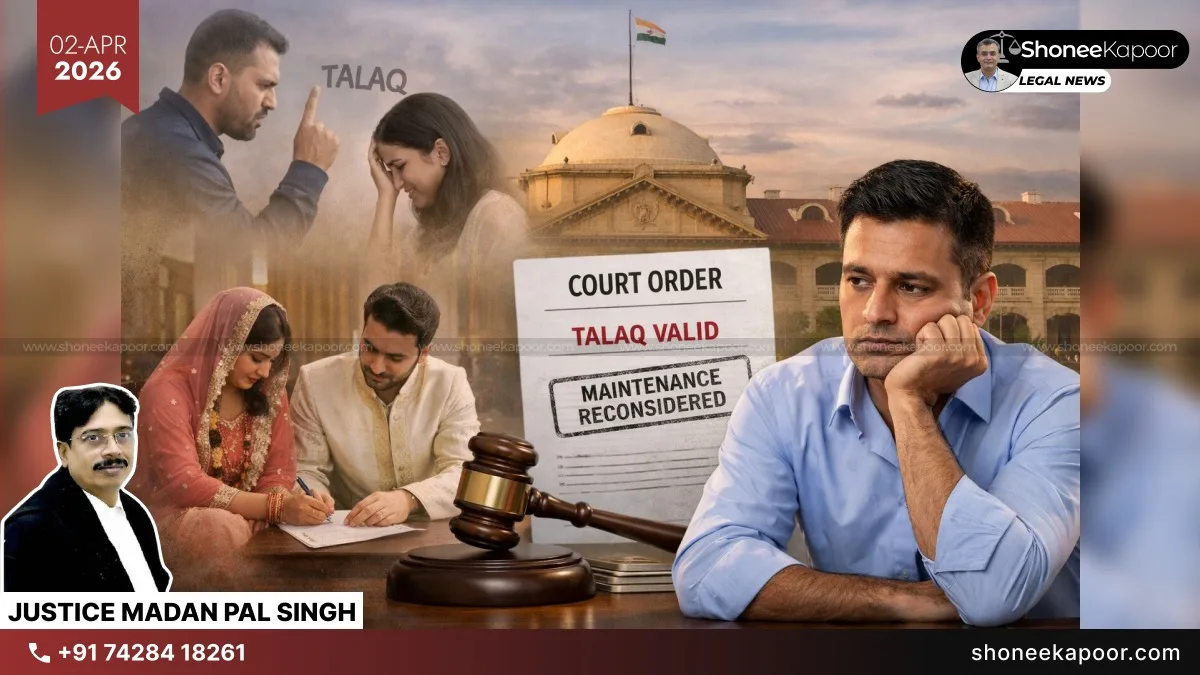
The Allahabad High Court’s ruling opens up a larger debate in maintenance jurisprudence —
Is a maintenance claim valid when the legality of marriage itself is disputed?
Talaq Valid: Justice Madan Pal Singh of the Allahabad High Court dealt with a case where a wife was denied maintenance by the Family Court after her second marriage was treated as legally invalid.
While the High Court found flaws in the Family Court’s reasoning and sent the matter back for reconsideration, the case again highlights how maintenance litigation continues to operate in a way where men remain financially exposed despite serious legal disputes about marital validity.
The case involved a woman who claimed she was divorced through talaq by her first husband and later remarried. The Family Court rejected her maintenance claim by holding that her second marriage was void since the formal declaration of divorce came later. However, the High Court disagreed with this technical reasoning and clarified the legal position.
The Court observed:
“Under Mohammedan Law, when a husband pronounces talaq, the divorce takes effect from the date on which the talaq is pronounced, subject to its validity in accordance with law.”
This effectively shifts the focus away from formal court declarations and towards the claim of earlier divorce, which has direct financial consequences for the husband in the second marriage.
The Court further stated:
“Where a husband pronounces talaq and subsequently approaches the court seeking a decree regarding the same, the decree passed by the court is ordinarily declaratory in nature, which merely recognizes or confirms the status of divorce that had already taken place.”
This interpretation reduces the importance of formal judicial confirmation and increases the scope for retrospective claims.
It also clarified:
“The decree of the court does not create a fresh divorce from the date of the judgment but only declares whether the talaq had already been validly pronounced earlier.”
In practical terms, this means liability can arise based on past claims, even when legal clarity comes much later.
At the same time, the Court noted:
“Where the validity of the talaq is disputed between the parties, the court is required to examine the evidence and determine whether the talaq was validly given in accordance with law.”
The High Court then criticised the Family Court’s reasoning and held:
“The approach adopted by the learned Family Court does not appear to be in consonance with the settled legal position that a decree in such cases is merely declaratory and relates back to the date of pronouncement of talaq.”
Because of this, the High Court set aside the order denying maintenance and sent the matter back for fresh consideration. The Family Court has been directed to re-examine the issue and decide again within six months.
This case reflects a deeper structural issue. Even where the validity of marriage itself is under serious legal doubt, the burden of maintenance does not disappear but instead gets prolonged through multiple rounds of litigation.
The law may recognise technical correctness, but in practice, the financial liability on the husband continues unless courts take a stricter view on disputed marital status and misuse of maintenance provisions.
Explanatory Table: Laws & Provisions Involved
| Law / Section | Purpose | How Applied In This Case |
| Section 125 Cr.P.C. | Law that allows wife, children, and parents to claim maintenance if they are not being supported | Wife filed maintenance case under this section |
| Section 482 Cr.P.C. | Gives High Court power to pass orders to prevent misuse of law or ensure justice | Earlier proceedings referenced regarding validity of divorce |
| Muslim Personal Law (Talaq) | Divorce under Muslim law becomes effective when talaq is pronounced, not when court confirms | Central issue—whether divorce was valid at time of second marriage |
| Declaratory Decree | Court order that only confirms an existing legal status, does not create a new one | Court clarified divorce decree was only confirming earlier talaq |
Case Details
- Case Title: Smt. Humaira Riyaz vs State of U.P. and Another
- Case Number: Criminal Revision No. 3305 of 2025
- Court: High Court of Judicature at Allahabad
- Bench: Hon’ble Justice Madan Pal Singh
- Neutral Citation: 2026:AHC:49191
- Date of Judgment: March 10, 2026
- Counsels:
- For Revisionist (Wife): Basharat Ali Khan, Zawwar Haider Naqvi
- For Opposite Party: Afzal Ahmad Khan Durrani, G.A., Jamal Ahmad Khan
- For State: Learned A.G.A.
Key Takeaways
- Even when the validity of marriage is legally disputed, men remain exposed to maintenance claims, showing how liability continues despite unresolved marital status.
- Courts prioritise technical interpretations of personal law, but the financial burden still shifts onto the husband through prolonged litigation.
- Declaratory divorce recognition allows retrospective claims, increasing risk for men who may be dragged into obligations based on past events.
- Instead of final relief, cases are often remanded, meaning men face extended legal battles, costs, and uncertainty.
- This case reflects a systemic pattern where maintenance laws rarely provide clean exit points for men, even in complex or doubtful marital situations.
This Could Change Your Case-Get FREE Legal Advice-Click Here!
Disclaimer: The views and opinions expressed in this article are those of the Indian courts and do not necessarily reflect the official policy or position of “ShoneeKapoor.com” or its affiliates. This article is intended for informational and educational purposes only. The content provided is not legal advice, and viewers should not act upon this information without seeking professional counsel. Viewer discretion is advised.
