
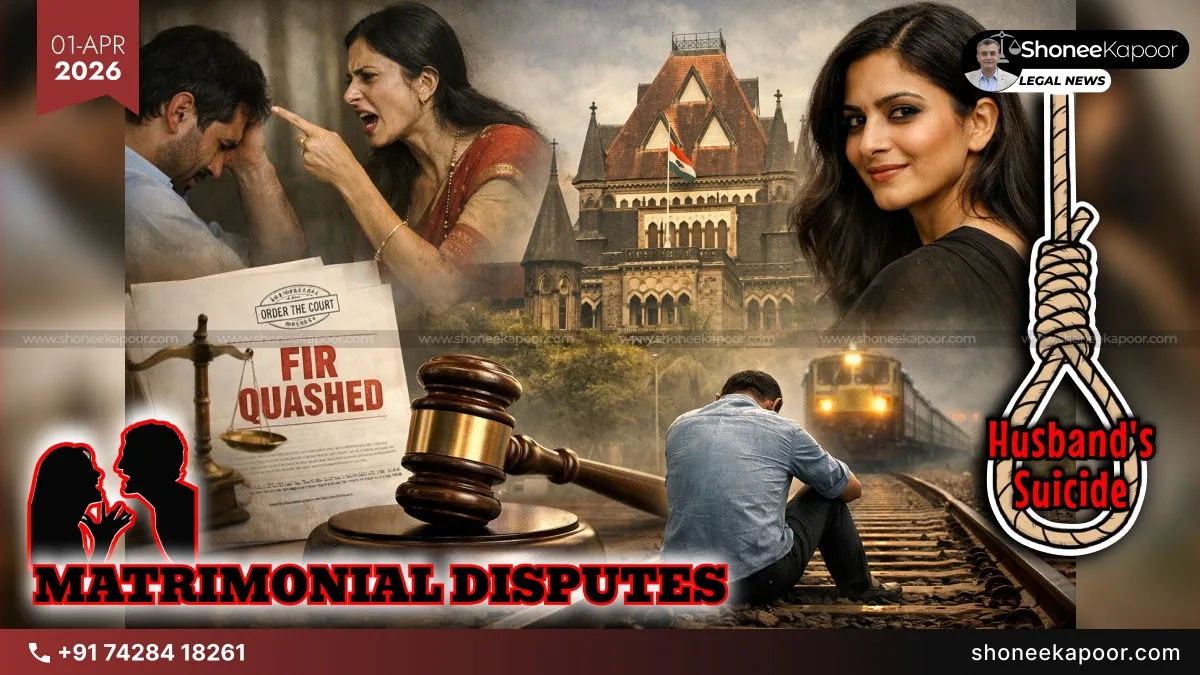
Bombay High Court has ruled that even allegations of abuse, threats, and marital disputes are not enough without clear intent to establish abetment to suicide.
Why are serious allegations like abuse and threats not enough to hold the wife liable after a husband’s suicide?
Marital Conflict ≠ Abetment to Suicide: In a recent judgment, the Nagpur Bench of the Bombay High Court has clarified an important legal position in cases where a husband dies by suicide after marital disputes.
The case was related to a 2019 incident from Amravati, where a man died by suicide after coming under a train. Following his death, the father of the deceased filed a complaint against his daughter-in-law. He alleged that she used to frequently quarrel, verbally abuse his son, leave the house without informing, and even threaten to implicate him in false cases. Based on these allegations, the police registered an FIR for abetment to suicide.
The woman then approached the High Court and challenged the FIR and the criminal proceedings initiated against her. She argued that the allegations, even if accepted, do not legally amount to abetment to suicide.
While hearing the matter, the Court examined whether normal marital conflicts can be treated as criminal abetment under Section 306 IPC (now Section 108 of the Bharatiya Nyaya Sanhita).
The Court clearly stated:
“Mere marital disputes, verbal abuse, or instances of leaving for one’s parental home cannot be categorised as ‘abetment to suicide.’ A case under section 306 of the Indian Penal Code (or Section 108 of the Bharatiya Nyaya Sanhita, 2023) is established only when the accused’s intention is clearly to compel the individual to take their own life,”
The Court further explained that everyday disagreements between husband and wife, even if frequent, do not automatically become criminal offences unless there is clear proof that the accused had the intention to push the person towards suicide.
Based on this reasoning, the High Court found that no such direct intention or instigation was present in this case. As a result, the FIR and all criminal proceedings against the wife were quashed.
In this case, despite allegations of frequent fights, verbal abuse, and threats of false cases, the Court held that such conduct alone does not amount to abetment to suicide.
It clarified that criminal liability arises only when there is a clear intent to push a person to take their life.
As no such intent was proved, the case against the wife was quashed.
Explanatory Table: Laws & Provisions Involved
| Law / Provision | Purpose | How Applied in This Case |
| Section 306 IPC | Punishes abetment of suicide | Court held no offence made out as no direct intent to cause suicide was shown |
| Section 108 BNS, 2023 | Defines abetment under new criminal law regime | Applied same principle—requires clear intention to push victim to suicide |
| Section 107 IPC | Defines abetment (instigation, conspiracy, aid) | Court found no instigation or active role by wife to compel suicide |
| Mens Rea (Criminal Intent) | Establishes requirement of guilty mind for criminal liability | Court emphasized absence of intention to drive husband to suicide |
| Proximity Test (Judicial Principle) | Requires close link between accused’s actions and suicide | Court found no direct or proximate act leading to suicide |
| Evidence Law Principle | Requires clear and specific evidence, not general allegations | Allegations of quarrels and threats were considered insufficient |
| Quashing Jurisdiction (Section 482 CrPC / Section 528 BNSS) | High Court power to quash FIR to prevent abuse of process | FIR and proceedings were quashed due to lack of legal ingredients |
Case Details
- Case Title: XYZ Vs. State
- Court: Bombay High Court (Nagpur Bench)
- Incident Date: 26 November 2019
- Nature of Case: Petition seeking quashing of FIR and criminal proceedings for abetment to suicide
- Relevant Law Invoked: Section 306 IPC (Abetment to Suicide)
Key Takeaways
- Even serious allegations like frequent fights, verbal abuse, and threats of false cases are not enough to fix criminal liability under abetment laws.
- Court has reinforced that emotional pressure or marital conflict alone does not meet the legal standard of abetment to suicide.
- Criminal liability arises only when there is clear, provable intention to push the person to take their life.
- Without direct instigation or a clear link between conduct and suicide, criminal law cannot be invoked.
- Abetment cannot be presumed from circumstances alone; it must be supported by clear intent and specific acts.
This Could Change Your Case-Get FREE Legal Advice-Click Here!
Disclaimer: The views and opinions expressed in this article are those of the Indian courts and do not necessarily reflect the official policy or position of “ShoneeKapoor.com” or its affiliates. This article is intended for informational and educational purposes only. The content provided is not legal advice, and viewers should not act upon this information without seeking professional counsel. Viewer discretion is advised.
