
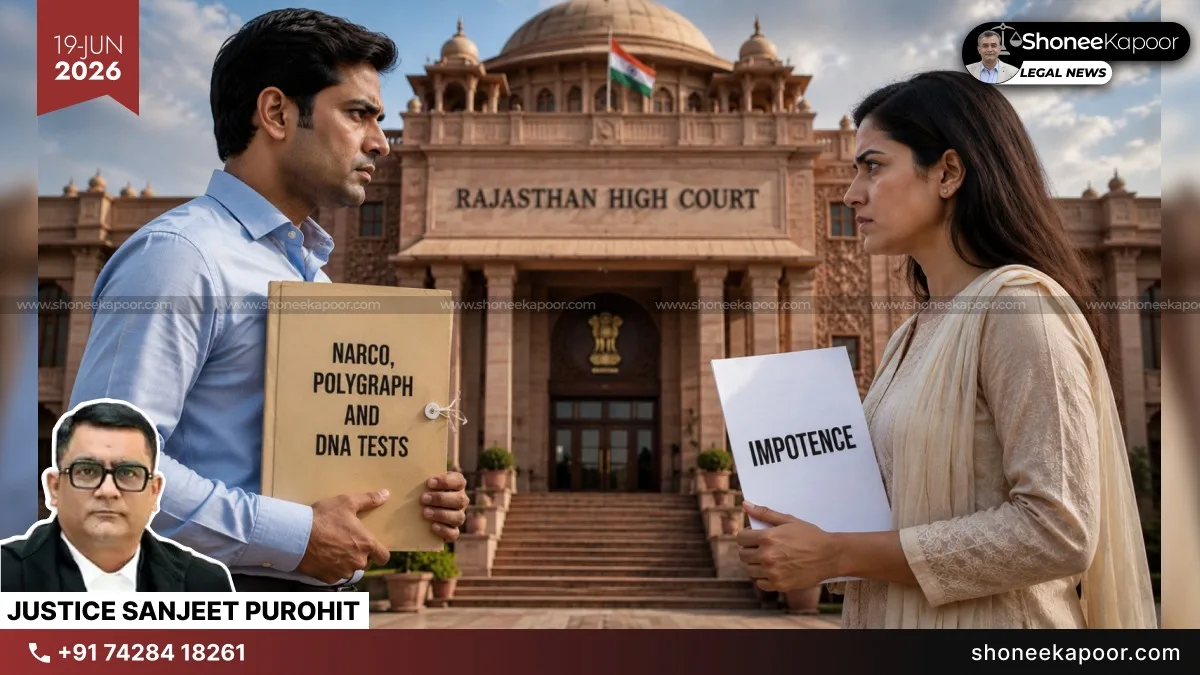
Can a husband’s dignity be attacked by an allegation of impotence? The Rajasthan High Court said such allegations hit a husband’s dignity, but when wife alleges impotence or sexual incapacity, she must prove it with evidence.
JODHPUR: The Rajasthan High Court at Jodhpur, through Hon’ble Mr. Justice Sanjeet Purohit, Vacation Judge, dealt with a divorce case where the wife had made sexual incapacity and impotency allegations against the husband.
The husband denied these allegations and claimed that they were false and were made only to malign and harass him.
The matter had already reached the stage of final arguments. Evidence from both sides was already closed. At this late stage, the husband filed an application asking the Court to direct both husband and wife to undergo narco-analysis test, polygraph test, DNA test and medical examination.
The wife opposed this request. Her side argued that the husband had already got proper opportunity during trial, but he did not bring medical evidence at the right stage. It was argued that this late application was only an attempt to delay the case and fill gaps in evidence.
The Rajasthan High Court examined whether such an application could be allowed after evidence was already closed.
The Court relied on the Supreme Court’s warning that the power under Section 151 CPC and Order XVIII Rule 17 CPC is “not intended to be used routinely, merely for the asking.”
The meaning was clear. A party cannot ask the Court to reopen evidence casually after the trial has almost ended. Such power can be used only in genuine cases where the additional evidence is necessary for proper decision of the dispute.
Applying this principle, the High Court held that a party cannot use late-stage applications to repair the weakness of its own case. Once evidence is closed, the Court cannot permit fresh evidence merely because one side now wants to improve its stand.
The High Court also relied on Gayathri v. M. Girish, where the Supreme Court had cautioned against repeated applications for “adjournments, reopening and recalling.”
The Supreme Court had said that such applications should be avoided unless there are compelling and acceptable reasons. It also warned that a party cannot use such applications:
“In order to overcome the lacunae in the plaint, pleadings and evidence.”
After applying these principles, the Rajasthan High Court found that the husband had not explained why DNA test, polygraph test or narco-analysis was relevant to the allegation of sexual incapacity or impotence.
The Court noted that the application was filed only after both parties had already completed their evidence. The husband had not shown any valid reason for not producing proper medical evidence earlier.
The husband relied on Deep Mukherjee v. Sreyashi Banerjee, but the High Court held that the judgment did not help him.
In Deep Mukherjee, the husband himself was ready to undergo a potentiality test. The Supreme Court allowed the husband’s test only because he had consented to it.
The Supreme Court had also noted that when the wife was not willing to undergo fertility test or mental health check-up:
“She cannot be compelled to undergo such tests.”
Therefore, the Rajasthan High Court held that Deep Mukherjee could not be used to force the wife to undergo joint medical examination, narco-analysis, polygraph test or DNA test without her consent.
The High Court held that the husband’s prayer for joint testing of both parties was legally untenable. The wife could not be compelled to undergo such tests without consent.
The Court also held that the husband had failed to show the relevance or necessity of narco test, polygraph test, DNA test or medical examination at such a late stage of the divorce case.
Most importantly, the Court agreed that since the allegation of sexual incapacity and impotence was made by the wife, the primary burden to prove that allegation would remain on her.
The Court made it clear that it cannot collect evidence for a litigant. It also cannot fill gaps in evidence which a party is legally required to prove.
Finally, the Rajasthan High Court found no illegality or perversity in the trial court’s order and dismissed the husband’s writ petition.
EXPLANATORY TABLE: LAWS AND SECTIONS INVOLVED
| Law / Section | What It Means | How It Was Used In This Case |
| Order XVIII Rule 17 CPC | Gives the Court limited power to recall a witness for clarification. | Husband used this provision to seek reopening of evidence and medical/scientific tests after evidence was already closed. |
| Section 151 CPC | Inherent power of the Court to pass orders for justice where CPC does not provide a specific remedy. | Husband relied on this section along with Order XVIII Rule 17 CPC, but the Court said it cannot be used to fill gaps in evidence or delay the case. |
| Code of Civil Procedure, 1908 | Procedural law for civil cases. | The procedural provisions of CPC were central because the husband wanted additional evidence at the stage of final arguments. |
| Section 13(1)(2) Hindu Marriage Act, 1955 | Provision mentioned in the order in relation to the wife’s divorce petition. | Wife filed divorce proceedings alleging desertion, cruelty and incapacity of the husband. |
| Section 9 Hindu Marriage Act, 1955 | Restitution of conjugal rights; used when one spouse seeks direction for the other spouse to resume cohabitation. | Husband argued that despite an order under Section 9, the wife did not resume cohabitation. |
| Hindu Marriage Act, 1955 | Main law governing Hindu marriages, divorce and matrimonial reliefs. | The original dispute was a divorce case under this Act. |
| Article 227 Constitution of India | Supervisory jurisdiction of the High Court over subordinate courts. | Husband approached the High Court under Article 227 to challenge the trial court’s refusal to allow his application. The High Court refused to interfere. |
CASE DETAILS
- Case Title: BLJ Vs. NJ
- Court: High Court of Judicature for Rajasthan at Jodhpur
- Case Number: S.B. Civil Writ Petition No. 12287/2026
- Neutral Citation: 2026:RJ-JD:26564
- Bench: Hon’ble Mr. Justice Sanjeet Purohit, Vacation Judge
- Date of Order: 02/06/2026
- Counsels:
- For Petitioner: Mr. Ankit Somani
- For Respondent: No counsel
KEY TAKEAWAYS
- When a wife alleges impotence, it attacks the husband’s dignity, masculinity and reputation; such an allegation must be proved, not merely made.
- A husband who is ready to face medical/scientific testing should not be left fighting only against stigma and suspicion.
- The burden cannot be silently shifted on the husband when the allegation was made by the wife.
- A man’s character and marital worth cannot be damaged through unproved claims in matrimonial litigation.
- Courts must protect due process, because one serious allegation can socially destroy a man even before it is legally proved.
This Could Change Your Case-Get FREE Legal Advice-Click Here!
Disclaimer: The views and opinions expressed in this article are those of the Indian courts and do not necessarily reflect the official policy or position of “ShoneeKapoor.com” or its affiliates. This article is intended for informational and educational purposes only. The content provided is not legal advice, and viewers should not act upon this information without seeking professional counsel. Viewer discretion is advised.
