
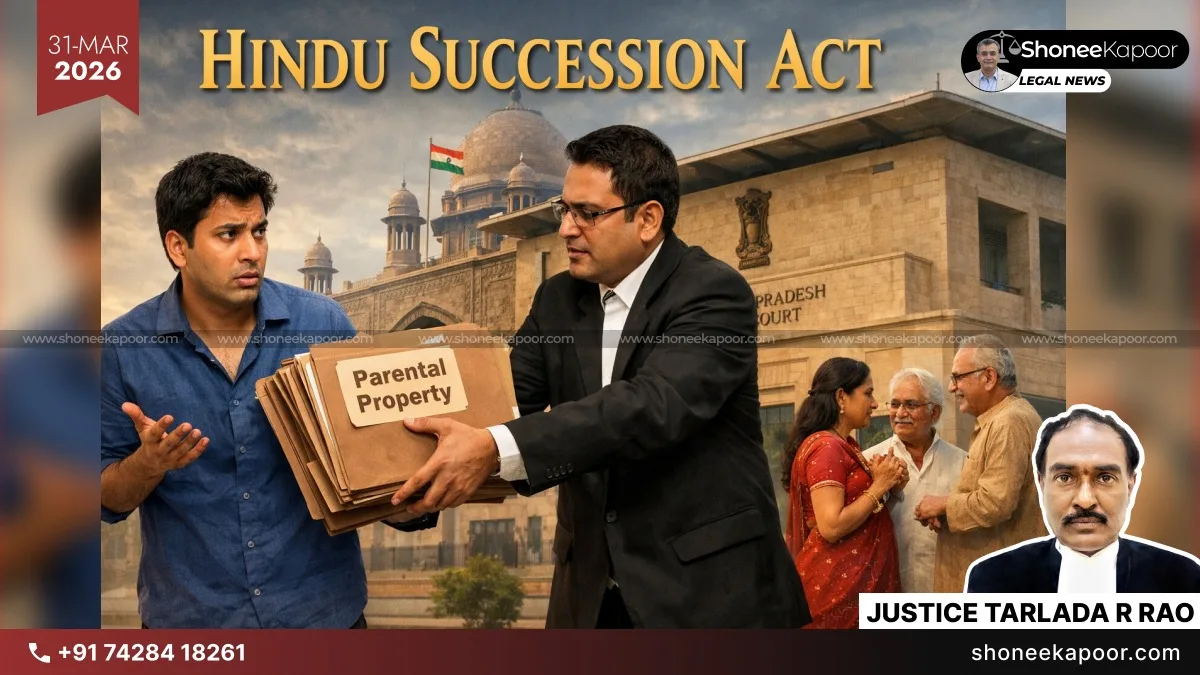
Can a husband claim his wife’s parental property after her death without children? Andhra Pradesh High Court gives a clear answer—this ruling may surprise many.
AMARAVATI: The Andhra Pradesh High Court ruled that if a married woman inherits property from her parents and dies without children, that property will go back to her father’s family, not to her husband or his relatives. This judgment comes under the Hindu Succession Act amid property claims.
The Court explained the law in simple terms while referring to Section 15(2)(a) of the Hindu Succession Act.
Justice Tarlada Rajasekhar Rao stated:
“The bare reading of Section 15(2)(a) of Hindu Succession Act 1956 clearly outlines that if the property is inherited by a female Hindu from her father or mother in the absence of any of child, the property of the deceased shall go to the legal heirs of father. The husband will not get any right over the property inherited by her from her father.”
The case involved a property originally owned by a grandmother. In 2002, she gifted this property to her first granddaughter, and the official records were updated accordingly. However, the granddaughter died in 2005 without any children. After this, the grandmother cancelled the earlier gift and later made a registered will giving the same property to her other granddaughter (the petitioner).
After the grandmother passed away in 2012, the petitioner applied to get the property records updated in her name. The Revenue Divisional Officer allowed this in 2017. But the husband of the deceased granddaughter challenged this decision. The Joint Collector later ruled in his favour and ordered that the property be transferred to him, saying the earlier gift cancellation was not valid.
The petitioner then approached the High Court, arguing that under Section 15(2)(a), the husband has no right over such property since his wife died without children. She also informed the Court that a civil court had already declared their ownership in 2025.
The High Court agreed with the petitioner and made it clear that the husband cannot claim rights in such property and cannot challenge actions taken by the original owner.
The Court further observed:
“… when the unofficial respondent is not entitled for the property pursuant to the Section 15(2)(a) of Hindu Succession Act 1956, the unofficial respondent is not entitled to claim over the property and in view of the same the gift deed executed by the original owner in favour of the wife of 5th unofficial respondent does not get any right over the property”
Finally, the Court allowed the petition, cancelled the earlier order of the Joint Collector, and directed the authorities to update the property records in the petitioner’s name.
Explanatory Table – Laws & Sections Involved
| Law / Section | What It Says | Role in This Case |
| Section 15(1), Hindu Succession Act, 1956 | Defines general order of succession for property of a female Hindu dying without a will | Basic rule of inheritance |
| Section 15(2)(a), Hindu Succession Act, 1956 | Special rule: Property inherited from parents goes back to father’s heirs if woman dies without children | Main legal basis used by Court to deny husband’s claim |
| Section 15(2)(b), Hindu Succession Act, 1956 | Property inherited from husband/father-in-law goes to husband’s heirs if no children | Clarifies reverse situation |
| Article 226, Constitution of India | Gives High Court power to issue writs to correct legal errors by authorities | Used to challenge Joint Collector’s order |
| Section 9, A.P. Rights in Land and Pattadar Passbooks Act, 1971 | Provides revision power to Joint Collector against revenue orders | Used by husband to challenge mutation order |
| Registration Rules (Rule 26(i)(k)) | Deals with cancellation of registered documents | Argument raised but rejected as not applicable here |
Case Details
- Case Title: Chikkala Devika Manasa & Anr. vs State of Andhra Pradesh & Ors.
- Case Number: Writ Petition No. 12421 of 2023
- Court: High Court of Andhra Pradesh at Amaravati
- Bench: Hon’ble Sri Justice Tarlada Rajasekhar Rao
- Neutral Citation / Identifier: APHC010233392023
- Dates:
- Reserved on: 12.03.2026
- Pronounced on: 17.03.2026
- Uploaded on: 24.03.2026
Parties
- Petitioners:
- Chikkala Devika Manasa
- Chikkala Dattathreya
- Respondents:
- State of Andhra Pradesh
- Joint Collector, Anakapalli
- Revenue Divisional Officer, Narsipatnam
- Tahsildar, Payakaraopeta
- Badireddy Naga Veera Venkata Srirama Dora (husband of deceased granddaughter)
Counsels
- For Petitioners: G. Venkata Subba Raju
- For Respondents: Government Pleader for Revenue
Key Precedents Cited
- Thota Ganga Laxmi vs Government of Andhra Pradesh (2010) 15 SCC 207
- V. Dandapani Chettiar vs Balasubramanian Chettiar (2003) 6 SCC 633
- Radhika vs Aghnu Ram Mahto (1994) 5 SCC 761
- Bhagat Ram vs Teja Singh AIR 1999 SC 1944
- Bamadev Panigrahi vs Monorama Raj AIR 1974 AP 226
- Anandilal Jhariya vs Ramlal Jhariya AIR 2010 MP 21
Key Takeaways
- A husband has absolutely no legal right in property inherited by his wife from her parents if she dies without children.
- The law prioritizes the woman’s parental family over the husband, even after marriage, showing a clear imbalance in succession rights.
- Even long-term marital association or contribution holds no value when it comes to such property claims.
- Men can be dragged into litigation over property but still be legally barred from any share, exposing structural unfairness.
- This judgment reinforces a pattern where men carry responsibilities in marriage but are systematically denied corresponding legal rights in property matters.
This Could Change Your Case-Get FREE Legal Advice-Click Here!
Disclaimer: The views and opinions expressed in this article are those of the Indian courts and do not necessarily reflect the official policy or position of “ShoneeKapoor.com” or its affiliates. This article is intended for informational and educational purposes only. The content provided is not legal advice, and viewers should not act upon this information without seeking professional counsel. Viewer discretion is advised.
