
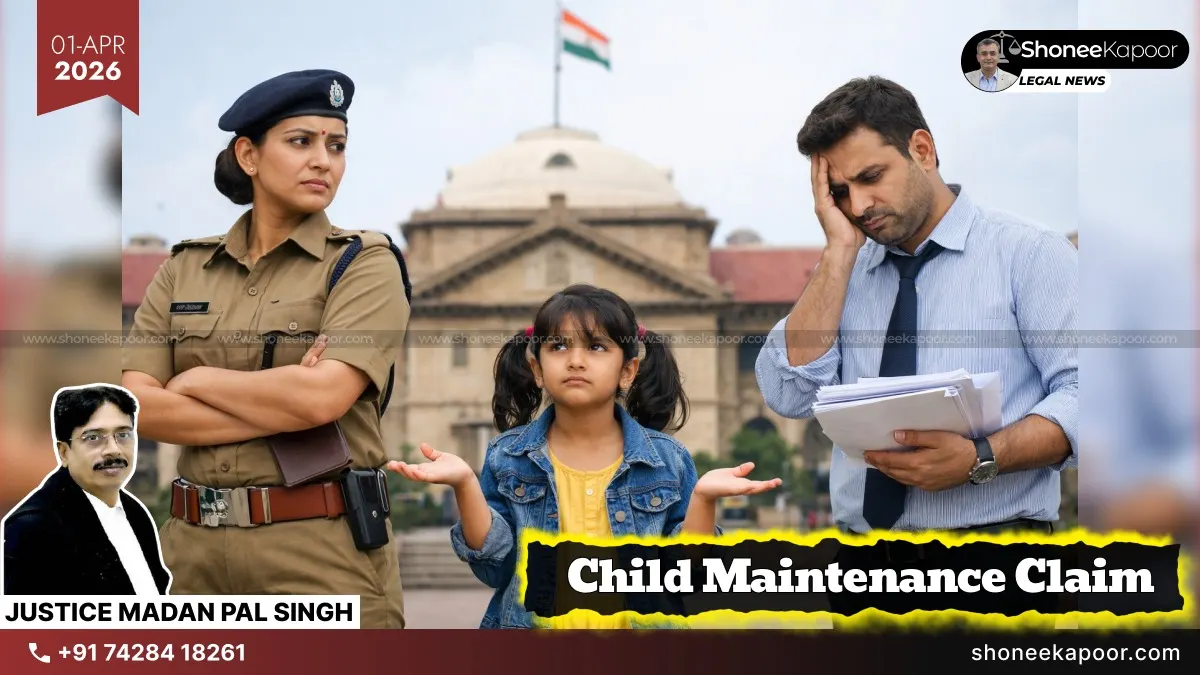
Despite the Allahabad High Court recognizing shared parental duty, should the law continue to treat the father as the default payer even when the mother’s earnings are higher?
The Allahabad High Court, through Hon’ble Justice Madan Pal Singh, clarified that while a father cannot escape his legal duty to maintain his child, courts must also consider the mother’s income to ensure fairness.
The case revolved around a father who requested that the child’s mother be made a party in maintenance proceedings, since she was earning more than him. The father, a railway clerk earning around ₹41,000 per month, argued that the mother, a police constable earning approximately ₹55,000, should share the responsibility.
The Court acknowledged an important legal principle laid down by the Supreme Court in Chandu Sridevi vs Chandu Sesha Rao, where it was observed that both earning parents have a joint responsibility towards their child’s upbringing.
However, the High Court upheld the Family Court’s decision rejecting the father’s request to implead the mother. The Court emphasized the legal position that the person filing the case has the right to decide whom to proceed against. It clearly stated:
“The opposite party no. 2 is the Dominus Litis (Master of the Suit). It is a settled principle of law that the person initiating a legal proceeding has the absolute prerogative to choose the parties against whom they seek relief.”
At the same time, the Court did not ignore the ground reality often faced by men. It made a crucial observation protecting fairness:
“Merely because the mother of the minor child is also earning does not absolve the father from his statutory obligation to maintain the child.”
But importantly, the Court balanced this by reinforcing shared responsibility:
“The responsibility of maintaining the child is a shared and joint responsibility”
The Court further directed that while deciding maintenance, the trial court must consider both parents’ financial capacity:
“The learned trial court must take into consideration the income and financial capacity of both parents”
It also stressed that the final amount should be fair and reasonable:
“Determine the amount of maintenance in a just and reasonable manner keeping in view the principle of shared parental responsibility”
Ultimately, the revision filed by the father was dismissed, with the Court finding no error in the Family Court’s order. However, a strong direction was issued to ensure balanced justice:
This judgment highlights a dual reality—law still places primary liability on the father, but courts are increasingly acknowledging that working women cannot be financially ignored. The burden cannot remain one-sided in modern times, where both parents earn.
Explanatory Table: Laws And Provisions Explained
| Law / Provision | Purpose | How Applied In This Case |
| Section 144 BNSS (Bharatiya Nagarik Suraksha Sanhita) | Provision relating to maintenance of wife, children, and parents (replacement of Section 125 CrPC framework) | The main maintenance proceedings for the child were filed under this section |
| Order 1 Rule 10 CPC | Allows addition/removal of parties in civil cases | Court clarified this provision does not apply to criminal maintenance proceedings |
| Principle of Dominus Litis | The person who files a case has the right to decide whom to sue | Used to justify why mother cannot be forced to be added as a party |
| Supreme Court Judgment: Chandu Sridevi vs Chandu Sesha Rao (2023) | Established that both earning parents share responsibility for child maintenance | Relied upon to highlight shared financial responsibility |
Case Details
- Case Title: Arvind Kumar vs State of U.P. and Another
- Court: High Court of Judicature at Allahabad
- Case No.: Criminal Revision No. 5048 of 2025
- Bench: Hon’ble Justice Madan Pal Singh
- Date of Judgment: 10 March 2026
- Counsels:
- For Revisionist (Husband): Ravindra Kumar Mishra
- For Opposite Party: Chandra Bhushan Singh
- For State: G.A. (Government Advocate)
Key Takeaways
- Financial responsibility for children is still largely imposed on fathers, regardless of comparative income.
- The person filing the case has full control over whom to proceed against, limiting the father’s ability to bring the mother into proceedings.
- Recognition is growing that parenting costs are not one-sided and must reflect contributions from both sides.
- Assessment of maintenance must factor in the actual earning capacity of both parents for a fair outcome.
- Practical relief for men depends less on law and more on how objectively courts apply these principles.
This Could Change Your Case-Get FREE Legal Advice-Click Here!
Disclaimer: The views and opinions expressed in this article are those of the Indian courts and do not necessarily reflect the official policy or position of “ShoneeKapoor.com” or its affiliates. This article is intended for informational and educational purposes only. The content provided is not legal advice, and viewers should not act upon this information without seeking professional counsel. Viewer discretion is advised.
