
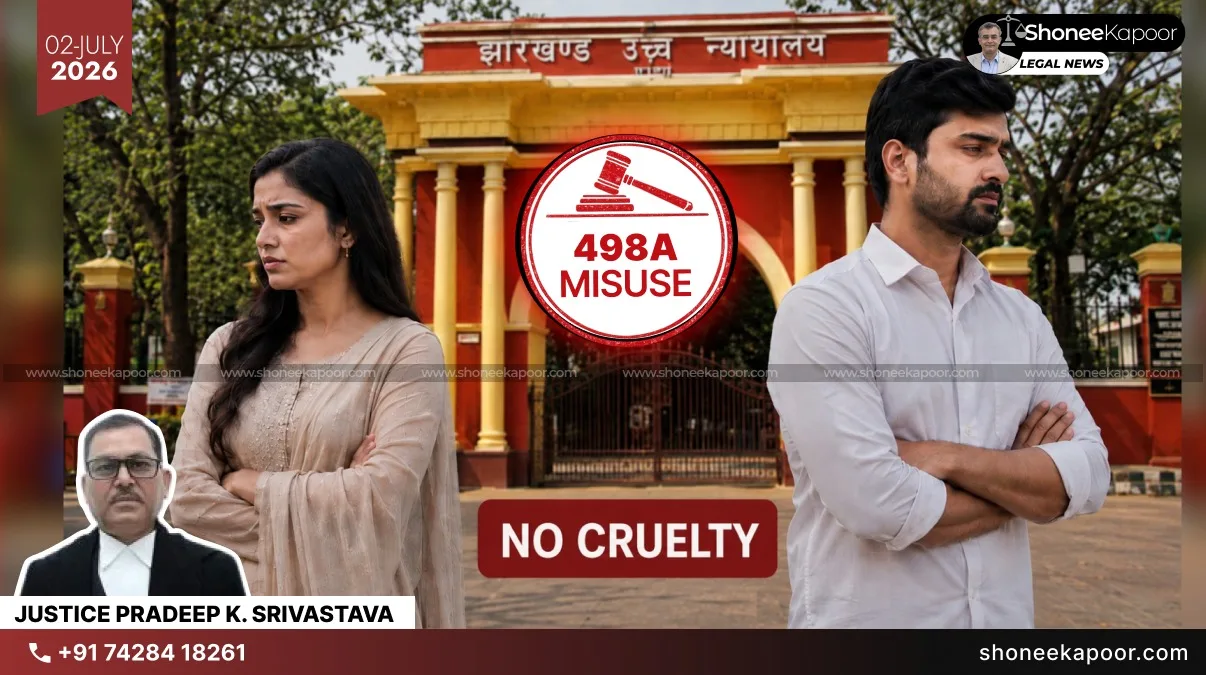
Can a broken marriage be treated as cruelty by the husband? Jharkhand High Court said No, holding that no talking terms, emotional distance, or refusal to live together cannot by itself amount to cruelty under Section 498A IPC.
RANCHI: The Jharkhand High Court has set aside the 498A conviction of a husband, holding that mere matrimonial discord, separation, silence, or refusal to continue married life cannot automatically become criminal cruelty.
Justice Pradeep Kumar Srivastava was hearing a criminal revision filed against the judgment which had upheld the husband’s conviction under Section 498A IPC. He had been sentenced to two years of simple imprisonment with a fine of Rs. 1,000.
The wife had alleged that after marriage, she lived peacefully in her matrimonial home for 4 to 5 years. Later, when her husband returned from Delhi, he allegedly stopped talking to her and the behaviour of her in-laws also changed.
She alleged demand of Hero Honda motorcycle and Rs. 2 lakh cash as dowry. She also alleged assault, torture, snatching of ornaments, and an attempt to kill her on 13.05.2010.
An FIR was registered under Sections 323, 498A, 379, 506 read with Section 34 IPC. After investigation, charge sheet was filed under Sections 498A, 323, 506 read with Section 34 IPC.
The trial court convicted the husband. The appellate court gave benefit of doubt to the father-in-law and mother-in-law, but maintained the husband’s conviction under Section 498A IPC.
The appellate court had noted that the allegations of dowry demand and assault appeared to be false. It also noted that the wife was still residing in the matrimonial home and was getting benefit from the husband’s family property.
However, the appellate court still held the husband guilty mainly because he was avoiding the wife and was not ready to keep her with him.
The appellate court observed that not keeping the wife without proper ground also amounts to cruelty. But the High Court did not agree with this approach.
The High Court examined the evidence and found that most witnesses were hearsay witnesses. The wife was the main witness, but her cross-examination weakened the prosecution case.
The Court noted that she did not complain in cross-examination about physical assault by her husband and in-laws or any illegal demand of money. She also admitted that she was still living in her matrimonial home since 2010.
The High Court found that both the courts had already recorded that the allegations of dowry demand, motorcycle demand, money demand, and physical assault were not proved.
The Court also held that the trial court mainly relied on the wife’s examination-in-chief, while ignoring important admissions made by her during cross-examination.
In a very important observation, the High Court said:
“Mere status of husband and wife showing some matrimonial discard and paying no attention against each other and showing reluctance in discharging conjugal rights and obligations does not fall within ambit of Section 498A I.P.C. as culpable cruelty.”
The Court made it clear that mere husband-wife status, matrimonial discord, no talking terms, and reluctance to perform conjugal duties cannot by themselves amount to cruelty under Section 498A IPC.
The High Court further observed that:
“It appears that the learned trial court has assumed the conduct of the appellant (petitioner herein) amounting to cruelty against his wife, which is absolutely unfounded and merely based on conjecture and surmises.”
The Court therefore held that the conviction could not stand. Accordingly, it allowed the revision, set aside the conviction and sentence, and discharged the husband from bail bond liability.
EXPLANATORY TABLE: LAWS AND SECTIONS INVOLVED
| Law / Section | Purpose | Role In This Case |
| Section 498A IPC | Cruelty by husband or relatives. | Husband was convicted under this, but High Court set aside the conviction. |
| Section 323 IPC | Voluntarily causing hurt. | Assault allegation was made, but not proved. |
| Section 379 IPC | Theft. | Wife alleged ornaments were taken, but main conviction was not on this. |
| Section 506 IPC | Criminal intimidation or threat. | Threat allegation was part of FIR, but not the main issue before High Court. |
| Section 34 IPC | Common intention of several accused. | Used against husband and relatives; parents got benefit of doubt. |
| Section 13 Hindu Marriage Act | Divorce provision. | Husband had filed divorce; Court said this cannot become 498A cruelty by itself. |
CASE DETAILS
- Case Title: Husband vs State of Jharkhand & Anr.
- Court: High Court of Jharkhand at Ranchi
- Case Number: Cr. Revision No. 1124 of 2016
- Neutral Citation: 2026:JHHC:18898
- Bench: Hon’ble Mr. Justice Pradeep Kumar Srivastava
- Date Of Judgment: 29.06.2026
- Counsels:
- For Petitioner: Mr. Ashok Kumar Sinha, Advocate and Mr. Sumeet Anand, Advocate
- For State: Mr. Sardhu Mahto, A.P.P.
- For Opposite Party No. 2: Mr. Anurag Kumar, Advocate
KEY TAKEAWAYS
- Broken marriage is not 498A cruelty. If husband and wife are not talking or living together, it cannot automatically become a criminal offence.
- False or unproved dowry allegations cannot sustain conviction. Court noted that demand of money, motorcycle and assault allegations were not proved.
- Men cannot be punished only for refusing to continue marriage. Filing divorce or avoiding a failed relationship is not equal to cruelty under Section 498A IPC.
- Cross-examination saved the husband. The wife’s own admissions weakened the case, showing why evidence matters more than allegations.
- 498A conviction cannot be based on assumptions. Criminal cruelty must be proved legally, not presumed from silence, separation or matrimonial discord.
This Could Change Your Case-Get FREE Legal Advice-Click Here!
Disclaimer: The views and opinions expressed in this article are those of the Indian courts and do not necessarily reflect the official policy or position of “ShoneeKapoor.com” or its affiliates. This article is intended for informational and educational purposes only. The content provided is not legal advice, and viewers should not act upon this information without seeking professional counsel. Viewer discretion is advised.
