



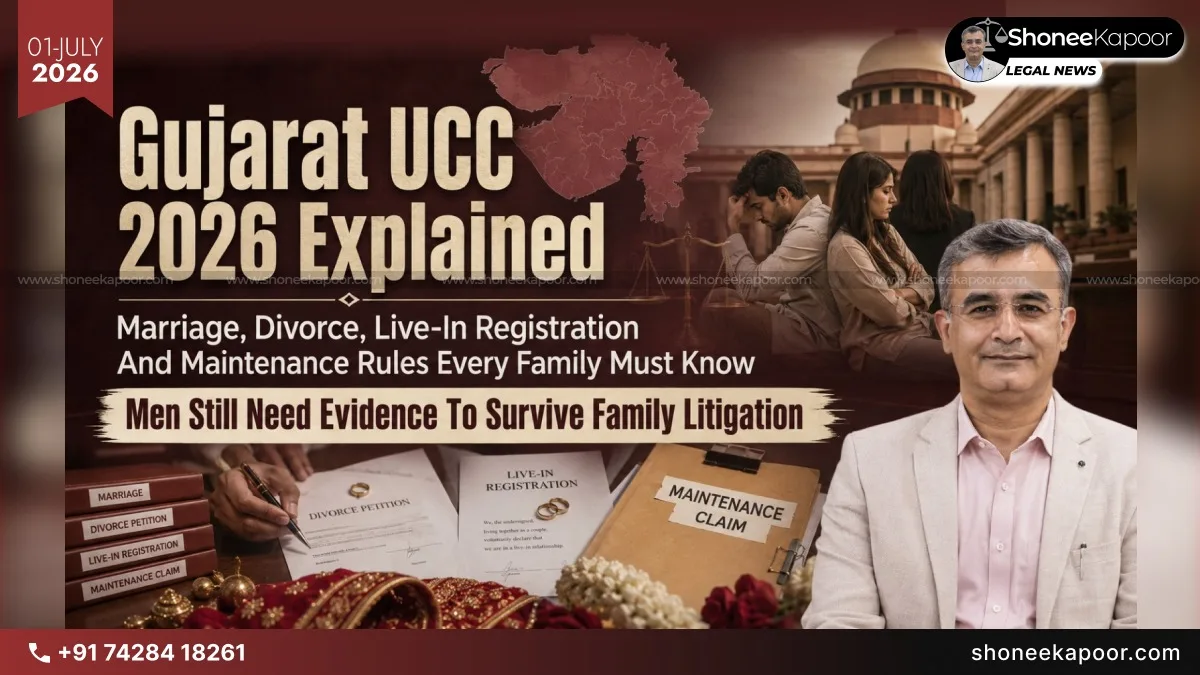
Gujarat UCC 2026 may change how marriage, divorce, live-in relationships and maintenance are proved in court. For families and men facing one-sided claims, the real protection will not be emotion, but documents, evidence and legal awareness.
NEW DELHI: Gujarat UCC 2026 is one of the most important family-law developments in India because it directly deals with marriage, divorce, succession, live-in relationships, maintenance, custody and family records.
Gujarat Bill No. 17 of 2026 is titled the Gujarat Uniform Civil Code, 2026, and the Bill says it will come into force on the date appointed by the State Government through a Gazette notification. Therefore, before anyone treats it as operational in court, the latest Gazette notification and rules must be checked.
The Gujarat Assembly passed the Uniform Civil Code Bill in March 2026 after a long debate, and Gujarat was reported as becoming the second state after Uttarakhand to adopt such a UCC framework. The Gujarat Chief Minister’s Office had earlier stated that a committee chaired by retired Supreme Court judge Justice Ranjana Prakash Desai submitted its final report after district visits, public opinions and consultations.
The biggest mistake people will make is to treat Gujarat UCC as only a political subject. In actual family litigation, this law is about evidence, registration, timelines, proof of relationship, maintenance claims and documentary discipline. A man who ignores documentation will suffer. A woman who makes allegations without proof will still have to face courtroom scrutiny. A family that keeps records will stand stronger than a family that only carries emotions.
WHAT IS GUJARAT UCC 2026?
The Statement of Objects and Reasons says the Bill seeks a uniform legal framework for civil matters irrespective of religion, caste, creed or gender, while referring to Article 44 of the Constitution. The Bill covers marriage and divorce, succession, live-in relationships, maintenance and connected family matters.
For ordinary citizens, this means personal-law differences may reduce in matters covered by the Code, once the law is duly brought into force. For litigants, it means courts may increasingly examine relationships through common statutory requirements, instead of only community-specific customs.
The men’s-rights reading is simple. A uniform law is useful only when it reduces arbitrary misuse, forces both sides to produce documents, and prevents one-sided emotional litigation. One law should not become one more weapon. It must become one common standard.
GUJARAT UCC MARRIAGE RULES
The Bill provides that marriage is between a man and a woman. It requires that neither party should have a living spouse, both parties must be capable of valid consent, the man must have completed 21 years and the woman 18 years, and the parties must not be within prohibited relationship unless custom or law permits it.
The Bill recognises different ceremonies and practices, including Saptapadi, Ashirvad, Nikah, Holy Union, Anand Karaj, Arya Samaji Vedic Vidhi, Nissuin and Mangal Fera. This is important because the UCC does not erase ceremonies; it regulates legal consequences.
After commencement, marriages covered by the Bill are required to be registered. The Bill provides a 60-day period for submitting the memorandum of marriage for marriages solemnised or contracted after the commencement of the Code.
This is where many husbands and families must wake up. In matrimonial litigation, the first battle is often not about law; it is about proof. Marriage certificate, ceremony photographs, invitations, residence proof, ID documents, travel records and bank records often become more important than emotional speeches.
IS UNREGISTERED MARRIAGE INVALID UNDER GUJARAT UCC?
The Bill requires registration of covered marriages, but the broader legal question of validity must be read through the exact final notified law and rules. NewsOnAir’s pre-passage report stated that non-registration would not make a marriage invalid but could attract consequences under the framework being discussed. The final court position will depend on the notified text, rules and judicial interpretation.
Practically, no one should rely on “marriage is valid anyway” as a litigation strategy. Registration is protection. In false cases, maintenance disputes, custody litigation or allegations of concealment, records can decide the direction of the case.
GUJARAT UCC DIVORCE RULES
The Bill lists divorce grounds including adultery, cruelty, desertion for two years, conversion, unsoundness of mind or mental disorder, incurable communicable venereal disease, renunciation, not being heard alive for seven years, marriage contrary to the one-spouse rule, and failure to comply with a maintenance order for one year.
The Bill also contains wife-specific grounds, including where the husband is guilty of rape or unnatural sexual offence, and where the husband had more than one wife in certain pre-Code situations.
Mutual consent divorce under the Bill requires that the parties have been living separately for at least one year, are unable to live together, and have mutually agreed to dissolve the marriage. The Bill also provides for a motion period and gives the court power to waive certain requirements in exceptional situations involving hardship, depravity or no possibility of reconciliation.
This matters because divorce is not a WhatsApp breakup. A marriage cannot be ended merely by private pressure, family meeting, threat, religious declaration or social announcement. The Bill specifically deals with dissolution through the Code and also recognises the right to remarry after a final decree.
CRUELTY IN DIVORCE: WHAT COURTS ACTUALLY LOOK AT
In Samar Ghosh v. Jaya Ghosh, the Supreme Court explained that mental cruelty cannot be placed in a fixed straitjacket and must be judged from the facts of each case. The Court gave illustrations and recognised that sustained conduct causing acute mental pain, agony or suffering may amount to cruelty.
This is crucial for men. A husband is often told to “adjust” endlessly. But courts have repeatedly recognised that cruelty is not only physical violence. False allegations, sustained humiliation, denial of normal marital life, calculated pressure and conduct destroying mental peace may become legally relevant when proved.
The courtroom does not run on outrage. It runs on pleadings, dates, documents, witnesses and contradictions.
MAINTENANCE UNDER GUJARAT UCC 2026
The maintenance provisions in the Bill are important because they are not drafted only as a wife’s remedy. The Bill allows either the wife or the husband to seek interim maintenance and litigation expenses if that spouse has no independent income sufficient for support and necessary expenses of the proceeding. The court has to look at the income of both parties, and the application is expected to be disposed of within a short timeline.
For permanent alimony and maintenance, the Bill again refers to “wife or husband” and allows the court to order a gross sum, monthly sum or periodical sum for a term not exceeding the life of the applicant. The court has to consider the income and property of both sides, mutual agreement or settlement, conduct of the parties and other circumstances.
This is where the hidden truth of family litigation comes out. Maintenance law should support genuine need, not finance revenge. A husband should not be treated as an ATM merely because he is male. A capable spouse, whether man or woman, must not use litigation as a pension scheme.
SUPREME COURT ON MAINTENANCE: RAJNESH V. NEHA
In Rajnesh v. Neha, the Supreme Court issued detailed maintenance guidelines and made disclosure of assets and liabilities crucial in maintenance proceedings. The Court said parties claiming maintenance, including spouses and partners in live-in relationships, should file affidavits of disclosure so that courts can assess maintenance objectively.
The Supreme Court also noted that income details may often be within the personal knowledge of the spouse concerned, and false statements or misrepresentation may invite serious consequences. The Court emphasised timely replies, affidavits and disposal of interim maintenance applications within a reasonable period.
This is the most important practical lesson: fight maintenance with documents, not anger. Salary slips, ITRs, bank statements, loan records, rent receipts, medical expenses, dependants, liabilities, lifestyle proof and the other spouse’s earning capacity must be placed properly before the court.
LIVE-IN RELATIONSHIP UNDER GUJARAT UCC 2026
The Bill makes live-in relationship registration a major part of the Gujarat UCC framework. It provides that partners in a live-in relationship within Gujarat must submit a statement, whether they are residents of Gujarat or not. Gujarat residents living outside the State may also submit such a statement. A child born out of a live-in relationship is treated as legitimate under the Bill.
Registration can be refused if the partners are within prohibited relationship, if either partner is married or already in another live-in relationship, if either partner is a minor, or if consent is obtained by force, coercion, undue influence, misrepresentation or fraud regarding material fact or identity.
The Registrar may conduct a summary inquiry, summon persons, take evidence and then either register the statement or refuse registration with written reasons. The Bill also provides for termination statements and notices where statements are not submitted.
This is where many young men must be careful. Live-in relationships are no longer only private romance. Once the law attaches registration, termination and maintenance consequences, casual arrangements can enter formal legal records.
PUNISHMENT FOR NON-REGISTRATION OR FALSE LIVE-IN STATEMENT
The Bill contains penal provisions for live-in relationships. Living in a live-in relationship for more than one month without submitting the required statement may invite imprisonment up to three months, fine up to Rs. 10,000, or both. False statements or suppression of material facts may invite imprisonment up to three months, fine up to Rs. 25,000, or both. Failure to submit a statement even after notice may invite imprisonment up to six months, fine up to Rs. 25,000, or both.
The Bill also contains stricter punishment where consent for a live-in relationship is obtained by force, coercion, fraud or misrepresentation, and where a person enters a live-in relationship while married or already in another live-in relationship. If a major is in a live-in relationship with a minor, the Bill refers to POCSO consequences.
For men, the warning is blunt. Do not enter a live-in relationship without understanding the legal consequences. Keep chats, rent records, ID proofs, travel records, consent records and termination records. In today’s litigation, ambiguity becomes allegation.
LIVE-IN MAINTENANCE UNDER GUJARAT UCC
The Bill says a woman deserted by her live-in partner may claim maintenance, and the relevant maintenance provisions apply.
This provision will become heavily litigated because it links live-in relationships with financial liability. Men must understand that live-in is not always “no responsibility.” Once a relationship is legally recorded or proved, the financial consequences may follow.
At the same time, courts must be careful. A genuine deserted partner deserves lawful remedy. But false claims, short casual arrangements, overlapping relationships and concealed marital status must not become a shortcut to extract money.
SUPREME COURT ON LIVE-IN RELATIONSHIPS
In D. Velusamy v. D. Patchaiammal, the Supreme Court held that not every live-in relationship is a relationship in the nature of marriage. The Court distinguished a marriage-like relationship from casual arrangements and observed that merely spending weekends together or a one-night stand would not amount to a domestic relationship.
In Indra Sarma v. V.K.V. Sarma, the Supreme Court observed that live-in relationships are neither crime nor sin, but also held that every live-in relationship does not automatically become a relationship in the nature of marriage. The party claiming such a relationship must positively prove its identifying characteristics.
This is why evidence matters. A live-in claim cannot be accepted only because one side says so. Courts must examine duration, shared household, public conduct, financial arrangement, exclusivity, children, documents, intention and surrounding facts.
COURTROOM DEBATE ON LIVE-IN REGISTRATION
The privacy debate around live-in registration is already visible in Indian courts. In a challenge to Uttarakhand UCC provisions, the Uttarakhand High Court was reported to have orally observed that the State was not prohibiting live-in relationships but providing for registration. This was a reported oral courtroom remark in a Uttarakhand matter, not a final Gujarat ruling.
This debate will matter in Gujarat also. The legal fight will likely turn on privacy, autonomy, State interest, protection from fraud, protection of women and children, and prevention of misuse.
CUSTODY AND CHILDREN UNDER GUJARAT UCC
The Bill gives the court power to pass orders regarding custody, maintenance, care and education of minor children. It states that the welfare of the child is paramount and also provides that a minor child under five years is ordinarily to remain with the mother.
For fathers, this is a familiar struggle. A father is often made to fight just to remain present in the child’s life. Any law on custody must not reduce fatherhood to an ATM function. Child welfare must include emotional bonding, access, schooling involvement, health decisions and regular contact with both parents where safe and appropriate.
WHAT HAPPENS TO EXISTING PERSONAL LAWS?
The Bill provides that inconsistent personal, statutory or customary laws cease to operate in Gujarat to the extent of inconsistency after commencement. It also preserves prior rights, responsibilities and proceedings under existing law, and repeals the Gujarat Registration of Marriages Act, 2006.
This means pending and past matters must be examined carefully. Do not assume that every old case will automatically shift into the UCC framework. Transitional provisions, commencement date, rules and court interpretation will decide the practical result.
WHAT MEN AND FAMILIES MUST DO NOW
- First, register marriage documents properly.
- Second, preserve proof of ceremony, residence, expenses and financial contributions.
- Third, keep income and liability documents updated.
- Fourth, do not ignore live-in registration consequences.
- Fifth, never rely on oral settlements in matrimonial disputes.
If divorce is being discussed, record settlement terms properly. If maintenance is being claimed or defended, file a complete financial disclosure. If custody is involved, maintain proof of involvement in the child’s life. If allegations are made, respond with documents, not counter-abuse.
Family law is not won by shouting that the other side is wrong. It is won by showing the court what is true.
FINAL VIEW
Gujarat UCC 2026 can become a major legal turning point if it creates uniform standards, reduces confusion and forces both sides to litigate with proof. But if the system still allows one-sided narratives, exaggerated maintenance claims and casual allegations, uniformity alone will not bring justice.
The law may change. The courtroom principle will not.
Evidence wins. Documentation protects. Silence destroys cases.
FAQs
The Bill says it comes into force on the date notified by the State Government in the Gazette, so the latest Gazette notification must be checked before treating it as operational.
The Bill requires covered marriages after commencement to be registered, with a memorandum to be submitted within 60 days.
Yes. The Bill uses “wife or husband” for interim and permanent maintenance, subject to income, property, conduct and circumstances.
The Bill requires partners in a live-in relationship within Gujarat to submit a statement, and also provides penalties for non-submission or false statements.
No. Courts examine whether the relationship is legally proved and marriage-like. The Supreme Court has held that every live-in relationship is not automatically a relationship in the nature of marriage.

Leave A Comment