
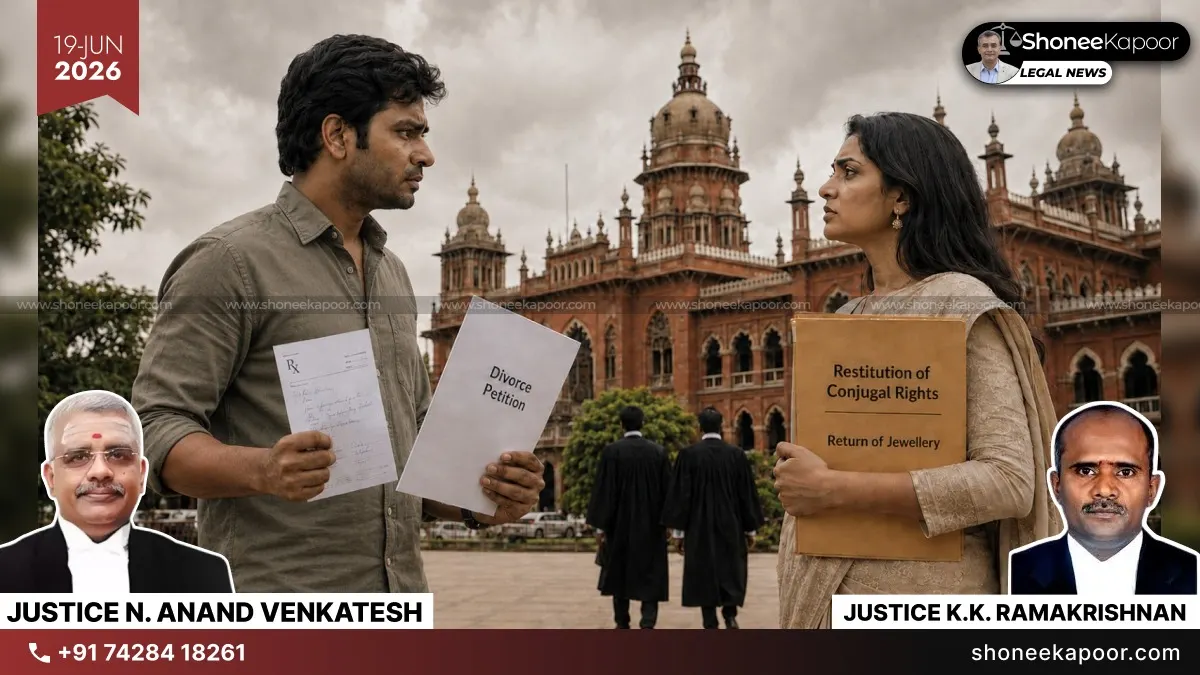
Can a husband get divorce by alleging wife’s mental illness? The Madras High Court refused divorce despite the husband producing doctors’ prescriptions, because mere prescriptions were not enough to prove the wife’s alleged schizophrenia or show that married life had become impossible.
MADURAI: The Madurai Bench of the Madras High Court, comprising Justice N. Anand Venkatesh and Justice K.K. Ramakrishnan, dealt with a matrimonial dispute where the husband sought divorce by alleging that his wife was suffering from schizophrenia. The court refused to grant divorce because the husband could not prove the allegation with reliable evidence.
The marriage between the husband and wife was an arranged marriage. They got married in July 2018 according to Hindu rites and customs. After marriage, the wife joined the husband in Mumbai, where he was working. The couple initially lived a normal married life.
According to the husband, the problem started after the wife became pregnant. He claimed that during medical consultation, he came to know that she was suffering from schizophrenia and had been taking treatment even before marriage. His case was that this fact was hidden from him before marriage.
The husband alleged that the wife behaved abnormally, spoke incoherently at odd hours, and created fear in his mind. He argued that because of her alleged mental condition, he could not continue the marital relationship. He also claimed that suppression of this alleged illness amounted to fraud and mental cruelty.
The wife denied all these allegations. She said she was not suffering from schizophrenia or any incurable mental illness. She also said that the allegation was made later only to avoid marital responsibilities. She maintained that she was always ready to continue the marriage and therefore sought restitution of conjugal rights.
The Family Court had dismissed the husband’s divorce petition and allowed the wife’s plea for restitution of conjugal rights. The husband challenged this before the High Court.
The High Court examined whether the husband had proved that the wife was suffering from schizophrenia either before or after marriage. The Court also examined whether the alleged condition was so serious that the husband could not reasonably be expected to live with her.
The Court explained that under the Hindu Marriage Act, mere mental illness is not enough for divorce. The spouse asking for divorce must prove that the mental disorder is incurable, serious, continuous, and of such a level that normal married life becomes practically impossible.
The husband relied on doctors and prescriptions. But the Court found that the doctors did not give any final or conclusive diagnosis proving schizophrenia. Important medical records like case sheets, diagnostic reports, psychological assessment, discharge summary or final expert opinion were not produced.
The Court held that mere prescriptions cannot prove a serious allegation like schizophrenia. It noted that the wife had completed her M.Tech, faced lengthy cross-examination, and answered coherently, which showed her mental stability.
The High Court said the husband failed to prove that the wife had schizophrenia or that any such fact was hidden before marriage. Therefore, mental cruelty on this ground was not accepted.
The husband also argued that the parties were separated for over six years, but the Court said irretrievable breakdown is not a statutory divorce ground under the Hindu Marriage Act. It also found that the husband had himself withdrawn from the marriage soon after the medical consultation.
The Court dismissed the husband’s divorce appeals and confirmed the wife’s restitution decree. On jewellery, it refused the wife’s full claim of 100 sovereigns and confirmed only 40 sovereigns due to lack of proof.
The Court set aside the direction to return the Mangalsutra, as the wife wanted to continue the marriage.
EXPLANATORY TABLE: LAWS AND SECTIONS INVOLVED
| Law / Section | What It Means | Relevance In This Case |
| Section 19(1), Family Courts Act, 1984 | Provides appeal against Family Court judgments or orders. | Husband appealed Family Court orders. |
| Section 28, Hindu Marriage Act, 1955 | Provides appeal against decrees and orders under the Hindu Marriage Act. | Used for appeal against divorce order. |
| Article 227, Constitution of India | Gives High Court supervisory power over lower courts. | Used in revision petitions. |
| Section 5, Hindu Marriage Act, 1955 | Lays down conditions for a valid Hindu marriage, including mental capacity. | Mental fitness before marriage was examined. |
| Section 13(1)(i-a), Hindu Marriage Act, 1955 | Provides divorce on the ground of cruelty. | Husband alleged mental cruelty. |
| Section 13(1)(iii), Hindu Marriage Act, 1955 | Provides divorce for incurable unsoundness of mind or serious mental disorder. | Schizophrenia allegation was tested. |
| Article 142, Constitution of India | Gives Supreme Court power to do complete justice. | Irretrievable breakdown issue was discussed. |
| Restitution of Conjugal Rights | Allows a spouse to seek resumption of marital cohabitation. | Wife’s decree was upheld. |
CASE DETAILS
- Case Title: S.N. v. M.N.
- Court: Madurai Bench of Madras High Court
- Neutral Citation: 2026:MHC:2123
- Case Numbers: C.M.A.(MD).Nos.696 and 697 of 2024, C.R.P.(MD).Nos.2029 and 3231 of 2023, and C.R.P.(MD).No.2086 of 2024
- Date of Judgment: 15.06.2026
- Bench: Justice N. Anand Venkatesh | Justice K.K. Ramakrishnan
- Counsels:
- For Husband: Mr. M. Ajmal Khan, Senior Advocate, for Mr. M. Mohammed Ibram Saibu
- For Wife: Mr. H. Laxmi Shankar for Mr. A. Senthil Kumar
KEY TAKEAWAYS
- Husband alleged serious mental illness, but without conclusive medical proof, his divorce case collapsed.
- Six years of separation still did not give him divorce, because irretrievable breakdown is not a statutory ground.
- His claim of mental cruelty failed because suspicion, prescriptions and fear were not treated as evidence.
- Even after the marriage had clearly reached court battles, wife’s restitution decree was upheld against him.
- The only relief against exaggerated claims was that wife’s 100 sovereigns claim was not fully accepted; proof still saved him from the full jewellery burden.
This Could Change Your Case-Get FREE Legal Advice-Click Here!
Disclaimer: The views and opinions expressed in this article are those of the Indian courts and do not necessarily reflect the official policy or position of “ShoneeKapoor.com” or its affiliates. This article is intended for informational and educational purposes only. The content provided is not legal advice, and viewers should not act upon this information without seeking professional counsel. Viewer discretion is advised.
