
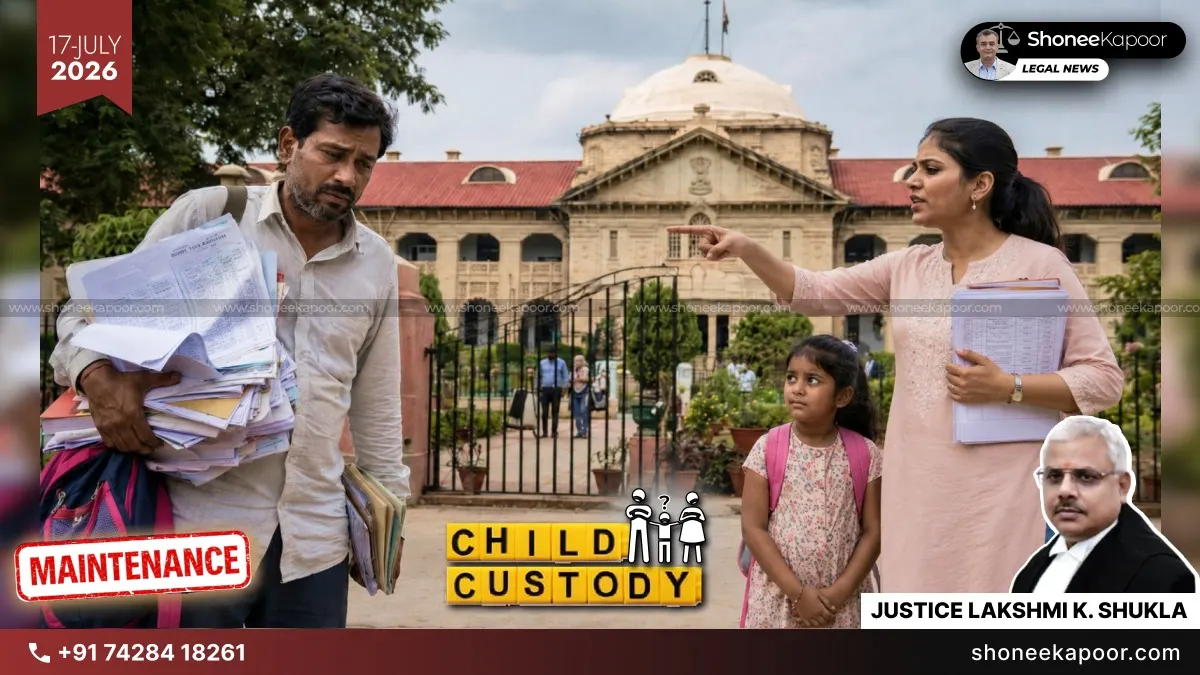
The Allahabad High Court held that a working mother who secured custody of the child after claiming financial stability cannot later demand that the father should be made solely responsible for the Child’s maintenance. When both parents are earning, the child’s reasonable expenses must be shared proportionately.
NEW DELHI: The Allahabad High Court has held that a working mother who obtained custody of her minor child after specifically claiming that she was financially capable of maintaining the child cannot subsequently place the entire child maintenance burden upon the father.
The Court clarified that where both the mother and father are earning, the reasonable expenses of the minor child may be shared proportionately according to their respective incomes and financial capacities.
Justice Lakshmi Kant Shukla dismissed a criminal revision filed by a woman and her minor daughter challenging an order passed by the Family Court, Prayagraj, on their application for maintenance under Section 125 CrPC.
The Family Court had rejected the mother’s claim for interim maintenance while directing the father to pay ₹3,000 per month as interim maintenance for the minor daughter.
Before the High Court, the mother argued that the amount granted for the child was meagre and insufficient. She also claimed that she had no independent source of income and that the Family Court had wrongly concluded that she was capable of maintaining herself.
The mother submitted that she had worked on a contractual basis for only three months in 2022. She claimed that she later resigned from the job due to pressure allegedly created by her husband.
However, the husband placed documentary material before the Court, including a salary slip showing that the mother was earning ₹14,125 per month.
The husband argued that the mother had not produced any documentary evidence to prove that she had actually resigned from her employment.
The husband further informed the Court that the minor daughter had earlier been living with him and was being maintained by him.
Subsequently, the mother filed a habeas corpus petition seeking custody of the child. In that petition, she specifically claimed that she was fully capable of maintaining herself and her minor daughter.
The child’s custody was handed over to the mother on the basis of this assertion regarding her financial capability.
The High Court found merit in the husband’s submissions and agreed with the Family Court’s conclusion that the mother was capable of maintaining herself.
The Court observed that no reliable documentary material had been produced to establish that the woman had resigned from her employment or that her financial circumstances had subsequently deteriorated.
Referring to the Supreme Court’s decision in the case of Rajnesh v. Neha (2021) 2 SCC 324, the Allahabad High Court observed that the reasonable expenses of a minor child, including food, clothing, residence, medical care and education—must be adequately provided for.
However, the Court clarified that when the mother is also working and earning sufficiently, the child’s expenses may be shared proportionately between both parents.
The Court observed:
“Although the reasonable expenses of the minor child, including those relating to food, clothing, residence, medical care and education, are required to be adequately provided for and the educational expenses are ordinarily to be borne by the father, where the mother is also working and earning sufficiently, such expenses may be shared proportionately between both parents.”
The High Court further held that the mother, after obtaining the child’s custody by asserting her own financial capacity, could not subsequently seek to impose the entire financial responsibility exclusively upon the father.
The Court also noted that no convincing material had been presented to show:
- Any substantial increase in the child’s actual and reasonable expenses;
- Any material increase in the father’s income; or
- Any subsequent deterioration in the mother’s financial condition.
In the absence of such evidence, the High Court held that there was no sufficient ground either to grant individual interim maintenance to the working mother or to enhance the maintenance already awarded to the minor daughter.
The criminal revision petition was dismissed, and the Family Court’s order granting ₹3,000 per month to the child while rejecting the mother’s individual maintenance claim was upheld.
The judgment reinforces the principle that child maintenance is a shared parental responsibility and cannot automatically be treated as the father’s exclusive legal obligation merely because he is the male parent.
Where the mother is qualified, employed and earning sufficiently, courts may examine the financial capacity of both parents and direct them to contribute proportionately towards the child’s welfare.
The ruling also makes it clear that a parent cannot claim financial capability while seeking child custody and later take a contradictory position while demanding maintenance from the other parent.
EXPLANATORY TABLE OF LAWS AND SECTIONS
| LAW/SECTION | LEGAL MEANING | APPLICATION IN THIS CASE | FINAL FINDING |
| Section 125 CrPC/Section 144 BNSS | Enables a wife, minor child or dependent parent who is unable to maintain themselves to claim maintenance from a person having sufficient means. | The mother and minor daughter filed an application seeking interim maintenance from the father. | The mother’s individual claim was rejected, while ₹3,000 per month was granted to the minor daughter. |
| Rajnesh v. Neha, (2021) 2 SCC 324 | Required parties in maintenance proceedings to disclose their income, assets, liabilities and financial status. | The mother allegedly left the occupation and income columns blank despite material showing that she was earning. | The Court considered the salary material and held that she was capable of maintaining herself. |
| Burden Of Proof | A person seeking maintenance or enhancement must establish financial need and relevant changed circumstances. | The mother claimed that she had resigned and that the child’s maintenance was insufficient. | No documentary proof of resignation, increased expenditure or financial deterioration was produced. |
| Principle Against Contradictory Claims | A litigant cannot rely upon one factual position to obtain relief and later adopt a contrary position for another benefit. | The mother claimed financial capability to obtain custody but later claimed financial incapacity to seek maintenance. | The Court refused to permit the entire maintenance burden to be shifted to the father. |
CASE DETAILS
| PARTICULAR | DETAILS |
| Case Title | Roji Bano And Another v. State of U.P. and Another |
| Court | Allahabad High Court |
| Neutral Citation | 2026:AHC:141825 |
| Bench | Justice Lakshmi Kant Shukla |
| Impugned Order | Order dated August 26, 2025, passed by the Additional Principal Judge, Family Court-05, Prayagraj |
| Original Proceeding | Maintenance Case No. 815 of 2023 |
| Law Involved | Section 125 CrPC / 144 BNSS |
| Decision Date | July 14, 2026 |
COUNSELS APPEARED
| Counsel For Revisionists | Akhilesh Kumar Vishwakarma, Anil Kumar Singh and Ranjeet Singh |
| Counsel For Opposite Parties | Ehtesham Khan and Government Advocate |
KEY TAKEAWAYS
- A working mother cannot automatically shift the entire child maintenance burden upon the father when she is also earning sufficiently.
- Child maintenance is a shared parental responsibility and must be determined according to the financial capacity of both parents.
- A mother who obtains child custody by claiming financial capability cannot subsequently claim complete financial dependence upon the father.
- Courts must examine actual income, employment records and financial disclosure affidavits instead of imposing maintenance solely on the basis of gender.
- Enhancement of child maintenance cannot be granted merely on demand; increased expenses or changed financial circumstances must be proved through reliable evidence.
This Could Change Your Case-Get FREE Legal Advice-Click Here!
Disclaimer: The views and opinions expressed in this article are those of the Indian courts and do not necessarily reflect the official policy or position of “ShoneeKapoor.com” or its affiliates. This article is intended for informational and educational purposes only. The content provided is not legal advice, and viewers should not act upon this information without seeking professional counsel. Viewer discretion is advised.
