
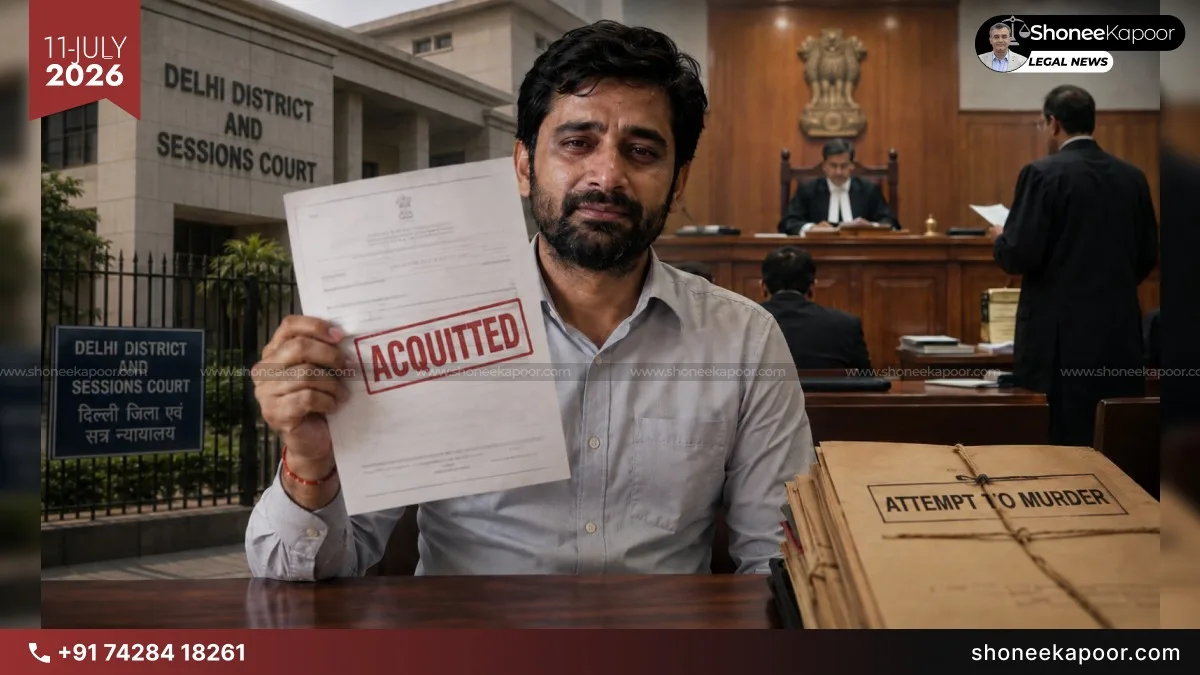
Can a husband be convicted only on the basis of an FIR and supplementary statement? The court held that unproved allegations cannot replace evidence tested during trial, especially when the complainant was never examined.
NEW DELHI: A Delhi court acquitted Abhinesh Tripathi alias Rahul in a 2021 attempt-to-murder case involving his wife, Rashmi. The court held that the prosecution could not prove the allegations because the wife, who was the only material witness, died before her statement could be recorded during the trial.
Principal District and Sessions Judge Sanjay Sharma passed the acquittal order after finding that there was no other direct witness who could prove any criminal act allegedly committed by the husband.
The case began with a complaint filed by Rashmi in April 2021. She alleged that her husband assaulted her after she refused to speak to an unknown person at his request. She initially claimed that he hit her with a hockey stick and threatened to kill her.
Based on her complaint, the police registered an FIR under Sections 307, 323, 341 and 506 of the Indian Penal Code. These provisions deal with attempt to murder, voluntarily causing hurt, wrongful restraint and criminal intimidation.
While receiving treatment at a hospital, Rashmi later gave a supplementary statement. She alleged that her husband came home in an intoxicated condition and threw her from the third floor while threatening to kill her. After this statement, the charge of attempt to murder was added.
During the trial, Rashmi could not be examined. The summons sent to her were returned because she had left the rented accommodation. Her father later informed the court that she had died.
Her father also stated that Rashmi had settled all disputes with the accused before her death. The couple had obtained divorce by mutual consent, and she had received ₹8 lakh as alimony.
The court observed that Rashmi was the only person who could directly explain what had happened. Since her evidence was never recorded, the allegations made in the complaint and supplementary statement remained unproved.
The court said:
“In the present case, the only material witness i.e. complainant/ injured Rashmi has expired and prosecution has not cited any other witness, who can depose regarding any overt act done by the accused.”
The remaining prosecution witnesses were police officials and other formal witnesses. Their evidence could only establish procedural steps such as registration of the FIR and investigation. It could not prove that the husband assaulted, threatened or threw his wife from the building.
The court also noted that there was no independent or incriminating evidence directly connecting the husband with the alleged offences. A person cannot be convicted only on the basis of an unproved complaint or allegations that were never tested during trial.
As the prosecution failed to prove the charges beyond reasonable doubt, the court acquitted the husband of all offences.
EXPLANATORY TABLE: LAWS AND SECTIONS INVOLVED
| Law/Section | Purpose | How It Applied In This Case |
| Section 307, Indian Penal Code, 1860 | Punishes an act done with the intention or knowledge of causing death, even when the victim survives. | This charge was added after the wife alleged that her husband threw her from the third floor while threatening to kill her. The charge failed because she died before testifying and no other witness proved the incident. |
| Section 323, Indian Penal Code, 1860 | Punishes voluntarily causing bodily pain or injury to another person. | The wife had initially alleged that the husband beat her with a hockey stick. However, the allegation remained unproved because her evidence was never recorded during trial. |
| Section 341, Indian Penal Code, 1860 | Punishes wrongful restraint, meaning illegally stopping a person from moving where they have a right to go. | This section was included in the FIR, but the prosecution could not produce any direct witness or evidence proving that the husband wrongfully restrained his wife. |
| Section 506, Indian Penal Code, 1860 | Punishes criminal intimidation through threats intended to cause fear or force a person to act in a particular way. | The wife had alleged that the husband threatened to kill her. Since she could not testify and the remaining witnesses were only formal police witnesses, the threat allegation was not proved. |
CASE DETAILS
- Case Title: State v. Abhinesh Tripathi @ Rahul
- Court: Delhi District Court
- Bench: Principal District and Sessions Judge Sanjay Sharma
- Order date: July 6, 2026
- Sections involved: Sections 307, 323, 341 and 506 of the Indian Penal Code, 1860.
KEY TAKEAWAYS
- Even a serious charge like attempt to murder cannot stand without reliable and legally admissible evidence.
- A husband cannot be convicted merely because allegations were made in an FIR or supplementary statement.
- When the sole material witness is unavailable, formal police testimony cannot prove what actually happened inside the matrimonial home.
- Criminal courts must decide cases on evidence tested during trial, not on accusations that were never proved.
- Weak matrimonial prosecutions can still consume years of a man’s life, making the legal process itself a form of punishment.
This Could Change Your Case-Get FREE Legal Advice-Click Here!
Disclaimer: The views and opinions expressed in this article are those of the Indian courts and do not necessarily reflect the official policy or position of “ShoneeKapoor.com” or its affiliates. This article is intended for informational and educational purposes only. The content provided is not legal advice, and viewers should not act upon this information without seeking professional counsel. Viewer discretion is advised.
