
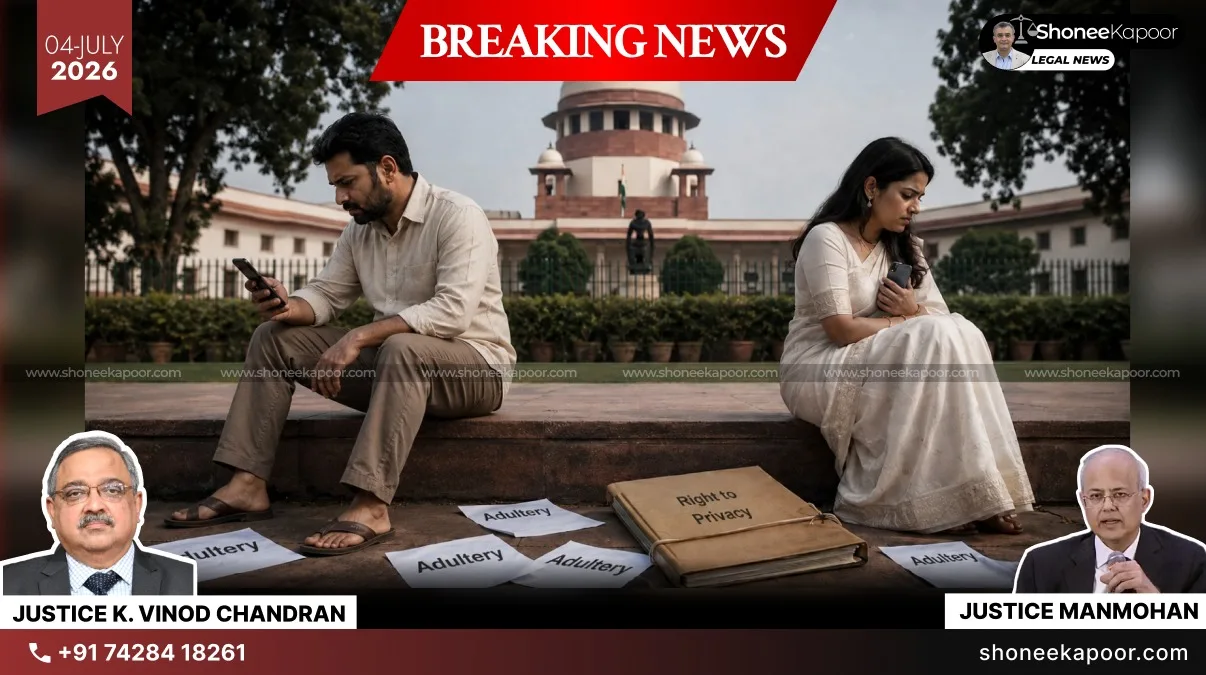
Can a spouse accused of adultery hide behind the right to privacy when call records and hotel details may expose the truth? The Supreme Court has now made it clear that privacy is important, but it cannot become a shield against evidence in a divorce case.
NEW DELHI: The Supreme Court has held that the right to privacy under Article 21 of the Constitution cannot be used to stop a spouse from getting mobile call records and hotel-stay details when adultery is alleged in a matrimonial case.
The case came before a Bench of Justice Manmohan and Justice K. Vinod Chandran after a husband challenged the Delhi High Court order. He argued that sharing his call detail records and hotel reservation details in court would violate his fundamental right to privacy.
The Supreme Court did not accept his argument and dismissed his appeal. The Court found no error in the Delhi High Court order, which had said that the right to privacy is not absolute and can be controlled by reasonable restrictions when public interest and fair judicial process are involved.
The matter started from a matrimonial dispute. The couple got married in 1998 and had a daughter in 2000. Later, the wife alleged that the husband had an extra-marital relationship and had stayed with another woman in a hotel in Jaipur. She filed a divorce case and sought the hotel reservation details and mobile call records to prove adultery.
The Delhi High Court had approved the Family Court’s direction for producing these records. It said that adultery is still a valid ground for divorce under the Hindu Marriage Act, even though adultery is no longer a criminal offence. Therefore, when a spouse comes to court with a specific allegation, the other spouse cannot simply use privacy to block relevant evidence.
The High Court held:
“This right of privacy under Article 21 of the Constitution of India has to be necessarily subject to reasonable restrictions, especially when the restrictions are in public interest. The Hindu Marriage Act specifically recognises adultery as a ground for divorce and, therefore, it would not at all be in public interest that the court should, on the ground of right to privacy, come to the aid of a married man who, during the subsistence of his marriage, is alleged to have indulged in sexual relationships outside his marriage,”
This ruling is important because matrimonial cases often depend on evidence which is not easily available to the affected spouse. Whether the suffering spouse is a husband or a wife, the law cannot expect a person to prove betrayal while denying access to the records which may reveal the truth.
The judgment also sends a wider message that privacy is a constitutional right, but it cannot become a tool to defeat justice inside the courtroom. In family disputes, where allegations like adultery, cruelty, false accusations, abandonment or misuse of process are raised, courts must balance privacy with the right to a fair trial.
For men also, this principle matters. Many husbands face serious allegations in matrimonial courts and are repeatedly asked to prove their defence with documents, records and timelines. If evidence is necessary to prove or disprove a serious claim, then the same standard must apply fairly to both sides.
EXPLANATORY TABLE: LAWS AND SECTIONS MENTIONED
| LAW / SECTION | WHAT IT MEANS | HOW IT WAS USED IN THIS CASE |
| Article 21, Constitution of India | Protects life and personal liberty, including the right to privacy. | Husband argued that disclosure of CDRs and hotel records would violate his privacy. The courts held privacy is important but not absolute. |
| Article 226, Constitution of India | Gives High Courts power to issue writs and exercise supervisory jurisdiction in appropriate cases. | The husband approached the Delhi High Court under Article 226 challenging Family Court orders. |
| Section 13(1)(i), Hindu Marriage Act, 1955 | Recognises adultery as a ground for divorce. | Wife filed divorce proceedings alleging adultery and cruelty. The courts held that evidence relevant to adultery cannot be blocked merely by claiming privacy. |
| Section 14, Family Courts Act, 1984 | Allows Family Courts to receive documents, reports, statements or information if they help decide the dispute, even if they may not be strictly admissible under the Evidence Act. | This was the key provision used to justify calling hotel records and CDRs. The Delhi High Court said Family Courts have wide power to receive evidence useful for deciding matrimonial disputes. |
| Order XVI, CPC | Deals with summoning and attendance of witnesses and production of documents. | Wife used this provision with Section 14 of the Family Courts Act to seek hotel booking details and CDRs. |
| Indian Evidence Act, 1872 | General law governing evidence in courts. | The Court noted that Family Courts have a wider evidentiary approach under Section 14 of the Family Courts Act. |
| Section 112, Indian Evidence Act, 1872 | Deals with legitimacy of a child born during a valid marriage. | Husband argued that calling records could cast aspersions on the other woman’s child; the Court considered this argument but did not stop production of records. |
| Section 114, Indian Evidence Act, 1872 | Allows courts to draw certain presumptions from conduct and facts. | Husband argued that no adverse inference should be drawn merely because he resisted disclosure on privacy grounds. |
| Joseph Shine v. Union of India, (2019) 3 SCC 39 | Decriminalised adultery but did not erase adultery as a matrimonial wrong. | Relied upon to show that consensual sexual relationship outside marriage by a married person does not automatically get Article 21 protection in a matrimonial dispute. |
| K.S. Puttaswamy v. Union of India, (2017) 10 SCC 1 | Landmark privacy judgment. | Used to explain that privacy is a fundamental right, but not an absolute right. |
| Sharda v. Dharampal, (2003) 4 SCC 345 | Deals with court-directed evidence in matrimonial disputes. | Cited by the husband to argue that such directions need a proper prima facie foundation. |
| Mr. X v. Hospital Z, (1998) 8 SCC 296 | Discusses clash between privacy and competing rights/public interest. | Relied upon to argue that privacy may yield where larger public interest or another competing right is involved. |
| Aparna Ajinkya Firodia v. Ajinkya Arun Firodia, 2023 SCC OnLine SC 161 | Deals with legitimacy/paternity-related concerns. | Cited by the husband while arguing that the records could affect the reputation and legitimacy issues concerning a child. |
| Linda Constance Edwards v. William Edwards, 2000 SCC OnLine Del 933 | Recognises that direct proof of adultery is rarely available. | Relied upon to support the idea that adultery is often proved through circumstances, not direct evidence. |
CASE DETAILS
| DETAIL | INFORMATION |
| Delhi High Court Case | CM(M) 64/2023, CM APPL. 2082/2023 & CM APPL. 6247/2023 |
| Reported Case Name | SA v. MA; the Delhi High Court |
| Delhi High Court Neutral Citation | 2023:DHC:3197 |
| Delhi High Court Date of Decision | 10.05.2023 |
| Delhi High Court Judge | Hon’ble Ms. Justice Rekha Palli |
| Supreme Court Bench | Justice Manmohan and Justice K. Vinod Chandran |
| Supreme Court Result | Husband’s appeal dismissed; Delhi High Court view upheld. |
| Petitioner Counsel in Delhi HC | Ms. Preeti Singh, Mr. Sunklan Porwal, Ms. Saumya Dwivedi, Ks. Kmkum Mandhanya and Mr. Rishabh Munjal, Advocates |
| Respondent Counsel in Delhi HC | Mr. Prabhjit Jauhar with Ms. Rosemary Raju, Ms. Ajunee Singh, Mr. Ranveer Talwar, Advocates |
KEY TAKEAWAYS
- Privacy is a fundamental right, but it cannot be used to bury evidence in a matrimonial dispute.
- Adultery may not be a crime now, but it is still a valid ground for divorce under Hindu Marriage Act.
- Courts cannot ask a spouse to prove betrayal and then deny access to records that may prove the truth.
- This principle must protect men equally when husbands need call records, chats, hotel details or timelines to expose false allegations.
- Matrimonial courts must move from sympathy-based decisions to evidence-based justice, because one false story can destroy a man’s life, family, reputation and years.
This Could Change Your Case-Get FREE Legal Advice-Click Here!
Disclaimer: The views and opinions expressed in this article are those of the Indian courts and do not necessarily reflect the official policy or position of “ShoneeKapoor.com” or its affiliates. This article is intended for informational and educational purposes only. The content provided is not legal advice, and viewers should not act upon this information without seeking professional counsel. Viewer discretion is advised.
