
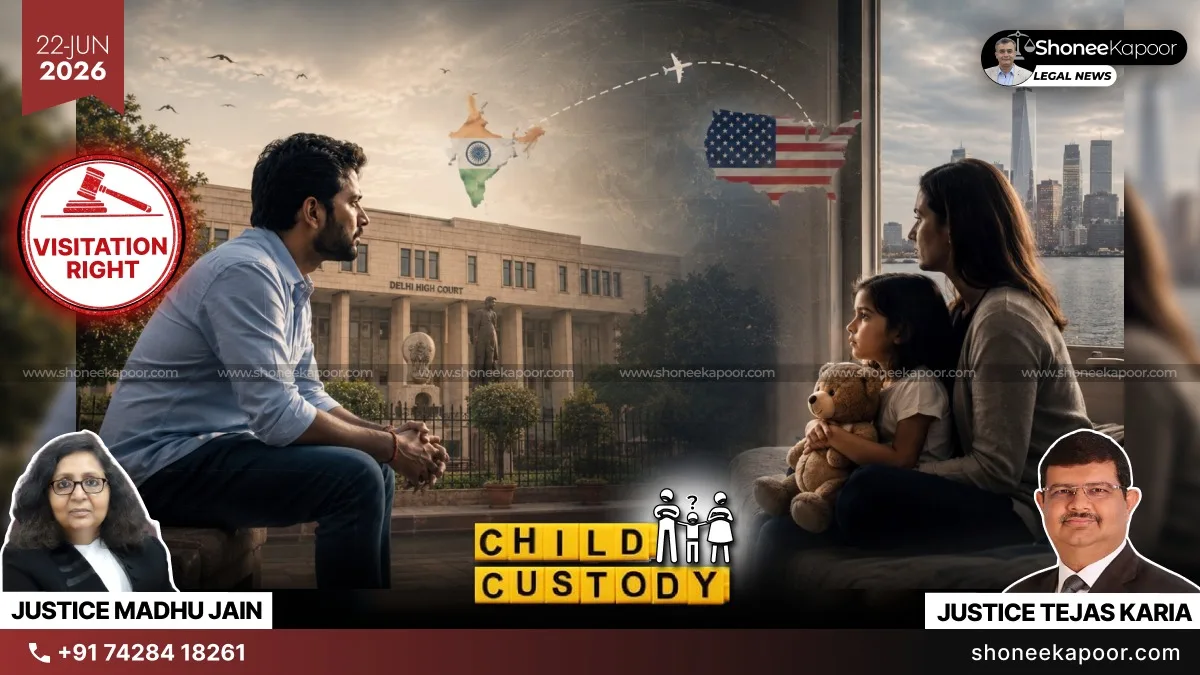
Can a father be forced to choose between work and child access? Delhi High Court held that the father may exercise his visitation rights with the minor child in the USA during vacation, but cannot bring the child to India in view of immigration and re-entry concerns.
NEW DELHI: The Delhi High Court, through its Division Bench of Justice Tejas Karia and Justice Madhu Jain, modified a Family Court order in a child custody dispute in which the father had earlier been permitted to bring the minor child from the USA to India during summer vacation.
The mother challenged this before the High Court. She said she was not stopping the father from meeting the child. Her concern was that the child’s immigration status in the USA was linked to her own visa status, which was under transition after her selection under the H-1B FY 2027 CAP Programme.
She submitted that if the child left the USA during this sensitive visa process, his re-entry could become difficult. She also placed the child’s tourist visa, F-2 visa and an opinion from a USA immigration attorney before the Court. The child’s new school session was also to begin on 15.07.2026.
The father opposed the appeal. He argued that the child had a valid B-1/B-2 tourist visa till 31.07.2029 and could return to the USA on that basis. He also submitted that the mother’s immigration position and “OPT” status would protect the child’s dependent visa status.
After hearing both sides, the Delhi High Court found that the Family Court had not properly considered the immigration concerns. The Court observed:
“The Impugned Order does not adequately appreciate the immigration-related concerns raised by the Appellant while holding that such objections do not justify denial of access to the Respondent.”
At the same time, the High Court also recognised the importance of the father-child relationship. The Court noted that:
“The pendency of such processes cannot indefinitely suspend the father-child relationship.”
However, the High Court said that the child’s welfare could not be put at risk. The Court found that the Family Court had-
“Overlooked the serious concerns arising from the change in the Appellant’s immigration status and the consequential impact on the minor child’s residence and immigration status in the USA.”
The Court also gave weight to the USA immigration attorney’s opinion. It clarified that:
“Although the opinion of the attorney placed on record is not binding on this Court, the opinion expressed on affidavit by a qualified immigration attorney may be treated as a statement of fact having persuasive value.”
The High Court then held that if the child was taken to India and later faced difficulty in returning to the USA, it would not be in his welfare.
Since the father had already travelled to the USA on 12.06.2026, the Court said he could spend summer vacation with the child there itself. The child would remain with the father in the USA during vacation, but would not be brought to India.
The father had argued that he had to return to work on 22.06.2026. The Court did not accept this as a reason to disturb the child’s immigration position. It observed that:
“It is always possible for the Respondent to give priority to the minor child by extending his stay in the USA by working remotely from there.”
The Delhi High Court modified the Family Court order and directed that the minor child shall remain with the father in the USA during the vacation period, without being brought to India. The father was directed to return the child to the mother in the USA three days before the reopening of school on 15.07.2026.
EXPLANATORY TABLE: LAWS AND PROVISIONS INVOLVED
| Law / Provision / Concept | Role In This Case | Simple Meaning |
| Section 19, Family Courts Act, 1984 | Appeal filed under this section. | Used to challenge Family Court orders before High Court. |
| Section 26, Hindu Marriage Act, 1955 | Father’s application was under this section. | Deals with custody, education and maintenance of minor children. |
| HMA No. 628/2025 | Main Family Court case. | Matrimonial case where child custody issue arose. |
| F-1 / F-2 Visa Status | Mother raised child’s visa risk. | Child’s USA stay was linked to mother’s visa status. |
| Form I-20 | Travel document issue raised. | Important document for F-1/F-2 visa travel. |
| H-1B FY 2027 CAP Programme | Mother’s visa was in transition. | Her changing status could affect the child’s status. |
| B-1/B-2 Tourist Visa | Father relied on this visa. | He said child could re-enter USA on tourist visa. |
| OPT | Father relied on mother’s OPT status. | Work permission linked to student status in USA. |
CASE DETAILS
- Case Title: Sanam Talwar v. Shabeer Gerewal
- Court: High Court of Delhi at New Delhi
- Case Number: MAT.APP.(F.C.) 204/2026
- Connected Applications: CM APPL. 38759/2026 and CM APPL. 38760/2026
- Date Of Judgment: 17.06.2026
- Neutral Citation: 2026:DHC:5127-DB
- Bench: Hon’ble Mr. Justice Tejas Karia | Hon’ble Ms. Justice Madhu Jain
- Counsels:
- For Appellant: Ms. Priya Hingorani, Senior Advocate with Ms. Aditi Ladda, Advocate
- For Respondent: Mr. Somnath Bharti and Ms. Kashish Aggarwal, Advocates
KEY TAKEAWAYS
- A father had to fight till the High Court just to secure meaningful vacation time with his own child.
- The Family Court had allowed the child to be brought to India, but the order got modified due to visa and re-entry concerns.
- The father’s access was not denied, but it became practically difficult because he had to stay in the USA instead of bringing the child to India.
- Even when the Court protected the father-child bond, the father still had to adjust his work, travel and stay because custody litigation rarely treats fathers’ time as simple.
- This case shows the hard reality: for many fathers, meeting their own child during vacation becomes a legal battle, not a normal parental right.
This Could Change Your Case-Get FREE Legal Advice-Click Here!
Disclaimer: The views and opinions expressed in this article are those of the Indian courts and do not necessarily reflect the official policy or position of “ShoneeKapoor.com” or its affiliates. This article is intended for informational and educational purposes only. The content provided is not legal advice, and viewers should not act upon this information without seeking professional counsel. Viewer discretion is advised.
