
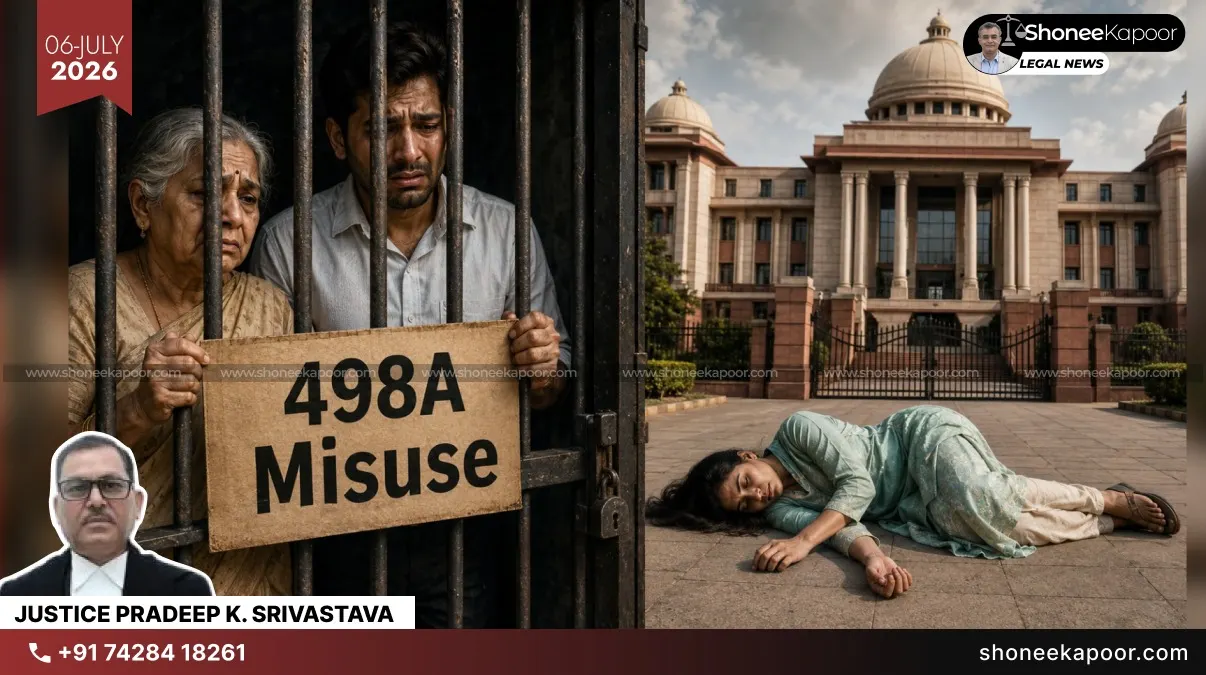
Can a mother-in-law be convicted under 498A only for scolding her daughter-in-law over a domestic issue? Jharkhand High Court says ordinary household scolding cannot become cruelty unless legal ingredients are proved.
RANCHI: The Jharkhand High Court has set aside the conviction of a mother-in-law in a Section 498A IPC case after finding that the prosecution could not prove cruelty as required under law. The Court held that merely abusing or scolding a daughter-in-law for placing a pot of treacle on the ground cannot by itself amount to cruelty under Section 498A IPC.
The case was heard by a Single Judge Bench of Justice Pradeep Kumar Srivastava. The appeal was filed against the judgment of the 4th Additional District & Sessions Judge, Fast Track Court, Dumka, which had convicted the mother-in-law under Section 498A IPC and sentenced her to three years of rigorous imprisonment with fine. The trial court had already acquitted her of the charge under Section 306 IPC.
As per the prosecution case, the incident took place on January 20, 2001. The deceased allegedly removed a pot containing treacle, also known as gur ka sheera, from a raised place on the wall and kept it on the ground. Her mother-in-law allegedly got angry and abused her over this issue.
The prosecution alleged that after this incident, the deceased took burning fire from a mud stove in the courtyard and set herself on fire. She suffered serious burn injuries and later died during treatment. After her death, Section 306 IPC was added during investigation.
It was also alleged that the deceased had been facing cruelty from her mother-in-law since the beginning of her marriage, which had taken place around seven years earlier. During trial, the prosecution examined eleven witnesses and also produced documentary evidence.
The counsel for the appellant argued that the only allegation against the mother-in-law was that she had scolded the daughter-in-law over a small household issue. It was submitted that such incidents are common in ordinary village life and cannot be treated as criminal cruelty. It was also argued that there was no allegation that the mother-in-law had set the deceased on fire or committed any act which could legally fall under Section 498A IPC.
The State opposed the appeal and argued that the conduct of the mother-in-law in abusing and scolding the deceased pushed her to set herself on fire. The State also submitted that the deceased had stated in her fardbeyan that she was frequently subjected to cruelty by the appellant.
The High Court noted that the trial court had treated the deceased’s fardbeyan as a dying declaration. The Court also noted that while the trial court acquitted the appellant under Section 306 IPC, it still convicted her under Section 498A IPC.
The High Court examined the legal ingredients of Section 498A IPC. The Court noted that cruelty under this provision must be of such nature which is likely to drive a woman to commit suicide or cause grave injury or danger to her life, limb or health. The provision also covers harassment done to force a woman or her relatives to meet an unlawful demand for property or valuable security.
In this case, the Court found that there was no allegation of dowry demand. Therefore, the second part of Section 498A IPC, relating to unlawful demand for property or valuable security, was not applicable.
The Court further found that apart from the allegation that the mother-in-law abused the deceased after the treacle pot was placed on the ground, there was no specific overt act against her. The Court also found that there was no evidence showing previous incidents of cruelty or harassment during the more than seven years the deceased had lived in her matrimonial home.
“Except the allegation that on scattering the treacle on earth the mother-in-law (accused appellant) abused the deceased. No other overt act has been stated against her and there is no demonstration of any earlier instances of cruelty and harassment meted with the deceased.”
The High Court also observed that the charge framed against the appellant did not contain allegations which could fall under Explanation (a) or Explanation (b) of Section 498A IPC. The Court further noted that even during the appellant’s examination under Section 313 CrPC, no specific allegation was put to her explaining how she had subjected the deceased to cruelty or harassment.
The High Court held that the prosecution failed to prove the basic ingredients required for conviction under Section 498A IPC. The Court said the trial court had committed a serious error in appreciating the evidence.
Accordingly, the Jharkhand High Court allowed the appeal and set aside the conviction and sentence of the mother-in-law under Section 498A IPC. Since the appellant was already on bail, she was discharged from the liabilities of her bail bonds.
EXPLANATORY TABLE OF LAWS AND SECTIONS MENTIONED
| LAW / SECTION | WHAT IT DEALS WITH | HOW IT WAS USED IN THIS CASE | HIGH COURT’S FINDING |
| Section 498A IPC | Cruelty by husband or relative of husband against a woman | Mother-in-law was convicted by trial court under this section for allegedly abusing/scolding the daughter-in-law | High Court held that one allegation of abusing over a domestic issue was not enough to prove cruelty under 498A |
| Explanation (a) to Section 498A IPC | Wilful conduct likely to drive woman to suicide or cause grave injury/danger to life, limb or health | Court checked whether the allegation showed cruelty of this serious nature | Court found the charge did not contain such allegation and the evidence did not prove it |
| Explanation (b) to Section 498A IPC | Harassment to force unlawful demand of property or valuable security, generally dowry-related harassment | Court examined whether there was any dowry/property demand | Court found no allegation fulfilling this part |
| Section 306 IPC | Abetment of suicide | Appellant was charged under this section because the deceased had set herself on fire and later died | Trial court had already acquitted her under Section 306 IPC; High Court noted there was no abetment finding |
| Section 313 CrPC | Examination of accused by court to explain incriminating circumstances | High Court checked whether specific allegations of cruelty were put to the appellant in her statement | Court found there was “no whisper” explaining how she subjected the deceased to cruelty or harassment |
| FIR / Fardbeyan | First version of the prosecution case and statement recorded by police | Trial court treated deceased’s fardbeyan as dying declaration | High Court found that even this material did not prove legal ingredients of 498A |
| Dying Declaration | Statement of a deceased person about cause/circumstances of death | Trial court relied on fardbeyan as dying declaration | High Court held that the material did not show instigation or legally proved cruelty sufficient for conviction |
CASE DETAILS
| DETAIL | EXTRACTED INFORMATION |
| Case Number | Cr. Appeal (SJ) No. 869 of 2005 |
| Neutral Citation | 2026:JHHC:19080 |
| Case Title | LD vs State of Jharkhand |
| Bench | Hon’ble Mr. Justice Pradeep Kumar Srivastava |
| Counsel for Appellant | Mr. Om Prakash, Advocate |
| Counsel for State | Mr. Tarun Kumar, A.P.P. |
| Trial Court | 4th Additional District & Sessions Judge, Fast Track Court, Dumka |
| Sessions Case | Sessions Case No. 80/2003 & 359/2003 |
| Police Case | Jama P.S. Case No. 8/2001 |
| G.R. Case | G.R. Case No. 64 of 2001 |
KEY TAKEAWAYS
- 498A needs legal proof, not family drama.
A single allegation of scolding over a domestic issue cannot become cruelty unless Section 498A ingredients are proved. - Relatives cannot be convicted just because they are in-laws.
The Court found no specific overt act against the mother-in-law beyond alleged abusive words. - No dowry demand means half the 498A case collapses.
The High Court clearly noted that there was no allegation satisfying the dowry/property-demand part of Section 498A. - Tragedy cannot replace evidence.
Even where a woman died by self-immolation, the Court still required proof of cruelty, harassment, or abetment. - This judgment protects families from mechanical convictions.
Men and their relatives often face criminal trials on broad allegations. This ruling reminds courts that conviction needs specific evidence, not sympathy-driven punishment.
This Could Change Your Case-Get FREE Legal Advice-Click Here!
Disclaimer: The views and opinions expressed in this article are those of the Indian courts and do not necessarily reflect the official policy or position of “ShoneeKapoor.com” or its affiliates. This article is intended for informational and educational purposes only. The content provided is not legal advice, and viewers should not act upon this information without seeking professional counsel. Viewer discretion is advised.
