



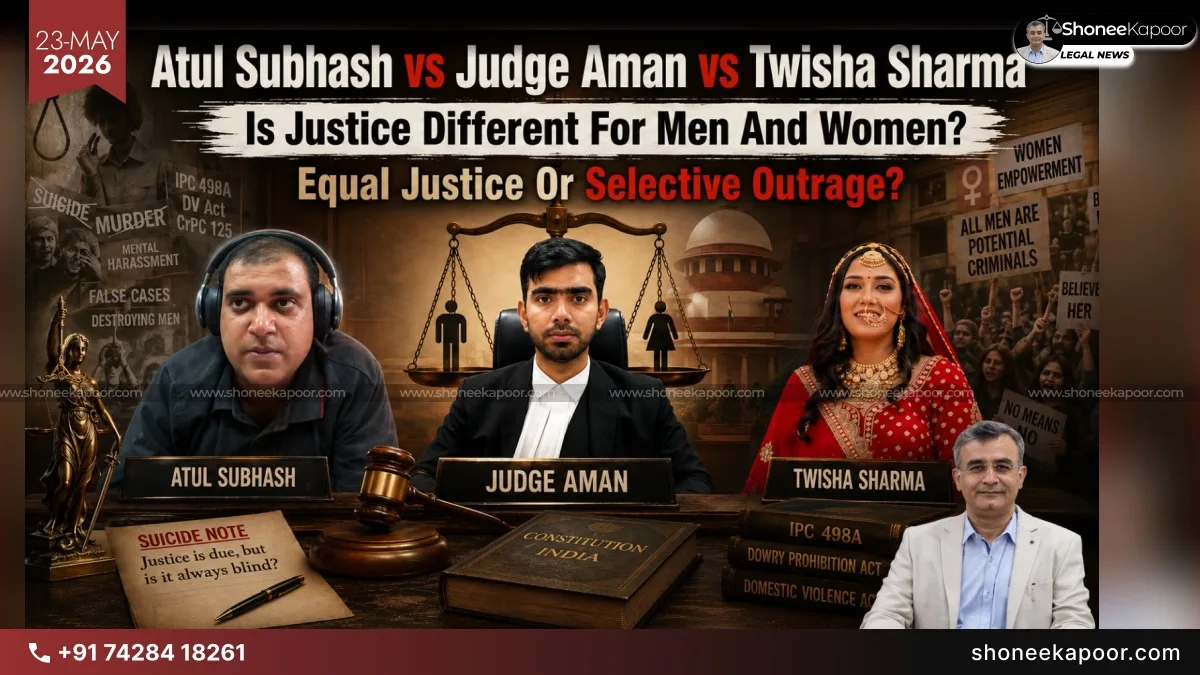
Atul Subhash, Judge Aman Kumar Sharma and Twisha Sharma all died in disturbing matrimonial circumstances. Why does India react differently when the deceased is male?
NEW DELHI: India cannot claim to be a constitutional republic if the value of a human life changes with gender.
Atul Subhash died by suicide on 9 December 2024. Before his death, he left behind a long note and video alleging harassment, false cases, extortionate demands and denial of access to his child. His wife and in-laws were arrested in the abetment case and later granted bail.
Judge Aman Kumar Sharma, a 30-year-old judicial officer, died by suicide in Delhi in May 2026. His family alleged harassment by his wife, also a judicial officer, and interference by his sister-in-law, an IAS officer. Police registered a case under Section 108 BNS for abetment of suicide and Section 61 BNS for criminal conspiracy.
Then came the death of Twisha Sharma in May 2026. Her husband, Advocate Samarth Singh, and family members came under immediate public and institutional scrutiny. An FIR was registered under BNS Section 80(2) for dowry death, Section 85 for cruelty, Section 3(5) for common intention, and Sections 3 and 4 of the Dowry Prohibition Act. The Bar Council of India suspended Samarth Singh from legal practice even while the case remained at the stage of allegations and investigation.
The question is not whether Twisha Sharma deserves justice. She absolutely does.
The question is:
Why did Atul Subhash and Judge Aman Kumar Sharma not receive the same national urgency?
THE UNEQUAL PUBLIC REACTION
When a woman dies in her matrimonial home, the system moves quickly. FIRs are registered. Arrests are demanded. Careers are damaged. Families are socially convicted. Media frames the husband and in-laws not merely as accused, but almost as already guilty.
But when a man dies after alleging matrimonial torture, financial extortion, false cases, denial of child access, harassment by wife and in-laws, or pressure from powerful relatives, the public response is colder.
Atul Subhash was not just another statistic. He spoke before dying. He documented his pain. He named people. He described the legal process itself as part of his suffering.
Judge Aman Kumar Sharma was not an ordinary litigant. He was part of the judiciary. Yet even his death did not create the kind of sustained national outrage that follows many female victim cases.
This selective outrage is not justice. It is prejudice dressed as sensitivity.
WHAT INDIAN LAW ACTUALLY SAYS
Under Indian criminal law, suicide by itself does not automatically prove abetment.
Section 108 of the Bharatiya Nyaya Sanhita, 2023 corresponds to the earlier offence under Section 306 IPC. For abetment of suicide, the prosecution must prove instigation, conspiracy, or intentional aid. The Supreme Court has repeatedly held that mere harassment is not enough unless there is a clear, proximate and active link between the accused conduct and the suicide.
That principle must apply to everyone.
If a wife is accused of driving a husband to suicide, she is entitled to due process.
If a husband is accused after the wife’s death, he is also entitled to due process.
Gender cannot replace evidence.
DOWRY DEATH LAW AND THE PRESUMPTION AGAINST HUSBAND’S FAMILY
In cases like Twisha Sharma’s, BNS Section 80 on dowry death becomes important. It applies where a woman dies under abnormal circumstances within seven years of marriage and it is shown that soon before her death she was subjected to cruelty or harassment in connection with dowry.
The law creates a serious presumption once foundational facts are shown. That is why dowry death cases are treated with gravity.
But gravity is not guilt.
An FIR is not conviction. Arrest is not conviction. Suspension is not conviction. Media trial is not conviction.
The same country that remembers “innocent until proven guilty” for some accused must not forget it when the accused is a husband.
THE ATUL SUBHASH CASE: A MAN WHO SPOKE BEFORE DYING
Atul Subhash’s case shook many men because he said what thousands silently feel: that matrimonial litigation can become punishment before trial.
His allegations included financial pressure, multiple cases, denial of meaningful access to his child, and demands for settlement money. Whether each allegation is ultimately proved is for the court to decide.
But one fact cannot be ignored: he died before he got justice.
There was outrage, yes. But did it translate into institutional reform? Did it lead to gender-neutral domestic violence laws? Did it force serious debate on false cases, child access, maintenance litigation and misuse of criminal process?
No.
THE JUDGE AMAN KUMAR SHARMA CASE: IF EVEN A JUDGE COULD BREAK, WHAT ABOUT ORDINARY MEN?
Aman Kumar Sharma’s death should have forced India to pause.
Here was a judicial officer, legally trained, institutionally placed, and familiar with the court system. His family alleged harassment by his wife and interference by an influential IAS sister-in-law. Police registered an abetment and conspiracy case.
If even a judge allegedly felt helpless inside a matrimonial conflict, what happens to an ordinary man with no legal training, no social power, no media access and no institutional backing?
This case deserved national debate.
It did not get enough.
THE TWISHA SHARMA CASE: JUSTICE IS NECESSARY, BUT MEDIA CONVICTION IS DANGEROUS
Twisha Sharma’s death is tragic. Her family deserves a fair investigation. If dowry harassment, cruelty or abetment is proved, the guilty must face the full force of law.
But the concern is the speed at which the husband and family were publicly treated as guilty.
The husband’s bar licence was suspended at the allegation stage. News coverage repeatedly described serious accusations before trial. Public opinion moved faster than evidence.
This is exactly what many men face: once accused, they are not treated as accused; they are treated as convicted.
That is not rule of law.
THE REAL QUESTION: WHY NOT EQUAL OUTRAGE?
Why was Atul’s 24-page note not enough to create sustained reform?
Why did Aman’s death not trigger nationwide judicial introspection?
Why does society understand matrimonial cruelty only when the deceased is a woman?
Why does a man’s suicide become “mental health”, but a woman’s suicide becomes “crime” before trial?
Why is a husband immediately answerable, but a wife accused in a husband’s suicide is treated with caution, sympathy and delay?
These are uncomfortable questions. But justice begins exactly where selective comfort ends.
MY STAND
Twisha Sharma deserves justice.
Atul Subhash deserves justice.
Judge Aman Kumar Sharma deserves justice.
The families of all three deserve a fair investigation, not selective outrage.
No accused should be declared guilty by television studios, social media mobs, professional bodies or public sentiment before trial.
But no male victim should be erased merely because his pain does not fit the popular narrative.
Justice cannot be gender-specific.
Law cannot be outrage-driven.
And society cannot demand due process only when it likes the accused.
LEGAL TAKEAWAY
Indian law requires evidence, proximity, mens rea and due process.
For abetment of suicide, there must be active instigation or intentional aid.
For dowry death, statutory presumptions may arise, but only after legal conditions are met.
For arrests, the Supreme Court in Arnesh Kumar cautioned against automatic arrests in offences punishable up to seven years.
For bail and liberty, Satender Kumar Antil reaffirmed that arrest is not meant to be punitive.
The courtroom standard is evidence.
The media standard should not be gender.
CONCLUSION
Atul Subhash died before Twisha Sharma.
Judge Aman Kumar Sharma also died before Twisha Sharma.
Both were men. Both deaths involved allegations of matrimonial harassment. One case also involved allegations against an influential IAS sister-in-law.
Yet the outrage was not equal.
That is the problem.
A civilised society does not ask whether the dead person was male or female before demanding justice.
It asks only one question:
Was a human being pushed to death, and will the truth be found without bias?
Until India asks that question equally, justice will remain selective.
FAQs
Atul Subhash was a Bengaluru techie who died by suicide in December 2024 after alleging matrimonial harassment, false cases and financial pressure.
Aman Kumar Sharma was a Delhi judicial officer who died by suicide in May 2026. His family alleged harassment by his wife and interference by his IAS sister-in-law.
Twisha Sharma was found dead at her matrimonial home in Bhopal in May 2026. Her husband and family members face allegations under dowry death and cruelty provisions.
No. Indian courts require proof of instigation, intentional aid, mens rea and a proximate link between the accused conduct and the suicide.
Yes. Justice must be evidence-based and gender-neutral. Victims deserve compassion, and accused persons deserve due process.

Leave A Comment